

I should've showered after checking on the garden
2 years ago
Featured Answer
Sort by:Oldest
Comments (15)
Related Discussions
Gardeners and treassured friends, please check in
Comments (31)Hi All! I thought I'd check in from Cocoa, Brevard. It's after 4pm and we are still getting a bunch of wind and rain. So far no damage so I'm grateful. My fibromyalgia is going crazy, my kids are getting antsy and my dog's poor bladder is bulging because he hates to go out in the rain but other than that we have been very fortunate. My poor husband has been out in the weather all day since he's a police officer, but luckily the bad guys don't like to get wet either. We haven't lost power which I consider amazing. So I hope everyone is safe. Best of luck! Tammy Something I did today to kill some time: SCENE: -Tammy can't sleep. After taking another half of a sleeping pill she gets out of bed and opens the bedroom door. -As an after thought, Tammy slips into her sandals, so as not to bump her toes trekking through the house at 4am to get outside to the back porch to listen to the rain on the metal roof from TS Fay. -It's dark. -Tammy can't see, but it doesn't matter because Tammy knows her way around the house with her eyes closed. -Tammy reaches the back door and flips the light switch on the wall for the back porch light so that she can see the bugs that are just waiting behind enemy lines for Tammy to make one wrong move so that they can drag her into the night and chew on her flesh so that she is never seen or heard from again. -Before Tammy can open the door, she feels something with lots of tiny legs scurry across the top of her foot. -It's still dark. -Tammy has not opened the door yet. -She vigorously shakes her foot trying not to screech like a banchee and takes several steps back. -Nothing. -Tammy takes a step forward with her right foot. She hears and FEELS a sickening C-R-U-N-C-H under her right sandal. -Don't move. -It might have been a Froot Loop. -It might have been a cookie crumb. -It might have even been a piece of dried Play-Doh that was left on the rug over the weekend. -Please don't let it be a giant bug. -Tammy opens the door and lets the light from the back porch spill in. -What lies before her on the floor in a crushed pile of gooey bug guts and oddly colored slime, turns Tammy's stomach. -It was one of those giant flying cockroaches. -The ones that no one can get rid of. -The ones that would survive nuclear fallout. -The ones that live under your house, planning a coup de grace while you sleep. -THIS ONE never knew what hit him. -Which was good. -Tammy had ALMOST gone out with no shoes on. -Which was bad. Tammy has had the heebie jeebies ever since....See MoreChecking back in after Hip Replacement
Comments (3)welcome back flo, take care to do exactly what you should be without pushing things and before yuo know it, you'll be better than new! your therapists may seem like they are pushing you, but it's all for the good of your recovery. your gardens will be just fine. good time to have it done when the gardens will be resting (soon if autumn and then winter ever get here). maryanne...See MoreRelative newbie gardener checking in
Comments (8)Hi Wayne! Welcome to the Oklahoma Gardening Forum! Before you start your garden, you need to figure out what kind of soil you have, how deep it is (for instance do you have many feet of good soil on top of rock, or 4" of good soil on top of rock--it matters!) how well it does or does not drain, if it is extremely rocky and what is the avearage date of your first fall freeze and last spring freeze. Since you are in an area that has a high annual rainfall rate, the ability of the soil to drain well is very important. If, by chance, you have had to have a percolation test conducted prior to the installation of a septic tank, that perc test can tell you how many hours it takes your soil to drain down to a certain depth. It also would be most helpful for you to have a professional soil test done. The soil test would let you know exactly what your soil contains, its' pH, what it is lacking, and how to improve it. Without a soil test, you are just guessing about what amendments to add to the soil. No matter what you want to grow--a lawn, trees, grass, shrubs, berries, tree fruit, veggies, etc., the single most important factor is the soil. Everything starts with the soil. No matter what kind of soil you have, the best way to improve it is to add organic material--compost, peat moss, shredded and chopped leaves, manure, greensand, lava sand, bone or blood meal, etc., etc., etc. You can learn everything you need to know about soil improvement on the Soil Forum. The most productive vegetable gardens are those utilizing raised beds. Raised beds warm up faster in the spring and drain better which helps prevent waterlogging of the roots. Mulching is important too. Mulch keeps the soil and plant roots from overheating in the hot months and protects the roots of marginally hardy plants from freezing in the winter. It also would be most helpful for you to decide up front if you wish to garden organically, garden with the use of synthetic/chemical products, or some combination of the two. That way, your decisions will be guided by the philosophy you choose to apply to gardening. If you want to save seed, you will want to grow open-pollinated vegetables which come true from saved seeds. Three of the best (and there are MANY more) sources for open-pollinated seeds are Baker Creek Heirloom Seeds (www.rareseeds.com), Victory Seed (www.Victoryseeds.com), and Seed Savers Exchange (www.seedsavers.org). An excellent source for tomato and pepper seeds, both open-pollinated and hybrids, is Tomato Growers Supply Company (www.tomatogrowers.com). Another excellent source of open-pollinated seeds is Sandhill Preservation Center (www.sandhillpreservation.com). One of the absolute best sources of information about gardening in Oklahoma is the OSU extension fact sheets. There are fact sheets on many topics, including planting dates for spring and fall gardens, recommended varieties of veggies, fruits, nuts, trees, shrubs, etc. It may take a while to find all the info, but once you know your way around the pods website, you can find many topics of interest are well-covered there. If you will be living and gardening in a rural to semi-rural area, you MUST have a way to protect your garden from all sorts of wildlife. If not, you will be growing a garden strictly for them, and you won't get much of your own produce if they can get to it first. Fencing is the most effective way. The easiest fencing is electric fencing, but the strands will have to be low enough to keep out rabbits, armadillos, possums and turtles, and tall enough to keep deer away. As far as the topography of your land, no one can really advise you without seeing the land, but here are some general tips: The site chosen for your vegetable garden, berry plants and fruit orchards must be easily accessible. If it is too far from the house, you won't visit it as often as you ought to...sort of the out-of-sightm out-of-mind thing. The site needs to have water access. If you choose a garden site which is 400 feet from the nearest water faucet, you will have to be prepared to string together 400+ feet of water hose. The site needs to be well drained or runoff in periods of high rainfall can be very damaging to your plants. Sometimes, though, you don't have as much control over this as you would like, since you may have adjacent land that sits higher than your land. The site needs some protection from the wind. If you plant on a location that is the highest land around, the wind will beat your plants to death. So, either choose a more protected location (although not the lowest-lying location either) or be prepared to plant a windbreak around the perimeter of your gardening site. Be aware that most people who have space for a vegetable garden tend to go overboard at first and plant an area that is much too large to maintain, and then become discouaged when they can't keep the grass and weeds out of the garden. It is better to start small and gradually enlarge the garden as you gain experience. The most productive gardens have wide (3' to 4 1/2') raised beds with more narrow pathways. You improve the soil in the raised beds only and walk only in the pathways so your garden bed soils do not become overly compacted. There are many wonderful books that describe how to garden in a biointensive manner. Two of the best are SQUARE FOOT GARDENING by Mel Bartholomew and THE VEGETABLE GARDENER'S BIBLE by Edward C. Smith. Mr. Smith's book focuses on the basic principles of veggie gardening with Wide Rows, Organic Methods, Raised Beds and Deep Soil. Because we have a long frost-free period in this part of the country, many people erroneously believe we have one very long growing season. Actually, we have several smaller mini-seasons, with some of them being best for cool-season crops and others for warm-season crops. Planting veggies at the right times for them will help you to raise a bountiful harvest. Good luck. Keep asking questions and let us know how things are going. I've linked the factsheet index. Click on the topic you're interested in, and then click on the appropriate factsheet. Dawn Here is a link that might be useful: Index of OSU Factsheets...See MoreCan I do a floating semi-circle shower bench (shower layout check too)
Comments (14)We thought that plywood was supposed to be sandwiched in between the solid surface. We thought the plywood can be ancored to the the wall more successfully than the solid surface material. Are you recommending just the two layers of solid surface laminated together with edge profile and then directly supported by the brackets with no wood frame inside? Of course, I assume we have to put backing in the wall with the brackets. Here are two images of what we thought to do to support the bench. Here is the text taken from the website that propsed the above way of supporting a floating shower seat: Structural Support for Cantilevered Bench "A cantilevered shower seat, outward from the shower wall, is an excellent approach from the end user perspective. It can easily and reliably be constructed with a couple of strong, stiff internal metal brackets. This is easier done than you might think by constructing a pair of welded support brackets. The brackets can be made inexpensively from carbon steel (or stainless) by any welding shop in a matter of 30 minutes or so. By way of illustration, I have constructed a "cantilevered" shower part-wall using this approach. It was especially important in my situation to ensure adequate resistance to wall "rotation" (i.e. 'tilting') because a grab bar is to be placed on the opposite side of this wall adjacent to a toilet. I wanted to make sure that any loads placed on the grab bar would not cause the wall to bend - and thus crack the shower tiles. Figure 1 shows the location of the steel support within the wall. Figure 2 shows the bolting of the support to the floor structure. In the case of a shower seat, a pair of welded steel "T-supports" or a pair of "L-supports" would be required. The vertical sections of these supports would be adhered and bolted to vertical studs. The horizontal sections would be concealed within the seats. Steel tubes of about 3" by 3" square by 1/8" wall would be adequate. Of course, if partly exposed (as in the photograph at the beginning of this thread), the horizontal sections of the supports could be made of round stainless steel tube or pipe, 2.5" to 3" in diiameter." Carol...See More- 2 years ago
 2 years ago



Related Stories
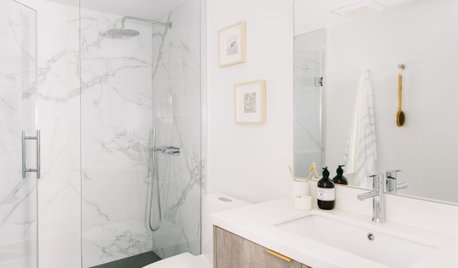
BATHROOM MAKEOVERSBefore and After: 4 Bathrooms Open Up With Clear Glass Showers
Shower curtains, glass blocks and walls all come down to brighten up dark and dated bathrooms
Full Story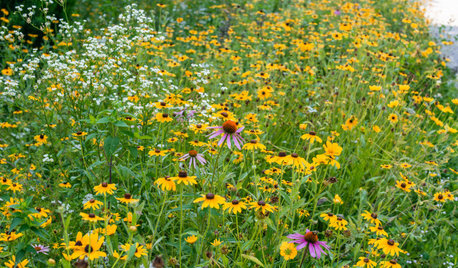
LANDSCAPE DESIGNBefore and After: 3 Meadow Gardens With Flowers for Pollinators
Each project uses native and perennial plants to attract pollinators, improve the land and delight visitors
Full Story
FRONT YARD IDEASBefore and After: Front Lawn to Prairie Garden
How they did it: Homeowners create a plan, stick to it and keep the neighbors (and wildlife) in mind
Full Story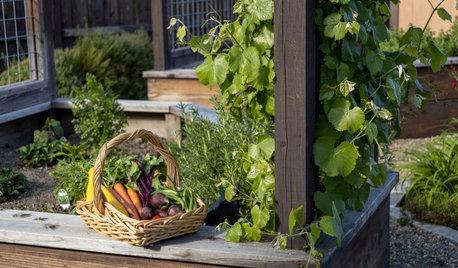
GARDENING 101What to Do in Your Edible Garden After the Summer Harvest
Set up your veggie garden to be productive and healthy year after year with this fall checklist
Full Story
BATHROOM MAKEOVERSBefore and After: 4 Bathrooms With Curbless or Low-Curb Showers
See how pros found on Houzz created beautiful and functional bathrooms with easy-to-access showers
Full Story
BATHROOM MAKEOVERSBefore and After: 4 Blue-and-Wood Bathrooms With a No-Curb Shower
Curbless glass-framed showers and soothing palettes suffuse these baths with serenity
Full Story
GARDENING GUIDESHow I Learned to Be an Imperfect Gardener
Letting go can lead to a deeper level of gardening and a richer relationship with the landscape. Here's how one nature lover did it
Full Story
DECORATING GUIDESThe Dumbest Decorating Decisions I’ve Ever Made
Caution: Do not try these at home
Full Story
FEEL-GOOD HOME12 Very Useful Things I've Learned From Designers
These simple ideas can make life at home more efficient and enjoyable
Full Story
BATHROOM DESIGNBefore and After: Room for a Tub and Shower in 84 Square Feet
A Canadian couple replace the shower-tub combo in their bathroom with a walk-in shower and a built-in tub
Full StorySponsored

Innovative & Creative Custom Closet Designer Servicing Franklin County

seagrass_gw Cape Cod