

Things we leave inside books ..........
3 years ago
last modified: 3 years ago


Featured Answer
Sort by:Oldest
Comments (18)
 3 years ago
- 3 years ago
Related Discussions
Cool nights recently - when do we bring things inside?
Comments (11)Regina, I will have to check the label on my systemic and post the name later. It is a granule that I get at Mayos, plus I have used one of the Ortho systemic liquids. Brugs - - I take my versi's inside once the night-time temps drop into the mid 40's (I store my dormant). Since I don't know exactly which one your unnamed Peach is - - hard to tell if it can be left out longer. There isn't much you can do to encourage these to grow taller (except plant them in the ground). If you take cuttings, you may or may not get a larger plant next year. However, if you plant these in the ground next year (mature root balls!), chances are you will start to get some ground level suckers that will grow taller. But I will tell you that my inground brugs (mature or this year's cuttings) are all huge. Some are more bush like, while others are standards. I store my versi's inside a closet in the basement (temps above 50). Caladiums - if in pots, bring inside once the foliage starts to die down. If you are having to lift the corms, I recommend you do it BEFORE the foliage dies down or you will have a hard time finding the corms. Important - store in darkness above 50 degrees. If storing lifted corms, put in peat moss to keep them from drying out. DO NOT WATER. Variegated (Tropical) hibiscus - bring inside once night time temps go below 40 degrees. Can be brought in sooner, but be sure to not let it get cooler than 40 degrees. Tropical hibiscus either need to be kept growing at temps about 65 with LIGHT, or in a semi dormant state above 50 degrees. NOTE - most but not all will come back from being stored semi dormant. EE's - should be safe to let light frost kill foliage. I usually take my ears in before then - - just because it's easier for me to! Store in dry, cool place. Magilla Perilla - - self seeds and comes back for me Clero Thompsoniae - - I take mine inside right before the first frost. Cuttings taken now should do ok if kept warm. I keep my mature plant in the garage at temps above 40 degrees. It does go dormant but leafs back out in the spring. Angel Wing Begonia - - I take mine inside right before the first frost. VERY prone to fungus - keep on the dry side. I usually try to keep mine growing in the garage under lights, but will cut them back in mid to late winter if fungus takes over. They DO come back from being cut back. Hardy begonia - - are hardy here if planted in the ground. If in a pot, just stick them in a cool, dry place. Ginger from the East Tn Swap - - I am presuming this is a Hedychium like Butterfly. Can be hardy here if mulched (if planted in a place with good drainage). I lift mine and put them in huge pots (cut back the foliage to ground level). They can be stored in a cool, dry place dormant, or given a LITTLE water and moderate light for them to resprout. Regina, these need a long growing season, and consistent watering all summer to bloom late in our summer. Mine are gorgeous now and smell wonderful!...See More'Making Peace with the Things in Your Life' - book
Comments (16)Here's an article from the Obsessive-Compulsive Hoarding website: "Saving the World" By Fred Penzel, Ph.D. I was recently reminded of a type of obsessive-compulsive disorder (OCD) known as "compulsive hoarding" when a patient brought me an article from a British newspaper that jokingly looked into the homes of several people afflicted with this problem. The reporter, in his ignorance, seemed to think it humorous that these homes were knee-deep in possessions, papers, broken or useless things, or just plain trash. Even in our own country, those who compulsively hoard and collect are sometimes kiddingly referred to as "pack rats," and they are laughed at as being eccentrics. Unfortunately, compulsive hoarding is no joke. It can in fact be quite excruciating, just like any form of OCD. When you look closely at the lives of compulsive hoarders, there is no doubt that they can become incapacitated and disabled by their habits, and their lives frequently become disorganized and unmanageable. Their home lives can be rather isolated, and socializing is often a problem. They are unable to have visitors or even repairmen come into their homes, due to the serious embarrassment they would feel at having someone see the clutter. Hoarders may collect large quantities of old newspapers and magazines, greeting cards, bottles, junk mail, plastic containers, broken appliances, old clothes, shoes, furniture, etc. They not only save broken and useless things, they also tend to save quantities of stuff that can greatly go beyond what a person could possibly ever need. This could include buying things such as soap or paper goods several cases at a time, or dozens of an item that might bean sale, but which most people would only own one of. Typical symptoms of compulsive hoarding could include any or several of the following: - Saving broken, irreparable, or useless things - Buying excessive quantities of goods beyond the amount needed for reasonable usage - Purchasing large amounts of useful items and storing them away for future usage, but never using them - Retrieving numerous materials from the trash on a regular basis - Having difficulty discarding anything due to a fear of accidentally throwing out something important - Saving excessive quantities of printed matter (newspapers, magazines, junk mail, etc.) - Making and keeping extensive lists or records of certain things, even after they are no longer needed - Saving large amounts of certain items for possible use by others or for future recycling Actually, the urge to hoard and collect may well be strongly instinctive in many species. The familiar sights of squirrels storing seeds and acorns and birds gathering nesting materials tell us that humans are certainly not alone when it comes to collecting and saving. Among our fellow human beings, we can observe a whole range of such behaviors, both positive and negative. However, when it is expressed through OCD, it may be that an instinctive program we all carry in our brains has been inappropriately activated. This may resemble trichotillomania, where it has been theorized that grooming instincts are wrongly turned on. I have observed that one of the main rea-sons for hoarding is this: a fear that if things are thrown away, they will almost certainly be needed one day, but will be gone for good. This loss will then lead to some kind of serious hardship or deprivation. This symptom is due to the chronic doubt of OCD. Because of this, many hoarders seem to lack the ability to discriminate between what is truly useless and what isn't. Ironically, hoarders rarely use, much less look through, the things they save. Even when they do search through their piles and heaps, they are usually unable to find what they are looking for. There are some who hoard for what seem like sentimental reasons they keep many or most of their old belongings. One adult patient of mine had all of her childhood toys, as well as all the clothes she had ever owned since she was a youngster. There may be a number of reasons behind such behavior. One may be superstitious bad luck may occur if they let go of any of these things. Another may be the previously mentioned fear of the loss of something needed one day. Such doubts may be further compounded if the individual is reluctant to grow up or has some reason for not wanting to give up the past. A different type of hoarding seems to relate more closely to the sort of hyperresponsible thinking often seen in OCD. Here, hoarders save things they believe will be useful to others rather than themselves. They would feel guilty and worry about being neglectful if they didn't have these things around for others who might need them someday. They may also feel guilty if they don't save a potentially useful item that could be repaired or recycled rather than discarded or wasted. In reality, no one ever really needs the things they save, and most of the things saved never get repaired or are too damaged to be fixed in any case. Some who appear to hoard actually don't save things for their own sake. Their obsessive doubts cause a fear that, when throwing trash away, something important will be thrown out with it by mistake. These people compulsively thumb through every page of newspapers or magazines, and they double-check the seams of paper bags, boxes, and envelopes to be certain they have not thrown out money, jewelry, or important papers. Throwing things out can involve hours of searching and checking. This can become so difficult and time-consuming, that they may eventually just stop throwing things away altogether: This type of saving may not really be true hoarding, but something more like a type of double-checking. Compulsive hoarders can accumulate such large amounts of things that they create storage problems and fire hazards. In particular, huge stacks of papers, excessive furniture, old clothing, non-working appliances, etc., can quickly overwhelm a house or apartment. The range of items saved can include something potentially useful such as reusable containers, except that hoarders may have hundreds. The other end of the range may include such unlikely things as cigarette ashes, pet hairs, or used tissues. Entire rooms become completely unusable. I know of people who have been evicted or threatened with eviction due to the large amounts they have collected. I also know of divorces resulting from a spouse refusing to live under such overwhelmingly disorganized conditions. Several years ago in our are, a case was reported of a woman who burned to death in a house filled with newspapers. In the most extreme cases, homes can almost look as if they have been vandalized, with floors covered with debris and rooms filled to overflowing with boxes and bags full of possessions. The most famous example of a compulsive hoarder was Langley Collyer who, between 1933 and 1948, filled a mansion on Fifth Avenue in Manhattan with 120 tons of refuse, junk, and human waste. He would prowl the streets of Manhattan at night looking for items to rescue from the trash. Both he and his invalid brother, Homer, were found dead among possessions that included 11 pianos and all the components of a Model T Ford. Langley was actually crushed by a falling heap of heavy items he had rigged as a booby trap for burglars. There are other types of hoarding, such as having to make a "complete" collection of a particular item to get a sense of "perfect" closure. There is "mental" hoarding, which is having to memorize all informa-tion on a particular topic. There is also the hoarding of memories or experiences. These symptoms seem to overlap with the problem of compulsive perfectionism. It is not unusual for some hoarders to buy and save large amounts of useful things that they then must maintain in a pristine and perfect condition. The items may be carefully wrapped, packaged, and stored away, never to be touched by anyone. Ironically, many of the saved items often deteriorate after years in storage, becoming totally unusable. Certain types of compulsive buying may be related to hoarding, depending upon what is done with the purchase. Proper treatment for compulsive hoarding relies heavily on behavioral techniques. Hoarders need to be encouraged to gradually discard items that they find harder and harder to part with. A therapist may have to accomplish several goals: first, visit the home in order to survey the dimensions of the problem; second, determine the order in which things need to be tackled; and third, assist in the throwing-out process if the person can't seem to get started or is too great a procrastinator. I have sometimes encouraged people to begin by bringing bags of belongings to my office to start the discarding process. Hoarders also need to be given guidelines for what is to be saved or discarded, now and in the future. We often use a "two-year rule." This states that if you haven't used it, worn it, or read it in the last two years, you don't need it. This obviously doesn't include valuables, heirlooms, or tools used only for special purposes. Some need even more specific rules. Most are discouraged from keeping more than the current week's newspapers or the latest issues of magazines, and articles are saved rather than entire issues. Mail must be sorted the day it arrives. Many also need help in organizing important personal papers and bills, and the purchase of filing cabinets is encouraged. In serious cases, medication may help a sufferer approach the therapy process with less anxiety and fewer obsessional worries. It can also relieve serious depression that robs someone of the energy needed to clean house. The usual antidepressant drugs shown to help OCD are recommended. It is important to find a psychiatrist who is sympathetic and experienced in the treatment of OCD, which can take a certain amount of expertise to do properly. With determination and support, hoarding can be conquered. I have seen people clean up some of the worst accumulations and keep them cleared up. There is no cure, however. In order to stay well, hoarders must learn to think differently and to keep up their new habits. Interestingly, upon recovering, the hoarder's reaction is often one of relief rather than anxiety. If this is your problem, get help. You don't have to drown in a sea of possessions and junk. If you would like to read more about what Dr. Penzel has to say about OCD, take a look at his self-help book, "Obsessive-Compulsive Disorders: A Complete Guide to Getting Well and Staying Well," (Oxford University Press, 2003). You can learn more about it at www.ocdbook.com...See MoreI'm going to entitle my memoirs "Cats: Why We Can't Have Nice Things"
Comments (150)How I Loooooove these cat stories!! I couldn't help getting a few tears in my eyes but so many more laughs!!! At 73, I can't say I ever remember a time I didn't have at least one weaving in and out of my legs, tail up, meowing either for attention or food. A few even tried to use me as a scratching post !lol My bff in IL takes in rescues, and at the moment has 21 or 22. The 100 yo historic home she bought 9 years ago came with 2 separate garages, one housing the majority of the kitties, the other is used for storage, but she always keeps the big door open a foot at the bottom, and knows *other* critters take part in the 'vittles' also. Sthe has either 4 or 5 in the house, one being a mama cat w/7 kittens, the very start of her rescue 'mission'. She gave away 2 of those kittens(after neutering!),and never stopped regretting it. They have all found a forever home with her. Her vet/food costs are insane, and when I visited in the summer we found worms in one of the litter pans, and in a two day period, took every cat into the vet to be dewormed. That was $400. It's neverending work! Whenever I call she's scooping, feeding, or rocking one of them in the old rocking chair that was moved out to the garage. She also donates to almost every animal organization known to man, even if it's only $5. She's a one-woman rescue shelter, and I wish I were closer to help. We always say we like animals more than people because animals can't help their situatuon, but people usually can....See MoreOT: We've Seen The Outside, What About the Inside?
Comments (45)I have enjoyed this thread so much! I love seeing everyone's homes and where they spend there time when not in the garden. I enjoy renovating and decorating almost as much as gardening. We have an old farmhouse (first a strawberry farm, then a Christmas tree farm) we have been renovating over the last 15 or so years. It has been a labor of love! Also, I plan my garden from the windows of the house...house and garden go hand in hand for me. I couldn't have one without the other. During gardening season, my house is usually more cluttery....but my mom came for a visit and I snapped these pics yesterday before she arrived (and I had tidied up!) This is our living room, which we haven't renovated yet. This music room used to be an old porch, which was enclosed by the previous owner. The view from these french doors is of an arch set in the middle of a boxwood hedge...the future home of my Florence Bowers Pink Tea rose! The dining room is one of the rooms that is almost finished. I just had this Laura Ashley wallpaper hung which I love! Here is the little dining nook in our newly renovated kitchen. Those are Pearly Gates roses on the table :) Here is the kitchen, which we renovated in 2013. I love to bake, so I have the marble on the island. I also do a lot of dishes...hence the huge sink! The wood counters on the sink wall were made from old Douglas Fir trees on our property. The french doors look out onto the back garden. There is another set on the other side of the stove. Everyone, and I mean everyone, tried to talk me out of these doors in my kitchen. But I wanted the garden to almost be an extension of the kitchen, and when the doors are open on a summer day it is! I don't miss the cabinet space at all! This kitchen is a Gardenweb kitchen....that's how I discovered this site: during the renovation (or actually, just before). I designed it with the help of all the amazing people on the kitchen forums. Without that forum it never would have turned out so well! I would love to post more pics, but something is wrong with my computer this morning...so I will have to do it later when my husband is home :)...See More 3 years ago
- 3 years ago
- 3 years agolast modified: 3 years ago
 2 years ago
- 2 years agolast modified: 2 years ago
- 2 years ago
- 2 years agolast modified: 2 years ago
- 2 years ago
- 2 years agolast modified: 2 years ago
- 2 years ago
- 2 years ago
- 2 years ago
- 2 years agolast modified: 2 years ago
- 2 years ago
- 2 years ago


Related Stories

LIFE10 Things Organized People Do First Thing in the Morning
Transform your morning routine by borrowing tips and insights from truly organized people.
Full Story
ARTAn Insider’s Guide to Creating the Perfect Gallery Wall
Bring your room to life with these expert tips for grouping artwork and photographs
Full Story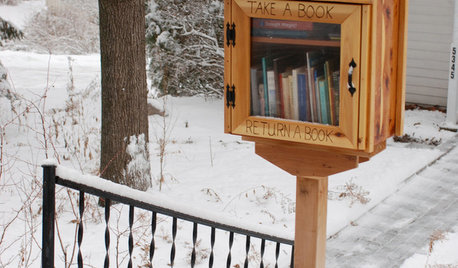
COMMUNITYBook It: Bring a Mini Library to Your Front Yard
Take a book, leave a book. An ingenious lending-library idea is sweeping the nation — see if it's right for your neighborhood
Full Story
HOLIDAYS10 Things to Do Early for an Easier Holiday Season
Make a gift list and check supplies twice, then ensure that the house looks nice, and buy travel tickets if you’re leaving town
Full Story
BOOKSBeautify Your Home With Things You May Already Own
Get ideas for creating vignettes, arranging collections and more in the new book ‘Domino: Your Guide to a Stylish Home’
Full Story
LIFE10 Helpful Things to Check Off Your List on a Rainy Day
When the weather feels right for staying inside, try one of these pleasant to-dos
Full Story
HOUZZ CALLShow Us Your Guest Book Traditions
Do you have a creative or unconventional way to let houseguests leave their mark? We want to see it!
Full Story
LIFEYou Said It: ‘Take Pleasure in the Small, Simple Things’ and More
Highlights from the week on Houzz include projects that celebrate fall and enhance our living spaces
Full Story
BOOKSBook Tour: 'Coastal Modern'
Fresh ways to bring beachy style to your home, no matter how far from the coast you are
Full Story

donnamira