

Canning question
6 years ago
Featured Answer
Sort by:Oldest
Comments (20)
- 6 years ago
Related Discussions
URGENT: Canning Question (canning in process)
Comments (7)OK, I'm coming onto this late but for what it's worth. Rather than what's called pear honey you've made pear butter, which actually calls for less sugar than a preserve, so you're just fine - different but still good. A butter you cook until you can mound some on a spoon and no liquid seeps out (no separation around the edges). You can continue to cook for a thicker product but at some point you risk caramelization of the sugar and an over-cooked taste. Thinner is better than over-cooked. If you don't boiling water bath you're not particularly at risk because you've got a high-acid product with lots of sugar. The only risk is mold and you'd know that right away through sight and smell. The problem with open-kettle canning (putting hot product into the jars and sealing without boiling water bath) is the vacuum is weaker and the risk of spoilage is somewhat higher. So it's quicker but you might end losing some of the jars because they might not keep as well. Depends on how long they sit on the shelf. Don't invert the jars. That can cause seal failures. Carol...See MoreCanning question ?
Comments (51)I think some of the vinegars used long ago (often even when people were making their own vinegar, which some people still do today) were much stronger. I believe I've read 40% in some cases compared to todays standard 5%. Even the horticultural-strength vinegars used as herbicides are only 20%. People have preserved food for centuries, including fermentation, pickling, dehydration and preservation by very heavy salting. I am not sure how long ago canning as we now know it came into common usage, but I know that some canned foods were developed in the USA as a way to feed the soliders in the Civil War era. The French were canning some foods as early as the very early 1800s. I think one of their methods was to can the foods and use them unless the cans started swelling, which was an indication the food had spoiled. To me, that seems a lot like Russian roulette. Catsup/ketchup and some other condiments came to us as a result of people trying to create sauces that would cover up the flavor of spoiled meat. Think about that one for a while. When you read through some of the old canning recipes, some of the things they did/used are just horrifying. I'm glad we live in a more enlightened age. Many previous canning methods once approved for use in the USA (sealing jams and jellies with wax, for example) have fallen by the wayside and no longer are recommended as safe processing methods. Some foods that could be safely canner in my parents and grandparents day no longer have approved home-canning processes for them. I bet that a lot of the methods and recipes once used by our great-grandparents, grandparents and even parents are not recommended for use today as research continually finds new ways to make the processes safer. I know that my dad's mother and sisters preferred pickling as much as possible way back in the early 1900s because if you use enough vinegar, sugar and salt, you can make safe pickles out of tons of different kinds of food. To me, that choice reflected some sort of knowledge about what worked best and seemed safest in their era. I do remember that a lot of the southern women I knew who canned in the 1960s and 1970s often cooked their canned goods almost to death after opening up a jar. Why? Because their mothers did. Why did their mothers do that? I think they were boiling the veggies hard for 10-20-30 or more minutes in order to possibly kill off any toxins that might have grown in the jars after the food was canned. They didn't have the extensive research we have today to assure them that they were using the safest possible preservation process, so they were extra careful to try to safeguard their families. I expect quite a few people died of botulism and other food-related illnesses back in the day, and am grateful that is a rarity nowadays. It still happens today, and the few cases I've read about in recent years seemed to most often involve green beans that accidentally were canned in a boiling water bath instead of in a pressure canner, and also some meat products where something went wrong. Mary, That's hysterical that the bomb squad couldn't break that seal on that canner, but I've heard other cases of canners sealed shut in such a way that nobody ever could get into them. I'm not ever going to suggest to my spouse that he and his bomb squad/SWAT team members try to blow up a canner to release the seal because I'm afraid the idea would intrigue them a bit too much and he'd want me to deliberately mess up my pressure canner just so they could try to get it open. I have a feeling I'd lose the pressure canner in the process. One of the most horrific developments in the last 10-15 years is that certain terrorist groups have used pressure canners to make IEDs. That makes a chill run up my spine. What a terrible misuse of a great kitchen helper. Dawn...See MoreCanning Question
Comments (3)Elizabeth - while it is always best to use tested and approved recipes. And while one of the basic rules of safe home canning is that you cannot safely can your own recipes, that is normally what we tell those who ask. But it is sometimes possible to safely BWB can just about fruit or vegetable in straight 5% undiluted vinegar as long as you use enough of it. Two issues in safe home canning: pH and the density of the food in the jar. The straight 5% vinegar insures the pH safety and as long as the food is liquid and /or fully suspended in liquid and moves freely in the jar the needed heat penetration is covered too. The issue then becomes the amount of time required. We have no way of knowing what the density of your recipe would be or how long a processing time you would need. However, inexperienced canners are safest when they stick with only tested and approved recipes since so many variables are involved. Best bet is to continue freezing your personal recipe. Dave...See MoreRecipe check/tomato canning question
Comments (2)Oh geez, where to start? First, I guess, is that you should add acidity to all tomatoes before canning, whether that is via a mix/preblended seasoning, lemon juice or (my choice) citric acid. My Mother is allergic to lemon and so I don't add it to my canned goods, in the chance she might accidentally eat some. Here is the link to the National Center for Home Food Preservation. This is the "official" government website for canning instructions, and is full of good information, easily found. https://nchfp.uga.edu/how/can_03/tomato_sauce.html I'm assuming your puree is like tomato sauce. The instructions for tomato sauce call for simmering the puree until the desired thickness is reached, leaving 1/4 inch head space in the jars, and then BWB them according to your altitude. Here in Michigan that would be 35 minutes for pints and 40 minutes for quarts, but yours may be different. The instructions will tell you what your timing should be. The enchilada sauce sounds fine to me, except that I would process that for the same amount of time required for tomato sauce. I do not cold pack things like tomato sauce because I get more jar breakage from thermal shock and the product tends to separate more in the jar, I get a nicer end product with hot pack, but that's me. The NCHFP does have instructions for a cold packing of tomatoes, but they call for an 85 minute time in the canner, much longer than the sbcanning instructions. However, that's for whole tomatoes and the other is for puree, so that may explain the timing difference. However, I cannot say whether that is really the difference or the safety of the final product. Happy Canning! I'm envious, my tomatoes are just starting to ripen and I plucked 13 hornworms from my plants today, so I'm thinking that they may cause me some problems this year! Annie...See More 6 years ago
- 6 years ago
- 6 years ago
 6 years ago
- 6 years ago
 PRO6 years ago
- 6 years agolast modified: 6 years ago
 6 years ago
- 6 years ago


Related Stories

BATHROOM MAKEOVERSFrom Canning Porch to Beautiful Vintage Bath in Oregon
Thrifty finds and DIY labor transform a cramped space into a serene hotel-style bath on a budget
Full Story
REMODELING GUIDESPlanning a Kitchen Remodel? Start With These 5 Questions
Before you consider aesthetics, make sure your new kitchen will work for your cooking and entertaining style
Full Story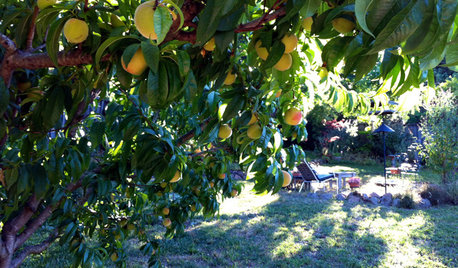
EDIBLE GARDENSHow to Grow Your Own Peaches and Nectarines
Make gardening a little sweeter with these juicy fruits, which you can eat after plucking or preserve for later
Full Story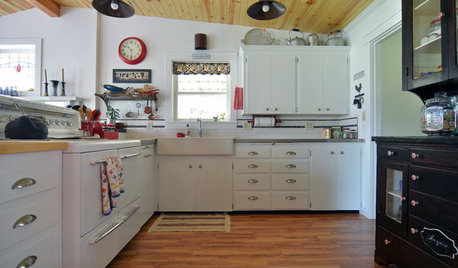
BEFORE AND AFTERSKitchen of the Week: Classic White Farmhouse Style Restored
A couple remodel their kitchen to better match their 19th-century Oregon home’s style
Full Story
KITCHEN DESIGN12 Farmhouse Touches That Bring Homeyness to a Kitchen
Shaker cabinetry, country-store-inspired hardware, barn elements or a key piece of art will add homestead appeal to your kitchen
Full Story
LIFESlow Living 101: Tips for Turning Off the Chaos
It may feel as though you're too busy to slow down and enjoy life. But even little changes can have a big effect
Full Story
BASEMENTSDesign Workshop: Is It Time to Let Basements Become Extinct?
Costly and often unnecessary, basements may become obsolete — if they aren’t already. Here are responses to every reason to keep them around
Full Story
DECLUTTERINGFoolproof Ways to Declutter Your Kitchen
If you find yourself fumbling through cupboards to find what you’re looking for, it’s time to take action with these simple steps
Full Story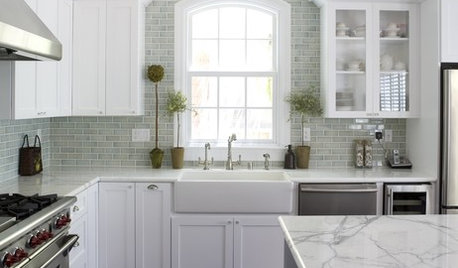
INSIDE HOUZZA New Houzz Survey Reveals What You Really Want in Your Kitchen
Discover what Houzzers are planning for their new kitchens and which features are falling off the design radar
Full Story
ARCHITECTUREDesign Workshop: Materials That Tell a Story
See how wood, concrete and stone convey ideas about history, personal taste and much more
Full Story
User