

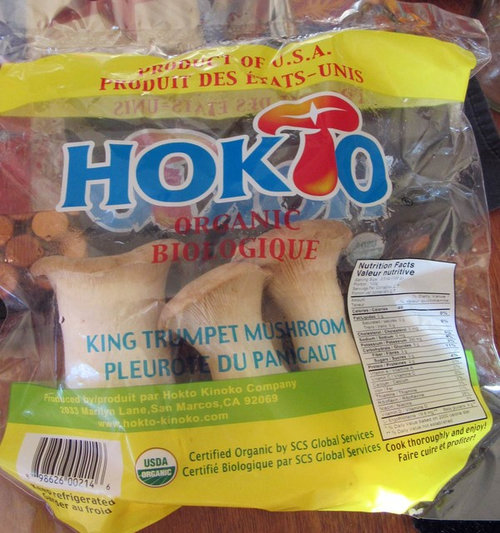
Eryngii King Trumpet Mushrooms
7 years ago
last modified: 7 years ago
Featured Answer
Sort by:Oldest
Comments (7)
Related Discussions
Cancer and healthy living
Comments (46)The Story of Essiac Tea below is for the benefit of anyone interested. On a fateful day in 1922 Canadian nurse Rene Caisse happened to notice some scar tissue on the breast of an elderly woman. The woman said that doctors had diagnosed her with breast cancer years before. However, the woman didn't want to risk surgery nor did she have the money for it. As luck would have it, she had met an old Indian medicine man who told her that he could cure her cancer with an herbal tea. The woman took the medicine man's advice, and consequently she was still alive nearly thirty years later to pass on this herbal remedy to Nurse Caisse. About a year later, Rene Caisse was walking beside a retired doctor who pointed to a common weed and stated: "Nurse Caisse, if people would use this weed there would be little cancer in the world." Rene later stated: "He told me the name of the plant. It was one of the herbs my patient named as an ingredient of the Indian medicine man's tea!" The "weed" was sheep sorrel. In 1924 she decided to test the tea on her aunt who had cancer of the stomach and was given about six months to live. Her aunt lived for another 21 years, cancer free. Rene Caisse (pronounced "Reen Case") later gave the tea to her 72-year old mother who was diagnosed with inoperable cancer of the liver, with only days to live. Her mother recovered and lived without cancer for another 18 years. In the ensuing years Nurse Caisse refined and perfected the original "medicine man's" formula. She tested various herbal combinations on laboratory mice and on human cancer patients. She eventually reduced the tea to four herbs: burdock root, sheep sorrel, slippery elm and turkey rhubarb. She called the formula Essiac, which is her surname spelled backwards. Rene Caisse devoted over fifty years of her life to treating thousands of cancer patients with Essiac. So effective were her free treatments that in 1938 her supporters gathered 55,000 signatures for a petition to present to the Ontario legislature to "authorise Rene Caisse to practice medicine in the Province of Ontario in the treatment of cancer and conditions therein". Unfortunately, due to the machinations of the Canadian Medical Association, the bill failed to pass by just three votes. WHAT DID DOCTORS SAY ABOUT RENE CAISSE'S TEA? Rene Caisse operated her cancer clinic under the supervision and observation of a number of doctors. Based on what those doctors saw with their own eyes, eight of them signed a petition to the Department of National Health and Welfare at Ottawa, asking that Nurse Caisse be given facilities to do independent research on her discovery. Their petition, dated at Toronto on October 27, 1926, read as follows: To Whom It May Concern: "We the undersigned believe that the 'Treatment for Cancer' given by Nurse R.M. Caisse can do no harm and that it relieves pain, will reduce the enlargement and will prolong life in hopeless cases. To the best of our knowledge, she has not been given a case to treat until everything in medical and surgical science has been tried without effect and even then she was able to show remarkable beneficial results on those cases at that late stage. "We would be interested to see her given an opportunity to prove her work in a large way. To the best of our knowledge she has treated all cases free of any charge and has been carrying on this work over the period of the past two years." Initially, Rene was not aware of the control that the medical/pharmaceutical establishment had over governments. After the petition was delivered to the National Health and Welfare Department, she was continually threatened with arrest until she finally withdrew from public view. Unlike Nurse Caisse, the medical establishment was more interested in making money than in helping people. Essiac was cheap. It could cut into the lucrative profits from radiation, chemotherapy and surgery--treatments that often did more harm than good. Essiac is non-toxic. Rene said, "Chemotherapy should be a criminal offense." The story of Rene Caisse's struggle to make Essiac an official cancer treatment was told by Dr. Gary Glum in his book CALLING OF AN ANGEL: ESSIAC, NATURE'S CURE FOR CANCER. In a telephone conversation Dr. Glum stated that people who take Essiac on a regular, preventive basis do not get cancer. Dr. Glum interviewed JFK's personal physician, Dr. Charles Brusch, who stated: "I know Essiac has curing potential. It can lessen the condition of the individual, control it, and it can cure it." Dr. Ralph Moss was appointed to the Cancer Advisory Panel that evaluates alternative cancer therapies for the government. On his web site and in his book CANCER THERAPY, Dr. Moss points out that each of the herbs in Essiac has been scientifically shown to contain anticancer substances. In his "Cancer Chronicles" [www.ralphmoss.com/essiac], Dr. Moss notes Essiac's rising popularity by comparing Essiac's low cost to a $150,000 bone marrow transplant. ESSIAC--MORE THAN JUST A CANCER TREATMENT Dr.Frederick Banting, the co-discoverer of insulin became interested in Essiac and even offered Nurse Caisse research facilities to test it. According to Rene, Dr. Banting stated that "Essiac must actuate the pancreatic gland into normal functioning". Even today diabetics are using Essiac to improve their condition and many have gone off insulin entirely....See MoreBlooming in October?
Comments (85)Awwww, thanks Robert for all you do and your concern. I really appreciate that buddy. I had no idea that the only smell at certain times. I was there in the early am when I smelled theirs. Oh man, I would love to spend a night in Logee's on the floor in a sleeping bag.lol I will post a couple pics of moss tomorrow once the sun is out all day. Thanks. I am telling you, I never looked at moss the same again until I saw it near a pond and in pots! Hello Olympia! Look for mail real soon. I wanted to send you a package today, but the Post Office had no electricity! Robert! I didn't know you were getting into plumeria! I lOVE that plumeria and the smell sounds devine! Oh, I had over a dozen at one time and now I have just about none. Those plants require a lot of patience, love, time, bug sprays, sun, and heat. My hats off to you :-) Jodik...OH what I would do to smell hundreds of roses in bloom at once! It all sounds so paradisiac there and then all those animals! Would you like me to baby sit soon, without all the work though? I'll feed the plants and animals and then smell the roses... It's the real sweet and deep fragrant ones I like and then anything that smell like coconut..lol I love the muted coolrs, usually whites, yellows, pale colors but I have never cared for the red roses. That one you posted looks so beautiful. Now, is there such a thing as a good ole rose that has a very strong fragrance and that is very hardy from the cold and pests that grows well? all these rose bushes sold locally that say "Hardy' is such a joke. Well we made it through the storm everyone with a bunch of damage, but we are ok.:-) Mike...See MoreCompanion/Accent Plantings for the Hosta Garden (pic heavy)
Comments (161)If you get to Milwaukee, let me know. I have clumps being given away all the time. tj...See MoreWhat's Blooming in your garden - photo thread - PART 2 July 2013
Comments (75)Pixie Lou, you have a lot of nice lilies. I only have a few because of the RLLB. I just couldnâÂÂt keep them clean if I had too many. As it is, the âÂÂOraniaâ this year looked fine until after it bloomed I noticed the foliage has a fair amount of holes in it. You canâÂÂt cut the stalks back to the ground after blooming, right? I would like to have enough to smell them in the house, but nope. The âÂÂOraniaâ does make the whole front walkway a very pleasant trip when they are blooming. And thanks, glad the comparison of peppers was interesting. I think growing hot peppers does make a difference, they seem to be a more vigorous and shapely shrub that produces more and smaller peppers. The large sweet peppers seem to be more difficult to get more than a few per plant. Thyme2dig, what a pretty daylily border! IâÂÂm not always pulled to purchase a daylily and some of that is the way I see them being used. The way you have planted them all together that way without competition from other plants and with that great shrub border behind it, I really like it a lot. What is that dark shrub in photo #3? And is that Nasturtium at the base of your purple tripod? Jane, I donâÂÂt blame you about the FarmerâÂÂs Market next year. I took a couple of yearâÂÂs off from the vegetable garden and I missed it and here I am still doing it. :-) But is this year an exception? I think some years are not the greatest and this year just wasnâÂÂt. IâÂÂm going to try to salvage some of the season and go for some fall crops of Broccoli and Lettuces and Kale and other greens. This weekend IâÂÂm probably going to start. I have three squash plants without a squash between them. *sigh* Spedigrees, thatâÂÂs a good looking lily and the foliage is a lot cleaner than mine. :-)...See More- 7 years ago
 7 years ago
 7 years ago
- 7 years ago
 7 years ago


plllog