

Help! It stinks!
8 years ago
Featured Answer
Sort by:Oldest
Comments (46)
- 8 years ago
Related Discussions
I need a source of garden netting
Comments (3)I have seen garden netting at Lowes in past seasons. Haven't looked for any there this year so I'm not certain they still carry it. You could call the nearest Lowes and ask. If you cover the squash vines, you will need to hand pollinate. This is best done early in the mornings soon after the blossoms open. It's not hard to do, especially if you don't have a large number of plants....See MoreStink Bugs :-( Nests and nests of them
Comments (7)Sammy, Your black and red bugs continue to puzzle me. The only way I know to describe them, from what I remember is that they were half red, half black, shaped similarly to lady bugs and flea beetles and somewhere in between the two in size. Do you see them get much bigger than the ones in the photo you posted a couple of years ago or does their shape become more elongated? Do you see them damaging anything? With there being so many insects in the world, it is extremely hard to figure out what less common ones are, and sometimes I wonder if we'll ever know what you have. If you see them damaging a specific type of plant, we can search for info about pests of that sort of plant and maybe get an ID that way. polyd, The stink bugs in the link you provided look to me like the brown marmorated stink bug, which has become a serious pest in Pennsylvania and some of the surrounding states during the last few years. It was not known to exist previously in this country prior to the recent outbreak in those northeastern states. It is not the same as the common brown stinkbug we have had here in this part of the country for decades and decades. You can tell the brown marmorated stinkbug by the black and white banding on its body and antenna. Regular brown stinkbugs that we have here do not have that banding. I am very well aware of the similarity in the appearance of the brown stink bugs and the spined soldier bugs. I mentioned it in my response to your original post. The only way to tell them apart is to study them carefully and hope for the best when you decide to kill one. Because their appearance is so similar, you need to rely on other information when trying to determine who is a bad guy and who is a good guy. The bad guys generally crawl around on your plants and feed on them. They don't chew. They insert their piercing mouth parts and suck the juice out of plants. I most often see them on tomato plants where they damage the fruit, causing a condition called cloudy spot that can ruin the fruit. I also see them a lot on corn plants, bean plants and okra. I believe they are a problem on some fruit trees. Sometimes you'll see several on one plant, but often they are solitary. When a brown stink bug sees a human, he or she knows to disappear and quickly crawls under a leaf or drops to the ground to hide. Spined soldier bugs prowl around looking for pest bugs to eat. Sometimes they find a spot and just sit there stationary waiting for a pest bug to come along. You'll see them sitting still in places---on a tomato leaf for example, but you won't see them crawling on the fruit feeding on it. They also generally aren't as scared of me as brown stink bugs are. Maybe they somehow sense I am not going to hurt them, though I don't know how they'd know that. The spined soldier bugs have spinier shoulders, and that's the main way I can distinguish them. I never see spined soldier bugs in huge numbers. I might see one of them for every 30 or 40 brown and green stink bugs I see. There is a biological reason for that---the spined soldier bugs generally do not appear until there is a large population of stink bugs to feed them. The spined soldier bugs don't reproduce until there's enough stink bugs (and other bugs they prey upon) to feed their young. This is common with beneficial insects---their population builds up in response to how many pests there are available to eat. It is one reason the beneficial insect population rebounds more slowly if a person uses a broad-spectrum pesticide. So, if I had to offer a guess, you might have one of two things going on here: --If your pests have the black and white banding on the body and antenna, then you have the brown marmorated stinkbugs. This would be the first time I've heard of them being present in OK. The fact that you found your stink bugs in such huge numbers sounds more typical to me of brown marmorated stink bugs than regular old brown stink bugs. I've lived in TX and OK all my life, have been a lifelong gardener from a family of lifelong gardeners, and never once have I seen a nest of stinkbugs like you describe. I only have seen stink bugs here and there on plants. Maybe when a new batch has hatched in the garden, I'll find 20 to 40 small nymphs on a plant, but even that doesn't happen more than a dozen times a year, and that is if I count all my sightings of the leaf-footed bugs in that dozen sightings. I've never seen them in huge nests like you describe. However, maybe you are in an urban or suburban setting where the landscapes are more refined and there aren't as many wild areas for the stink bugs to nest and hatch. I am in a rural area, surrounded by tens of thousands of acres of land left largely in its native state, so the stink bugs have oodles of good hiding places where they can hatch out their young and then move into farm fields, ranch pastures, home gardens, orchards and landscapes to feed. --You have an unusually large hatching/nesting area for a huge infestation of common brown stink bugs. I've never seen this occur with regular brown stink bugs, and never heard of it, but that doesn't mean it doesn't happen. I've always had crape myrtles and never have seen stink bugs on them. Usually the main pest I'll see on crape myrtles is aphids. --Could you have a huge nest of spined soldier bugs? It seems unlikely since they only would hatch in numbers like that if there was a plentiful food source for them. The easiest way to figure out what you have is to put on gloves and squish a mature one. If it is a brown stink bug, you'll smell their stinky little aroma. If it is a spined soldier bug, you won't smell that stink bug smell. Insects of all kinds live in your yard. Your yard is an ecosystem. In a perfect world, particularly one in which broad-spectrum pesticides are not used, you will have a balance ecosystem where you have beneficial insects that help control the pest insects. My garden is chock full of insects every day, but I'd say 98% of the damage is done by 2% of the bugs. If I am patient, the beneficial insects will take care of the majority of the pest insects for me. I've seen that in action in my garden this week. However, even in organic gardens that are very friendly to beneficial insects, there are some pests that appear in such huge numbers that the beneficial insects have a hard time controlling them. With pest insects in that group, I help out the beneficials by handpicking and destroying the pests that show up in huge numbers. I recently has my first-ever outbreak of harlequin bugs. I hand-picked all I could find over an 2-day period and removed most of the plants (broccoli, cabbage, kale, Swiss chard) they were feeding on. If allowed to stay and multiply, the harlequin bugs would move to tomato plants and inflict upon them the same damage stink bugs cause. I knew I didn't get them all. This week I have found a few more and hand-picked and drowned them. Two of the ones I found, though, were being dealt with by beneficial insects---a spider had one and a spined soldier bug had the other. I don't think I'll have to worry about handpicking them again unless their population soars again. Since I spent hours scouring the garden searching the backs of leaves for their eggs, I don't expect a big outbreak will happen again, but I'll be watchful. The few insects that get to large enough levels that I need to worry about controlling them will vary from year to year. One year it might be Colorado Potato Beetles, and another year it might be squash bugs. It isn't every pest in every year, so I just keep my eyes open, pay attention to what is going on, and watch the interaction between good insects and bad insects in my garden to see if the beneficial insects need any help controlling the pest insects. Every year we always have far too many spider mites, and generally far too many grasshoppers. Stink bugs are a problem every year but some years they are a small problem and other years they are a large problem. If they are a small problem aren't doing much damage, I ignore them because at the lower population level, the spined soldier bugs, big-eyed bugs, and wheel bugs will handle them. If they are a large problem, I spend time trying to help keep them under control. Sometimes I will see pests at such a high level that I think that my beneficial insects aren't controlling them, but then I'll visit other gardens in my area and see that they have a truly huge problem with the same pest and have many more of those pests than I have....and that shows me that my beneficial insects indeed are controlling the pest insects to some degree. Sometimes it is hard for me to stay calm and let the beneficial insects do their job, but I know I have to do it. I am adamantly opposed to spraying any kind of broad-spectrum pesticide on my property. I've never done it, and likely never will. I haven't spent 15 years cultivating a healthy population of beneficial insects only to turn around and kill them myself. However, I always support any individual gardener's right to use whatever pesticide they choose in whatever way they feel they must. What they do on their property is their decision, not mine. I know several mostly-organic gardeners who have felt compelled, at times, to use a broad-spectrum pesticide like Malathion, for example, because they felt they had to do that at that point in time to save their garden. I understand that. I've just never yet reached the point where I have felt like I have to do that in my garden. Using a broad-spectrum pesticide is a two-edged sword, and since it wipes out the beneficial insects, the place where they are used may struggle with pest issues more than usual for a few years afterward until the beneficial insect population rebuilds. There was a time in our early years here when we had an outrageously bad grasshopper outbreak. It was so bad I cannot even describe it. You'd take a step in the grass and 12 or 15 grasshoppers would fly up. You'd take another step in the grass and 15-20 more would fly up. They would land right on you and hang on to your skin, your clothing, your hair. I'd look outside through the window, and they'd be clinging to the window screens,eating them. Being in a rural area, I watched as farmers and ranchers sprayed and sprayed and sprayed. I relied on organic methods, and still had far too many grasshoppers but was determined I would not spray a broad-spectrum pesticide. It was the worst summer ever. What I didn't yet know was that things would go from bad to worse. Because I wasn't spraying a pesticide, we still had songbirds which spent a significant time on our property eating insects, including grasshoppers. Before that grasshopper summer, we had tons of bluebirds. I loved watching them every day. People sprayed pesticides all summer long. All the bluebirds went away. I always have assumed they ate the sprayed insects and died. We didn't see another bluebird that summer or for the next three summers. Not a single one. Finally we began to see a few, but very few. That was just over a decade ago, and our bluebird population now is still only about 10% of what it was before that year. I really miss them. The oddest thing? A couple of our neighbors who were life-long local residents and both farmed and ranched noticed as they drove by our property that the grass in our bar ditches was not coated with wall-to-wall grasshoppers. They thought I had some big secret pesticide I was using and demanded I tell them what it was and how to get it. I tried to give them the whole organic scenario of the many ways you work to control them without using pesticides and told them that was all I was doing. They didn't believe me. It wasn't that we didn't have grasshoppers---we had huge hordes of them on our property. It is just that our huge hordes of them actually were smaller than their really huge hordes of them. More than anything else, that experience has stuck with me and made me more determined than ever to garden as organically as possible and to do as little harm to the beneficial insect population as I can. When I see a pest outbreak of something in huge numbers, do I get panicky and wish I "could" use a pesticide that would just kill them instantly on the spot. Hmmm. Maybe a thought like that crosses my mind, but then I remind myself that we all live in this ecosystem together---people, animals, birds, fish, frogs, lizards, etc. and the poisons that would hurt the pest insect could potentially harm all the rest of us. So, when dealing with a pest, I start with the least harmful method---something like hand-picking and destroying just that kind of pest, and then I move up to stronger and stronger control methods. Most of the time, hand-picking pest, spraying nymphs with insecticidal soap, and finding and destroying their eggs before they hatch is all that I do. So, as you battle your stink bugs, try to do what targets only them without harming your beneficial insects. It is the best thing for you and for the ecosystem on your property in the long run. You can google and find insecticidal soap recipes all over the internet. I am not a big fan of homemade soap sprays, especially in the hands of new gardeners. I prefer to use commercially produced formulas that will not harm plants when diluted and used per the label directions. I have seen many people harm their own plants by making soap sprays that are too strong, by spraying them on their plants in hot weather in direct sunlight, and by spraying far too much soap spray on the plants. I've also seen people inadvertently kill their plants by using detergent instead of soap. Detergent and soap are not the same thing. I will sometimes make my own soap spray and when I do, I use one tablespoon of a vegetable- based castille soap to one gallon of water. I only spray in the evening hours, and I aim the spray at the pests themselves and do not spray it all over the whole plant---I just spray where the pests are. Remember that at lower concentrations, soap sprays are a pretty benign pesticide. At higher concentrations, soap sprays can be used as herbicides, and that is why you need to be careful when using them, especially if you've never used one before. I use Dr. Bronner's soap to make a soap spray, usually either his lavender soap or peppermint soap, depending on what scent I am in the mood to smell that evening. Some people use "dish soap" but if you choose to do that, you need to check and make sure it is a soap and not a detergent. It really does matter. I'd hate for you to inadvertently damage or kill a plant when you were trying to kill stink bugs. Regarding the spined soldier bugs, they are my favorite bug in the world and I know how to recognize all their instars. I suggest you print out the photos and carry them with you and learn to recognize them in your garden. If you are lucky enough to have them, they are a true treasure because they will provide you with tons of pest control. People who don't have spined soldier bugs can purchase them, but they are very pricey, so when you see them in your garden, treat them like royalty! I've never seen spined soldier bugs appear in huge hordes---I just see an occasional hatch of a few dozen nymphs here or there. I'd be really surprised if the nest of insects in your crape myrtle or underneath it is spined soldier bugs. You normally wouldn't see them in huge numbers like that unless you already had thousands of pest insects for them to feed upon. Hope this helps, Dawn Here is a link that might be useful: Look-Alike Insects...See MoreLaptop is sick
Comments (6)I felt I should report back to my fellow Computer Forum members. I received a brand new hard drive from Dell via FedExp. yesterday and plan to have my son-in-law install it tomorrow. I will let you know the results. My son-in-law doesn't think it happen because of the latest Windows update...he thinks my hard drive just crashed. I didn't lose any data because I have all my data on a cd....thanks again for being here and letting me sound off. I have to admit Dell Chat did help me....See MoreHelp - squirrel stink in my garage
Comments (2)First try one of the enzymes sold for treating dog/cat urine. If other cleaners are used first, they tend to prevent the enzymes from working....See More- 8 years ago
- 8 years ago
- 8 years ago
- 8 years ago
- 8 years ago
- 8 years ago
- 8 years ago
- 8 years ago
- 8 years ago
- 8 years ago
- 8 years ago
- 8 years ago
- 8 years ago




Related Stories
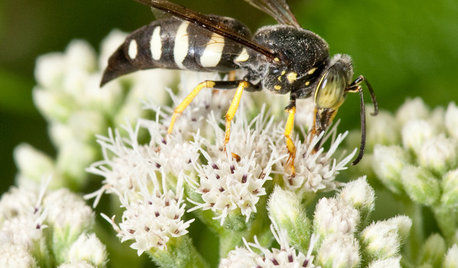
GARDENING GUIDESSand Wasps Keep True Bugs in Check and Help Pollinate Summer Flowers
Look for these solitary wasps nesting in sandy sites and foraging on flowers in July and August
Full Story
SELLING YOUR HOUSEThe Real Scents That Will Help Sell Your House
Ditch the potpourri and baked cookies. Follow these guidelines on scents to use and avoid to help sell your home
Full Story
SELLING YOUR HOUSE10 Low-Cost Tweaks to Help Your Home Sell
Put these inexpensive but invaluable fixes on your to-do list before you put your home on the market
Full Story
GARDENING GUIDES6 Questions That Will Help You Pick the Best Plants for Your Site
Before you head to the nursery, learn more about your outdoor space
Full Story
PETSHow to Help Your Dog Be a Good Neighbor
Good fences certainly help, but be sure to introduce your pup to the neighbors and check in from time to time
Full Story
LIFE12 House-Hunting Tips to Help You Make the Right Choice
Stay organized and focused on your quest for a new home, to make the search easier and avoid surprises later
Full Story
SMALL SPACESDownsizing Help: Where to Put Your Overnight Guests
Lack of space needn’t mean lack of visitors, thanks to sleep sofas, trundle beds and imaginative sleeping options
Full Story
MOST POPULAR9 Real Ways You Can Help After a House Fire
Suggestions from someone who lost her home to fire — and experienced the staggering generosity of community
Full Story
LANDSCAPE DESIGNHelp Your Garden Hit the Mark With These 12 Focal Points
Find out how to use sculptures, benches and plants to draw the eye and direct attention in the landscape
Full Story
TRENDING NOWTop 10 Laundry Rooms of 2020
Smart storage features and stylish finishes helped make these the most-saved laundry photos among Houzz users this year
Full Story
User