Houzz Logo Print
garysut

Pasta Water: Uses and abuses....

8 years ago
last modified: 8 years ago

I have been to web sites asking about how I might use water from cooking pasta instead of throwing it out. You might figure that I had just blasphemed the bible with the almost angered responses I received.

The most common, and mostly only, answer was to add it to the pasta sauce. Well, ok but then what?

Water your plants with it. Yea, right.....

"If it is cloudy, throw it out. (Is that supposed to be helpful?)

I decided to take the horse by the reins myself and maybe others will follow suit.

First of all, I cook my pasta in water scarcely enough to cover it. Start with cold water and 24 minutes later if it is not totally absorbed by then, I drain but save the water.

I froze it by measures of 16oz in baggies which makes it available on call. It is so thick/slimy that it clogs a turkey baster.

My first use was to substitute 1 1/3c of water with as much pasta water in a off-the-shelf box chocolate cake mix. I choose box mix because for multiple tests, no other parameters will change except that of the water.

It seemed to be more silky/smooth/moist for a box mix. I will try another one tomorrow but will also prepare one with tap water.

I wonder how it will affect brownies. gravy, stews, bread, pastries??? Maybe not at all but it is in my blood to test this out. How about you?

After extensive searches on the internet, I found not one recipe, other than spaghetti sauce, that uses pasta water.

Comments (54)

  • 8 years ago

    I have a bag of semolina flour I could use it for gravy...never thought to maybe I'll try it...you think it tastes better?


  • 8 years ago

    The problem is this...

    "After extensive searches on the internet, I found not one recipe, other than spaghetti sauce, that uses pasta water."

    You must be using the wrong key words. Probably a thousand or more using pasta and bean water. Nothing new, search again.


  • Related Discussions

    Hosta-one of the most used and abused landscape plants?

    Q

    Comments (13)
    In a way I have found the carelessness in placing hostas in landscaping has been useful for my education. I have learned from errors. Our City Hall building in my community has zero trees on the property. There is a narrow dirt strip on the south facing wall with a four evenly spaced hostas along the edge abutting the asphalt parking lot. The hosta are Frances Williams. Amazingly, they keep coming up every spring and by June 1st are nothing but cripy waste. We have two wonderful parks on an island between the Kankakee River and a millrace. There are many shadded areas under oaks and the water table is less than 2 feet in many places near the millrace which is at above dam level. It is ideal for growing hostas, and wouldn't you know it - not one hosta in sight. We have a new director for our park district and I am planning on speaking with her about beautification plans. If the PD will provide some labor I will volunteer management services. I visited a jobsite, a high school in the CPS on the far SE side of Chicago. Bordering both sides of the main entrance walk were hostas in full sun. They were Sagae and in late July a bit washed up looking but not crispy at all. Sagae is one of the most sun tolerant hostas I have. But in general I usually wonder where professional landscapers have learned their trade when it comes to the use of hostas. You sure can tell the doctors offices where automated underground watering systems are in use. The best commercial use I have seen regarding hostas are associated with skilled nursing facilities, and the Brookfield Zoo has a few fantastic hosta beds. Les
    ...See More

    Do you use a colander or tongs to drain pasta? (recipe included)

    Q

    Comments (32)
    I was cooking pasta with a friend this summer on holiday, and we were discussing all this stuff. He is of Italian heritage so considers cooking his birthright, LOL. He strongly disapproved of putting oil in the water or on the pasta after draining it. He said the sauce wouldn't "stick" as well with the oil. I believe in oil. I put a little oil and mix it into the drained pasta to prevent sticking. It helps to put it in the pasta water also. (I don't care what Alton Brown says about THAT!) My sauces have no problem adhering to the pasta afterwards. Viva La Pasta! (Lou, I have about 10 folded up post-it notes in my purse as we speak!)
    ...See More

    Uses and abuses of Pasta Water

    Q

    Comments (76)
    OK, I gave in and prepared a pasta dish strictly according to the directions. I cooked Ronzoni #21 Large Shells with a lot of water and the recommended salt. I used the strainer method to wilt the spinach leaves. Prepared the sauce and fresh grated Pecorino Romano cheese. Everything was SALTY. I used little of the cheese. Even the spinach was salty. My tomato sauce has no salt added but even that tasted salty. It may well be that since I never salt anything when cooking that I have become accustomed to not having that much salt. Anyway, I began to wonder if I could smell salt in the air... As I see it, when the cook salts the water, it takes away my choice to control the salt. On the other hand, if someone grabs the salt shaker before tasting the meal then it is an insult to the chef. ======= One additional quirk with cooking this pasta with a lot of water: Most shells end up being as single in the sauce. Many are nested as double and few are triple in one. On the other hand, minimum water will make many many more double up leaving fewer as single. I prefer the mouth feel of the changing densities of pasta from single shells to multiple shells as one. A single nest of three has the mouth feel of a twirled fork of spaghetti.
    ...See More

    Uses and abuses of Kale

    Q

    Comments (29)
    Kale chips! I can eat a whole kale plant in one sitting this way.. Cut the rib out of the kale and toss it. Cut leaves into 2" pieces. Toss in a baggie with olive oil, seasoning you like (onion powder, etc) and spread out on a large cookie sheet. Bake at 300 degrees for about 15 minutes or until just crisp but not burned. It's the only way I eat kale.
    ...See More
  • 8 years ago
    last modified: 8 years ago

    I drain pasta water into a heatproof bucket and when cooled, I use it to water plants outside.

  • 8 years ago
    last modified: 8 years ago

    So is Emerogork and Gary one and the same???

    I cook pasta in a full pot of water. There is a reason for this. Pasta swells as it cooks. Too little water the pasta becomes gummy and can stick I also well salt the water.. Pasta cooking water goes down the drain.

  • 8 years ago

    Small amounts of pasta water are often called for in sauces that are not tomato based--Carbonara for example.

  • 8 years ago

    "So is Emerogork and Gary one and the same???" No but we are in touch and becoming in sync. She has more radicaler ideas than I.

    For over a year now I have enjoyed cooking pasta in minimal water and do not find that it becomes gummy. I have used all kinds but do find that Linguini and Angel Hair are special cases. A Pain-de-Mie pan works well for spaghetti.

    Never thought of and internet search for bean water. I will try that one.

    Scalding water does kill weeds in my brick sidewalk.

    "There's a whole thread about this very thing that was in December"
    This is where I got the title but that thread went far off topic.

    "Small amounts of pasta water are often called for in sauces that are not tomato based--Carbonara for example."
    I will freeze it in ice cube trays and keep a bag full of cubes. This way when I want to thicken something, I won't have to contend with lumping when using dry flour.


  • 8 years ago

    Well if you are using pasta water to thicken a gravy or sauce you will have a lot of dilution. Is this pasta water you are freezing thick like gravy?....even if it is, when you add it to say 2 cups of something you want to thicken, you would have to add about 2 cups of pasta water....and even then It wouldn't be as thick as the pasta water.
    Your directions say to start with just enough cold water to cover and cook it 24 minutes, and to save any water that is not totally absorbed. WOW....can you say limp and mushy spaghetti? Do you know about cooking pasta al dente?
    My beef is not about pasta water....I toss mine unless I might need a little to thin out the sauce or amalgamate a carbonara.....but this about the pasta! 24 minutes in only enough water to cover that may be entirely absorbed....it must have the consistency of canned spaghetti like Chef Boyar dee

  • 8 years ago

    Leave a container of pasta water out until it evaporates.

    You will find out there is very little starch in the water.

    dcarch

  • 8 years ago

    24 minutes it is. I did not say to boil it for 24 minutes.

    From cold water, it takes 12 minutes to foam enough to push out of the lid then 12 minutes until done. It is very nicely firm. Sometimes it then sits for another 5 minutes to let more water be absorbed, Stirring throughout is essential. Sometimes browning a bit on the bottom adds flavor not unlike browning rice before steaming it.

    "Well if you are using pasta water to thicken a gravy or sauce you will
    have a lot of dilution. Is this pasta water you are freezing thick like
    gravy?."

    It is thick enough to clog a turkey baster. I am not so sure that it thickens a gravy though. Maybe it just adds a trace of different flavor.

  • 8 years ago
    last modified: 8 years ago

    You obviously like your pasta cooked very diffntly than most. The object when cooking pasta is not to have it absorb as much water as possible, the object is to cook the flour and egg. I have a box of imported linguini close at hand....directions say to put the pound box into 4 quarts of rapidly boiling salted water and cook for 8 to 10 minutes, drain and serve.

    And as for "slightly browned on the bottom of the pot"...nope!

  • 8 years ago

    Never had toasted vermicelli?


    I doubt that you will detect any difference from starting with rapidly boiling water for 12 minutes and my 24 minutes starting from cold water. I have people asking me for my recipe but in reality they want my technique.

    All I can say is try it before you knock it.
    You may know a lot but you don't know everything.


  • 8 years ago

    Exactly what ann_t said, in entirety, including the question.

    I make all our pastas myself, and I'd never allow it to sit in water that long, but to each their own.

    Yes, I've made toasted vermicelli, fettuccine, but not toasted ravioli. Farina arso (I don't mill my own flour... yet, so it's not Pasta de Grano Arso). I toast flour and/or semolina in a skillet on med-low stirring with a whisk constantly until it's browned. Gives it a nice nutty flavor. If I go to the trouble of toasting my pasta (takes time), I serve it simply, with crushed/minced garlic and olive oil, sometimes roasted tomatoes.

    We don't live in an arid region, but someday when I've more time, I do plan to save all veggie and pasta water for the garden.

  • 8 years ago

    Well I must say that the way you cook pasta makes absolutely no sense to me. And there is a big difference from "browning" something stuck in the bottom of a pot ( More commonly known as "burning") than toasting rice or vermicelli, etc..

    There is no way that I will be trying this method. But, Gary, I'm not knocking you or your preferred way to cook pasta. If this is the way that you like to cook your pasta and saving the water makes you happy, that is all that matters. Go for it.


    You’re Doing it Wrong: The Guide to Making Perfect Pasta

  • 8 years ago
    last modified: 8 years ago

    "So is Emerogork and Gary one and the same???" Hard to believe there are 2 people posting here referring to the "poetry" of pasta water/cooking, both from CT, lol!

    Somewhere (here?) I read about adding pasta -I've only used this for spaghetti and vermicelli- to boiling water and then turning off the heat and let it cook until done. I get perfect pasta every time with no boil over and no watching. I never salt my water either.

  • 8 years ago

    Yeah...I have had toasted vermicelli, but it was toasted dry and then cooked....very briefly....
    and I wil guar-an-tee I can tell the difference between pasta that has been sitting in various temperatures of water for 24 minutes and pasta that has been plunged into rapidly boiling water and drained after 8 minutes!

    I cook a lot of pasta for church meals....mostly fusilli and penne. One time someone forgot about a pot of pasta cooking and let it go for about 15 minutes....the fusilli uncurled....it was mushy and got tossed.

  • 8 years ago

    Regularly pouring boiling water down the drains is good drain maintenance.

    "5. Once a week (make it a regular part of your weekly cleaning schedule) pour boiling hot water down your drains."

    https://www.popularmechanics.com/home/how-to/a3779/4293091/

    That's what pasta water is for as far as I'm concerned. Wish I cooked pasta more often.

  • 8 years ago

    **** Caution!!! If you're going to do the boiling water down the drain thing, just don't dump a canner load of boiling water down a bathroom lavatory. I was frustrated with an perennially sluggish bathroom drain when I tried that trick...the sink cracked.

    I cook spaghetti with much less water using a deep chef's skillet; start with cold water, add spaghetti, bring to a boil using high heat, stirring a couple of times as the water heats. Once boiling, stir, cover, turn off heat, set timer for 6 minutes. Drain. Much quicker. No lugging bits pots of water and the skillet is easier to wash.

  • 8 years ago
    last modified: 8 years ago

    I make pasta maybe 5 times a year, so I'm not worried about dumping the water. I don't use the recommended amounts of water, but neither do I use just enough to cover. Mother used a splash of oil, instead of salt, to keep stuff from sticking... I do the same.

    I think I'll just water plants, or kill weeds, with it in the future.

  • 8 years ago

    I used to add oil to the pasta when it is cooking but later it let the tomato sauce slip off too easily. I am sure that oiled spaghetti does have its place though.

    Really, 12 minutes to bring the pot to boil plus 12 minutes to cook is not all that far from the box directions.

    I wonder what kind of sink would crack with hot water even if it was boiling. I wonder if the crack was there already then become obvious. I destroyed the plastic pipes in a garbage disposer once by accidentally dumping a large amount of very hot oil into it. I was deep frying chicken and did not intend to dispose of the oil that way.

    "And there is a big difference from "browning" something stuck in the
    bottom of a pot ( More commonly known as "burning") than toasting rice
    or vermicelli, etc.."

    I presume that you never had mac and cheese with some char to it. Are not the burnt parts of a meatloaf inviting? Even some blackened popcorn is good. There is at in all food not cooked by canned recipes. Maybe I am a bit tired of always cooking to perfection. It becomes boring.


  • 8 years ago

    Sorry Gary, But when you roast or bake, browning is desirable. Although there is a difference between brown bits and burnt bits. You want a meatloaf and a mac and cheese casserole to brown. But a pasta cooked in water that sticks to the bottom on the pot and is turning brown, well, that is what is commonly known as "scorching" and I don't know about anyone else, but I've never considered scorching as desirable.

  • 8 years ago
    last modified: 8 years ago

    I used to add oil to the pasta when it is cooking but later it let the tomato sauce slip off too easily. I am sure that oiled spaghetti does have its place though.

    Do not put oil in the pot: As Lidia Bastianich has said, “Do not — I repeat, do not — add oil to your pasta cooking water! And that’s an order!”

    Olive oil is said to prevent the pot from boiling over and prevent the pasta from sticking together. But, the general consensus is that it does more harm than good. It can prevent the sauce from sticking to the pasta. Since oil is less dense than water and is composed of hydrophobic molecules, it creates a layer across the top of the water. When the pasta is drained, it is poured through this oiled layer and leaves a fresh coat of oil on the pasta.

    However, if you are not using a sauce or are using an olive oil base, then the oil has little effect.

    Regarding using pasta water:

    A little pasta water is essential for Pasta Aglio e Olio but that's about it for me.

  • 8 years ago

    Jerzeegirl, it has been common knowledge for as long as I can remember that adding oil to pasta water was not recommended. I'm always surprised when someone is still doing that.

  • 8 years ago

    Odd that it still comes up..."that's what Mom always did". Especially when adding something like an oily pesto to pasta...the pesto will cling much better to a pasta that has, microscopically, expanded in water and now has a tooth to grip sauce rather than an oily 'sealed' surface. *dry cutting board vs oiled cutting board

  • 8 years ago

    I don't mind telling on myself, though ignorance is not something I brag about... My mom didn't teach me to add oil to pasta water, but I started doing it after watching cooking shows. I stopped only a few years back... I add my pasta back to the water pot and spoon in tomato-based sauces and let it soak into the pasta, but noticed the oil prevented the sauce from being absorbed by the pasta.

  • 8 years ago

    "But a pasta cooked in water that sticks to the bottom on the pot and
    is turning brown, well, that is what is commonly known as "scorching"
    and I don't know about anyone else, but I've never considered scorching
    as desirable."

    Have you never had scorched onions?


    I scorch peppers in order to peel them easier and give them a roasted flavor. I leave a lot of scorched skin as a benefit.

    A great kazandibi, the Turkish milk pudding, requires a totally scorched
    bottom to fulfill its delicious potential, the milk pushed to the same
    shade as a fire-licked marshmallow.

    For me, it is a shallow cook that refused to use something scorched even if it is a result of mistake. If nothing else, it can lead to an invention.

  • 8 years ago

    Nope....don't like scorched onions nor burnt toast and I scrape the black off of my roasted red peppers. If it's between eating scorched or starving...I likely would eat scorched....but If I scorch rice it taints the whole pot same for pasta and vegetables. I make a glazed carrots which calls for boiling carrots in water with some butter brown sugar and ginger and cooking until the water just boils away and leaves a buttery glaze....20 seconds too long and it's garbage!
    And I want my marshmallows golden brown with not one bit of char on them

  • 8 years ago

    I admit to loving char. My DH hates it. However, I don't think either of us would like charred pasta.

  • 8 years ago

    I wonder what kind of sink would crack with hot water even if it was boiling. I wonder if the crack was there already then become obvious.

    Gary, it was a bathroom lavatory. White some kind of clay. American Standard. No, the crack was not already there. I heard a distinct 'pop' after the hot water got dumped and remembered thinking 'uh oh'. Luckily, the crack was aligned with the molded overflow portion of the sink and did not leak for the quite a several years before I replaced the sink last fall for cosmetic reasons.

    BTW, the boiling water treatment didn't work to cure the sluggish drain. Just before I replaced the sink, out of frustration, I dumped an assortment of drain cleaners, waited and then plunged. Must have cleaned all the built up gunk out of the pipes because it started draining like a champ &, knock on wood, still is.


  • 8 years ago
    last modified: 8 years ago

    I don't "scorch" peppers, but , I will "blacken" peppers when I want to peel them. Can be done either directly on a gas burner or on the grill. Or even under a broiler. And I love caramelized onions. Make them all the time. I love a little char on onions that are grilled. Scorched is in my opinion an error. Not something someone deliberately is going for when cooking.

    I don't want scorched pasta , or a custard that isn't stirred properly and it sticks to the bottom of the pan, and "scorches".

    Maybe it is just our terminology that is different, but scorched pasta indicates to me that someone did not use enough water to cook the pasta properly. Adding a sauce to scorched pasta, would affect the flavour of the dish . I doubt any self respecting chef would every serve a customer a dish where the pasta had been scorched.

  • 8 years ago

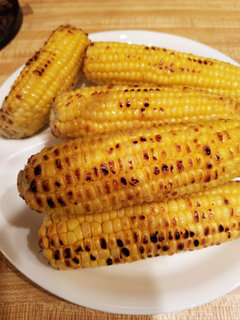
    Clearly, the difference between charred, burnt, and scorched are in our personal definitions, and what each of us likes or dislikes has to do with our eyes, noses, and taste buds. I like a bit of 'char' on my corn when grilled...

    Photos for uploading · More Info
    and my hot dogs, and my marshmallows.

    To refer to someone as 'shallow' who refuses to eat or try 'scorched' food - food burnt by mistake or on purpose, is discourteous at the very least. If DH insisted I eat spicy foods, it would be cruel. If I insisted DH eat seafood, that would be cruel. We have different tastes, and we have both turned down foods without tasting them.

    If one wishes to 'break rules' please do so at your pleasure - I have had many a happy mistake in the kitchen, but far more more horrific blunders which I would never eat, nor would I request others try it if it looks or smells distasteful to them.

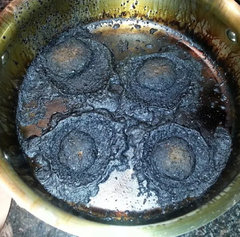
    The following are not my photos:

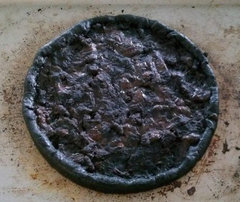
    burnt pasta

    Photos for uploading · More Info
    burnt salmon patties
    Photos for uploading · More Info
    burnt pizza
    Photos for uploading · More Info
    Most people would find the 3 photos above distasteful. And the last photo, a sacrilege : ) Though these are extreme examples, if I wish to be superficial and not eat something stuck to the bottom of a pan, that's my prerogative.

  • 8 years ago

    It's semantic - scorch sounds bad and char sounds good!

  • 8 years ago

    Not unlike the difference between drugs and medicine. Good people sell medicine...

  • 8 years ago

    Just another note...

    My recent pasta salad (Large shells, mayo, mustard, ground pepper, tuna fish, coarse chopped onions etc) I netted about 1/3 cup of pasta water. The shells were firm. Nothing stuck to the pot save the pasta water which needed a spatula to save. That which stuck to the pasta made a thickener for the mayo and the guests raved over it.

    Yep, 24 minutes of cooking with 5 minutes to absorb more water., I timed it again. 24 minutes starting with cold water.


  • 8 years ago

    "Scorched" onions taste very different from scorched pasta and other starchy foods!

    Who here enjoys the smell/taste of burnt popcorn? I don't know anyone IRL who does.

  • 8 years ago
    last modified: 8 years ago

    I'm guessing Gary doesn't like his pasta "al dente"

    Carol, no, I don't know anyone either than enjoys burnt popcorn. Or scorched for that matter.

  • 8 years ago

    carolb, my dog eats it when she finds one so she must enjoy it, but I don't know that she cares for it more than 'un-charred popcorn'. ; )

  • 8 years ago

    Sooo....that same 24 minutes in cold water works for spaghetti, linguini, orecchiette, large shells, bucatini etc? How much water do you add? Same amount for a pound of large shells as for a pound of spaghetti? How much water for 2 pounds of pasta? Or for half a pound? Is the timing the same for what must be lots more water for a larger amount of pasta? Even though the larger amount of water takes longer to come to a boil?

  • 8 years ago

    Ravioli falls into the pasta category. I'd not ever try it but if I let my homemade ravioli sit in cold water for any period of time, I'm sure the seams would come unbound and I'd have a real mess: All pasta, no filling, except what was floating in the water.

  • 8 years ago
    last modified: 8 years ago

    I kinda like the burnt popcorns. I don't go out of my way to burn the stuff but if one is there I won't reject it. I also like a little dark crisp on the top of my lasagna but not really charred - just so the pasta gets a bit crunchy.

  • 8 years ago

    "How much water do you add? Same amount for a pound of large shells as
    for a pound of spaghetti? How much water for 2 pounds of pasta?"

    I find that just enough to cover has worked for any amount 1/2 lb to 1lb for spaghetti, linguini, ziti, elbows, as is probably good for any non-filled pasta. Assembled pasta such as ravioli or tortellini do not fall into this cooking technique. I am sure they would fall apart. Angel Hair is a bit too flimsy for this too.

    If too low, you can always add water while it is cooking. It would be like making gravy, you add broth as needed. I have never cooked 2 lbs at once but I don't see it any different. Use what water you need.

    I cook my lasagna, spaghetti, and linguini in a pain De Mie pan.

    As for "Al dente", too many people think that scarcely cooked is al dente and no, when cooked to the box directions it is under cooked for me as it has been for my family for years. All I can say is cook it to my directions and write back to let us know what you find.

    My father taught us that we could tell when spaghetti is done by the "placking" the water makes when boiling and foaming becomes large bubbles but that works only with the classic large pot of water. My grandfather would say "Throw it at the wall, if it sticks it is done".


  • 8 years ago

    "I also like a little dark crisp on the top of my lasagna but not really charred - just so the pasta gets a bit crunchy."

    I recall, as a kid, I liked the taste of browned/burnt strands of uncooked spaghetti when held in the flame as the pot of water was being brought to the boil.


  • 8 years ago

    So if cooking 2 pounds of pasta ( and in my kitchen if 8 people are eating spaghetti and meatballs you better cook at least 2 pounds) you will need almost twice as much water to cover as for 1 pound which will take almost twice as long to come to a boil, do you time 24 minutes from the time you put the cold water and pasta on the heat? Or 12 minutes from when it finally comes to a boil?
    And what kind of a cook top are you using that a pan with enough water to cover one pound of pasta takes 12 minutes to come to a boil?

  • 8 years ago

    I have never had to cook more than 1 lb of pasta, so I am wondering: What size pot are you using? Do you need double the water as indicated by the box for 1 lb?

    If you use two stock pots, 1 lb each, I imagine that it would take less time to cook than a larger stock pot. If that is the case, then my 24 minute recipe would work, no?


  • 8 years ago

    "I make all our pastas myself, and I'd never allow it to sit in water that long, but to each their own."

    Maybe you should. I am finding that the shock of dumping pasta into boiling water changes the end product, not unlike cooking potatoes and eggs. Ever wonder why potatoes separate by layers after boiling? It is because the outer layers are cooking faster than the center. Starting with cold water allows them to cook evenly.

    Additionally, I am now adding flavors such as basil, garlic, even chopped peppers into the concentrated water and pasta before I add any sauce. The pasta itself has the flavor instead of the sauce.


  • 8 years ago

    Um, Gary, the rule of thumb for cooking vegetables is to start root vegetables in cold water. If you’ve been putting them into boiling water you’ve been doing it wrongly.

  • 8 years ago

    I have always started with cold water but I have corrected a few cooks who boil the water first. The difference is convincing.


  • 8 years ago
    last modified: 8 years ago

    Just read this article and thought of this discussion...

    Why You Should Never, Ever Drain Your Pasta In The Sink

    "If you drain your pasta water through a colander and down the sink, you’re throwing away an invaluable asset that cooks call “liquid gold.”

    (The term “liquid gold” has also been used to refer to wood cleaner, hair products and of course, urine. For the love of God, please don’t confuse pasta water with any of these.)

    Because pasta is made of flour, it releases starch into the cooking water as it boils, creating a white, cloudy liquid that we often deem “dirty” and then dump down the sink.

    Big mistake. That’s the liquid gold we’re talking about.

    Why would you want to keep that cloudy liquid, you may ask? Because it’ll help emulsify and thicken your sauce...."

    And they tested it out as well.

  • 8 years ago

    I thought you were going to explain some reason to not send the pasta water down the drain because it would somehow affect the drain and plumbing. (:

    I am finding that there are other uses for the water other than a thickening agent for sauce. I am not sure if such a small amount of semolina flour has much benefit. It is however thoroughly blended with the water that there is no chance of clumping.

    It thickens hot chocolate nicely. Makes it silkier.

  • 8 years ago

    I just tried this low-water cooking of pasta and I have to shout out "What incredible pasta flavor in my macaroni salad!" I may never cook pasta in anything more than one quart of water ever again. Why have we been throwing it down the drain all these years?