

Turkey prices in your area. Report!
8 years ago
Featured Answer
Sort by:Oldest
Comments (20)
Related Discussions
One reporters take on gas pricing, refining capability
Comments (15)I don't think anyone wants any type of industrial plant in a residential neighborhood, but there's also a point where people have to be reasonable. Right now all over the country you have many people moving out to the country, and then they gripe -- and in some cases even file lawsuits -- about smelling manure from farm fields and livestock operations. People move near airports and then they want the airport shut down because they hear airplanes. It's ridiculous. You're right, the EPA is the least of the problems. They have specific regulations, and anyone who wants to build something can look up the relevant rules and decide whether it is or isn't possible to meet them. But the lawsuits filed by people to hamstring almost every proposed project are a much bigger problem. Even in places such as Indiana which are economically depressed and literally crying for more economic activity, as soon as anyone proposes anything, there are two or three pressure groups quickly organized to fight it. People do not even take time to gather information and make an informed decision; they read a newspaper article saying this or that is proposed, and instantly they're opposed to it. Personally, I'd rather live next to a factory or a power plant than to people who are closed minded and opposed to everything....See MoreDon't Prepay Your Mortgage [Consumer Reports]
Comments (100)Hi Tom, (JUST jabbing ya! Everyone calls me Dan, Don... whatever... ;~) I read from the very top of this thread when I stumbled upon it via a Google search on 'Prepay vs Refi'. Google is sweet, no? Very emotionally charged this thread; must have spent a good 2-3 hours trying to understand the postings. I was totally against your argument (angry even) in the beginning but eventually came around to understanding what you are trying to explainthe basic economic concept of maximizing your utility. I *LOVE* seeing that kind of epiphany happening!!! We are currently in the 7th year of a 30-year fixed mortgage at 5.75%. Side Note; REALIZE that the year # is meaningless except for how it affects the weight of your amortization burdens. The further you go, the heavier the weight on your payments against your liquidity. You can *ALWAYS* stroke a check, at any moment, to eliminate as much of your leverage as you can afford. Of course... trying to do so BEFORE you can actually aford it (like the people who constantly shave away their safety cash with extra monthly principal surrender payments) is simply dangerous & cash-foolish. Even though we could have originally afford a 15 year mortgage, we choose to have the leverage of lowered monthly payments so that we can 1) invest the additional money or 2) be financially stable should one of us looses a job. Through budget tightening, we now have an extra $400 a month to invest. That is both smart, and responsible! I took about a 50% hit on my various investments last year (401k, VUL, IRA) and this quarter does not look to promising either so I am somewhat skeptical on when the market might rebound. OUCH! I would strongly suggest getting OUT of investments that are still open to downside losses, if you cannot aford to lose your principal. Your 401(k)* and traditional IRA (especially after the market collapses) can be rolled on a tax-efficient basis into a ROTH IRA (or similar) and then engaged in fixed-indexed instruments (income or growth annuities) that catch any annual upsides to the stock markets, lock in the gains against any future losses, and guarantee your principal against any stock market downsides. That VUL can be tax-free 1035 exchanged to a fixed-indexed universal contract that will provide the same (or better) upsides, with guarantees against any losses to the downsides. NOW is DEFINITELY the time to stop the losses and get in a position to take advantage of volatility (riding the up-waves, and then locking int the gains with guarantees against downside losses on the down-waves.) With this skepticism in mind and the fact that I hate my mortgage company for what they did to us post-Hurricane Ike, we are thinking that the additional $400 monthly towards the mortgage might be a better way to go for now. We like to think of it as our very own personal refinancing plan. Same results but no ridiculous closing fees and the flexibility to resort back to a lowered payment should one of us looses a job. With interest rates so low, we even thought about refinancing the other way to get another 30-year mortgage at 4.50% but still adding all the extra money towards the principle. Fees and recouping time steered us away. I'd suggest you were either miscalculating, or analyzing from a misperception. Depending on the size of your home value, re-balancing your leverage from 5.75% to 5% or lower, and moving as much of your real estate equity OUT of the house and into tax-free principal-guaranteed growth vehicles with stock-index upside (at a 8-10% average) versus yoru tax-deductible sub-5% cost of leverage... its really far safer, conservative, and more responsible. Questions for owning the house outright: Why is house rich, cash poor so bad? Because "you can't eat real estate equity." As long as you can pay for your property tax and minimal utilities, you still have a roof over you head right? Doesn't really matter if you can't afford the rest of the common costs of survival during duress. Granted standards of living might be lowered, but it beats living in the streets. You can always sell it and rent an apartment. Hate to be an involuntary, desperate seller in the current real estate markets... and that's what you are suggesting as the "safety-upside" to your plan. Likewise for the imminent domain argument; some kind of compensation will be available for you. "Some kind" of compensation? Google "Kelo emminent domain" and see how reliable our government is in that regard. Do you really prefer to leave your family's financial security & safety in the hands of the courts? (And do you really think that in times of desperation you can wait it out & fund the litigation required?) As for Act of God, insurance should compensate; Tell that to the H. Katrina people... the ones who got stiffed while various insurance companies played games of "chicken" through the court systems to see whether the damages to be covered were caused by wind-driven rain, or wind-driven floods (yeah... like it mattered!) And the entire time NO checks were issued... Tell that to the California earthquake victims who's homes were destroyed by the indirect consequences, and not by the earthquakes themselves. Insurance is the "contractual rental of other people's safety reserves." It can never effectively cover the safety you can give yourself by using your OWN reserves instead of someone else's (at their own rules of engagement.) or worse case scenario, you can pitch a tent on YOUR land. And feed yourself with what? Using what sewage systems? Getting water, heat & power where? Cash reserves means you can take your family to safety, WHEREVER that may actually be. Questions for carrying a mortgage and leveraging for as long as possible: As morally repugnant as a previous user put it, you still can walk away from your mortgage should you be upside down and keep all your liquidity, right? The answer is; It depends on your state's laws. Some states say purchase money loans are non-recourse, but refinance loans are not (i.e. California,) while other states say that purchase loans ARE recourse, and equity refinancing is not (i.e. Texas.) Homestead laws are various among different states as well. CASH is the ultimate law... "the golden rule" remember. The only things you would loose are your equity and credit (and dignity). Just chalk up the interest as rent paid for your time at the house (OR you can try to take advantage of the current Administration bailout policies J LOL). Seriously, should you walk, can the bank go after your liquidity in this situation? Im not familiar with bankruptcy and foreclosure rules and their ramifications. I always thought that walking away is one of the leverage I have for a prolonged mortgage. See above. Also, an assumption that I always have is that all debts under my name would go with me to the grave should I die and my wife gets to keep the liquidity. Am I correct or does my wife have to shoulder the financial burden (life insurance aside) eventhough her name is not on any of the debts? It depends on how you have planned & structured your estate. NOT to be taken lightly... a seperate conversation than cash/liquidity... but super-critical nonetheless. Cheers, Dave Donhoff Leverage Planner...See MoreConsumer Reports - have you used for your build?
Comments (11)They aren't very accurate, and don't do their research well. For instance, Whirlpool owns Maytag, Jennair, Kitchenaid, Inglis, etc. And supplies most of the washing machines and standard refregerators to be rebadged into Kenmore. They will rate the exact same model, with different ''name'' badges, differently. Same factory and same innards. Different ratings. Plus they have a bias against appliances that cost more than what they think is average. If two ranges have the same number of service calls, the one that is cheaper, regardless of features, will be scored higher. And they do not differentiate in service call types in their ratings model. Someone not being able to figure out how to get the right program for washing their delicates gets as much weight as catastrophic failure of the mothherboard. So again, biases against technology and higher featured appliances. Not to mention that by the time they are done with their reporting period, 90% of the models that they've tested have been discontinued. Sure there are replacement models, but those will have different components that will render the comparison to previous models moot. It's only helpful if you are searching for used appliances. And very specific models of used appliances. Ask any industry insider, from repairmen to shop owners. They'll tell you the same thing. If you want accurate advice on appliance purchases, those industry insiders are who you should actually listen to. The same is true for whatever component you are buying. Ask the folks who deal with the products day in and day out what they would buy for their own homes....See MoreHousing prices - what is it like in your area?
Comments (58)Yes, chisue. Look up thread a bit, I did mention haves and have nots and the generation of my kids needing help. It's not new in my area, it's the result of decades of appreciation and runaway income and gains fueling net worth increases for those in and supporting the tech sector in the SF Bay Area. The same is true (with different industries) in coastal SoCal. And I think ditto in other metro areas nationwide. "Are big homes with big RE taxes not lingering in your market?" No, I don't think so. But real estate taxes work a bit differently here than in other places. California's Prop 13 in 1978 limited total tax to 1% of value and capped upward annual value increases to the lesser of an inflation factor or 2 percent per year. Appreciation since then has been significantly greater so longer term owners pay less in tax than more recent buyers living next door in the same house, where that's applicable neighborhood wise. We've owned our house over 25 years. Houses can be reassessed to market value only when sold, so a new owner of my house would pay 3 times as much property tax as I pay. That's true statewide. Here's information, stats from the Santa Clara County realtor board. They're misleading because the community is polarized with more average houses and more expensive houses and not so much in between. That shows in the difference between median and average prices, average being $300K higher. Prices are up overall 3% in the past year, but more so for more expensive houses and less for less expensive ones. Inventory is at 40 days (average time on market), much lower than even 12 months ago, The chart shows days of inventory is down a fair amount, sales are down too (fewer houses being offered for sale). Real estate market stats...See More


Related Stories

DECORATING GUIDESHow to Choose an Awesome Area Rug No Matter What Your Space
High use, a low door, kids and pets running amok — whatever your area endures, this insight will help you find the right rug for it
Full Story
KITCHEN DESIGNSpecial Report: Kitchen News from Cologne
Blended Kitchen-Living Rooms, Super-Skinny Counters and Hidden Appliances Are Headed This Way
Full Story
HOUSEKEEPINGGot a Disastrously Messy Area? Try Triage
Get your priorities straight when it comes to housekeeping by applying an emergency response system
Full Story
MOST POPULARThanksgiving Tales: When the Turkey Tanks
Houzz readers prove adept at snatching victory from the jaws of entertaining defeat
Full Story
FALL AND THANKSGIVINGYour Guide for a Simpler Thanksgiving
Ease the stress of hosting the big day with these tips
Full Story
INSIDE HOUZZHere’s Why Kitchen and Bath Renovations Are Costing More
The 2019 U.S. Houzz & Home report shows that costs have steadily risen in recent years, a trend expected to continue
Full Story
SAVING WATER11 Ways to Save Water at Home
Whether you live in a drought-stricken area or just want to help preserve a precious resource, here are things you can do to use less water
Full Story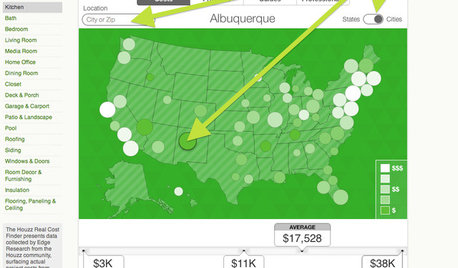
REMODELING GUIDESBreakthrough Budgeting Info: The Houzz Real Cost Finder Is Here
Get remodeling and product prices by project and U.S. city, with our easy-to-use interactive tool
Full Story
SELLING YOUR HOUSE5 Savvy Fixes to Help Your Home Sell
Get the maximum return on your spruce-up dollars by putting your money in the areas buyers care most about
Full Story
INSIDE HOUZZData Watch: Home Renovation Industry Confidence Remains High
The majority of home remodeling pros have seen gains in 2015 over last year. Hiring is a challenge in some areas
Full Story

User