

Breadmaker
9 years ago
Featured Answer
Sort by:Oldest
Comments (6)
 9 years ago
Related Discussions
In what ways does honey affect breadmaking?
Comments (17)Thank-you for the explanation about the scaling on the website. I'm sorry I maligned a fictive editor! I was just trying to make the amounts match and thought the second addition was an error too. :) If there had been a single measure of honey and the directions had said "half of the honey" it would have been clearer and worked better on the scaling. Oh, well. Scaling a recipe you've never made can be dangerous even if you think through every ingredient. My mother's challah recipe, which I've made the most, and made for decades, makes three loaves, and it's much better to make three loaves and freeze two than to try to make it work for a single loaf. One thing to remember in baking bread is that recipes often fail the first time you make them, especially while you're developing expertise. There are so many variations in flour, kitchen climate and oven climate, that a recipe is really a starting point, not an absolute. I'd also follow the recipe exactly once to get a better idea of what it's supposed to be before changing the ingredients. After that, remember that when you make changes, you're not following the recipe, and you're relying on some very precise chemical and biological reactions not to care. Keep in mind that you're making an experiment, not a recipe, and that there are things that may be going wrong. I've been doing that almost weekly for the last year, and learning a lot from it about what reactions such changes bring, It's fun! But if your point is to make a good recipe and have a good loaf of bread, do start by actually making the recipe. I have all kinds of ideas of how to proceed and tried writing them out, but I realized I'm not expert enough to make them make sense. It sounds like it might be overrisen, underbaked, or perhaps baked at too low a temperature. Do you have an oven thermometer? Re soaking, if you're trying to adjust the nutrients of the whole wheat, you should do at least 8 hrs. and with some acid (I found a jar of vitamin C crystals easy to find and use a pinch of that, but normal kitchens acids will work). Adding extra liquid for it might have required a little extra baking too. I've found that even if a soaker seems very dry, when I mix everything together, it's fully hydrated and doesn't need an addition of water. This is true even when I knead the ingredients together by hand. My best advice is to decide on a few small adjustments, try again, and see what happens. :)...See MoreZojirushi breadmaker question
Comments (22)rorymory- Choose a recipe that includes a pre-ferment (aka sponge, soak), and be sure to add an acidic ingredient - I use ascorbic acid, but Fruit Fresh will also work since it is a mixture of ascorbic acid and citric acid. You may find some recipes that have lemon juice or vinegar as the acid ingredient. Use the bread machine for mixing/kneading ONLY. Remove dough from the machine as soon as it has completed the kneading cycle. You won't use the timed rise cycle at all. Place the dough in a dough-rising bucket (I use a 2-quart plastic food storage container with a tight-fitting lid I purchased from a restaurant supply store, it has graduated measurements on the side). Pat the dough into the container and fasten on the lid. Note where the dough amount is. Double that amount and that is how high you allow the dough to rise. If it is at the 1-quart line, it will have "doubled" when it reaches the 2-quart line. It's actually best to only allow it to rise to just UNDER "double". Whole wheat flour doesn't have the extensibility that white flour does. MILDRED BREAD (adapted from a recipe from Pleasant Hill Grain by my friend, Mildred) (makes over 2-pounds of dough) This recipe is for 100% whole wheat bread, and is an enriched dough baked in a loaf pan in the oven, NOT the bread machine. When done correctly, using quality wheat for the flour milled into a very fine flour using an impact mill (Wonder Mill or Nutri-Mill), the loaves are as high-rising and light as most white bread recipes. If you use Hard Spring White Wheat, the color is very light and the flavor is very mild, as well. Sponge: In the pan add these ingredients - 3/4 c. warmed buttermilk 3/4 c. barely warm water 2-1/2 c. freshly milled hard whole wheat flour 1/4 t. ascorbic acid (you can use Fruit Fresh if you don't have ascorbic acid) 2 t. instant yeast (such as SAF Instant) Set the Zo on the shortest dough setting and only mix/knead these ingredients until they are well incorporated. Using the buttons on the top of the machine, stop the machine, and then unplug it. [You can also do this in a mixing bowl with a wooden spoon or Danish dough whisk and add it to the Zo pan.] Allow the mixture in the bread pan to sit in the bread machine with the lid shut for no less than 2-1/2 hours, or overnight (up to 12-hours). The next morning (or after 2-1/2 hours) add to the top of the sponge and stir in lightly with a rubber/silicon spatula by hand: 2 T. coconut oil (or oil of choice, but coconut oil will keep the bread fresher longer) 2 T. honey (or agave nectar, which also aids in keeping fresher longer) 1 egg (room temperature - warm in a bowl of warm water, if necessary) Add to the top of this mixture: 2-1/2 c. freshly-milled whole wheat flour 2 t. salt Set machine to the shortest dough cycle. When it has finished kneading, stop the machine and remove the dough from the pan and place it in a dough rising bucket and finish the dough, as usual, without the bread machine. There is enough dough for more than one loaf and if I only make one loaf, I use the remainder of the dough to make something else like 6 jumbo sticky pecan cinnamon rolls, an 8" pan of dinner rolls, 6 hamburger buns or 6 hot dog buns. * 1-pound of dough will make a medium loaf of bread in a 7-1/2x3-1/2" pan * 1-1/2-pounds of dough will make a regular loaf in an 8-1/2x4-1/2" pan * 2-pounds of dough for a 9x5" quick bread loaf pan Bake the bread in a 350° preheated oven until it reaches an internal temperature of 195°-210°F when tested with an Instant Read Thermometer. Yeast rolls - 190°F-195°F. -Grainlady...See MoreCuisinart Breadmaker
Comments (1)go to their site. search their recipes start here (click link below) Here is a link that might be useful: sourdough results at Cuisinart...See MoreBreadmaker that isn't non-stick
Comments (4)Hi cacocobird. The only bread maker that I know of that may meet your requirements is the Beem 5-in-1. It has a ceramic lined bowl instead of Teflon or other non-stick surfaces. If it is the PFOA's and the PTFE's that are concerning you, the ceramic lined bowl does not leech the toxins when heated. But as far as just a plain SS bowl, those are very, very tough to come by and the Beem in sold in the UK....See More 9 years ago
 9 years ago
- 9 years ago
Related Stories
KITCHEN STORAGEGet It Done: How to Clean Out the Pantry
Crumbs, dust bunnies and old cocoa, beware — your pantry time is up
Full Story
KITCHEN DESIGNKitchen of the Week: Simple Style Fuels Creativity
A food blogger proves you don't need fancy kitchen appliances or even a lot of space to create an amazing meal
Full Story
KITCHEN DESIGN7 Strategies for a Well-Designed Kitchen
Get a kitchen that fits your lifestyle and your design tastes with these guidelines from an architect
Full Story
KITCHEN APPLIANCESConsidering a New Kitchen Gadget? Read This First
Save money, time and space by learning to separate the helpers from the hassles
Full Story
KITCHEN DESIGNHouzz Call: What’s Cooking in Your Kitchen?
Most of us turn to recipes, videos and culinary shows when we cook. Where do you set your cookbook, tablet or TV screen?
Full Story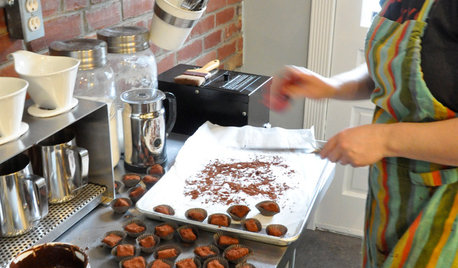
KITCHEN DESIGNLove to Cook? We Want to See Your Kitchen
Houzz Call: Show us a photo of your great home kitchen and tell us how you’ve made it work for you
Full Story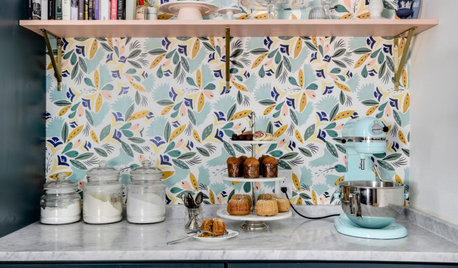
KITCHEN DESIGN12 Items Worth a Spot on Your Kitchen Counter
Keep these useful tools and accessories out in the open to maintain high function without spoiling the view
Full Story
ORGANIZING21 Tips for Organizing Your Stuff
Restore order at home with these ideas for tidying up cupboards, shelves, doors and more
Full Story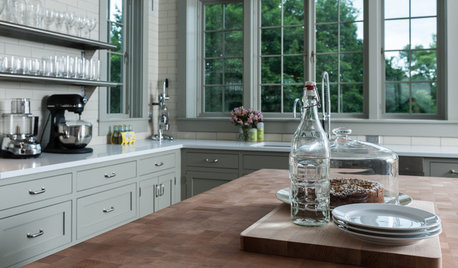
MOST POPULARKitchen Evolution: Work Zones Replace the Triangle
Want maximum efficiency in your kitchen? Consider forgoing the old-fashioned triangle in favor of task-specific zones
Full Story
KITCHEN DESIGNHow to Lose Some of Your Upper Kitchen Cabinets
Lovely views, display-worthy objects and dramatic backsplashes are just some of the reasons to consider getting out the sledgehammer
Full Story
plllog