Houzz Logo Print
docmom_mn_zone_5

Having fun with pollinators!

10 years ago
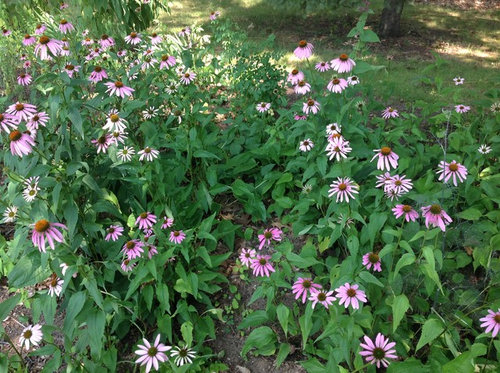
I've been gradually increasing the numbers and variety of native and other plants in my garden that can benefit pollinators. I've been really disappointed and quite concerned at the small numbers of insects I've seen over the past three summers. But, just this week, I've finally started to see better numbers. Instead of one solitary bumble bee, now I see three or four. Instead of just bumble bees, I see tiny sweat bees and giant black wasp-looking things and others I can't describe. It might have something to do with my ever expanding patch of coneflowers. They seem to find this spot a perfect location for sowing seedlings, so what started as 4-5 plants has grown to hundreds. And they are all blooming just now.

The photo doesn't capture them all, and the edges have hundreds of this year's seedlings. I've already transplanted many plants at various ages to other parts of the yard, and I hope the multiplication process continues. I also have salvias, penstemon, mountain mints, milkweeds, liatris, several different monarda, prairie onion, pussy toes, anise hyssop, annual and perennial coreopsis. Also shady plants like trillium, blood root, Virginia Creeper, Jack-in-the-Pulpit, columbine, Jacob's Ladder, native and non-native ferns, hosta (from the previous owner and enjoyed by the deer). I collect seed from as many plants as I can, and wintersow them to widen current patches, or begin new ones. I wish I knew of other gardeners who would plant these, because I would be thrilled to share. But, my babies aren't the size most folks expect plants to be when they put them out. Though, they need to be planted out in order to develop the robust root systems native plants use to survive in hostile surroundings.

Anyway, the pollinators are increasing and that makes me very happy! I hope others on this forum are seeing encouraging changes around them, too. Let us know what's going on in your yard.

Martha

Comments (26)

  • 10 years ago

    You should plant a nice Eutrochium too. They're August bloomers here (just opening here) and my big one attracts every bee within 2 miles. They love Symphyotrichum too.

  • 10 years ago

    Bravo, Momma Doc! Studies are supporting your observations of lesser insect populations. I know-lots of people would say this is great news-less bugs!...but we here on this board know better.

    Was up on Washington Island (Door County, WI) last weekend and was surprised and delighted to learn that there is a thriving lavender-growing industry up there. You want to see bees? Plant lavender! Sure, sure, non-native, but a benign entity that bees just go crazy over. I think I've never seen so many bees packed into an area. Amazing.

  • Related Discussions

    HAVE: I have orangeglo hand pollinated.

    Q

    Comments (4)
    Pip, it is not the season for me to start seed trades but I am interested in more Orangeglo seeds. They were the best watermelon I grew this year. But I have to go through my seeds and see what I have and it won't be soon. My list gets updated in winter.
    ...See More

    Fun Fun Fun

    Q

    Comments (7)
    Remember... some of us want to see M. le bebe wearing some of the luxurious knitted finery that awaited his arrival... ummm... BOOTIES? how about booties and nothing else? (will prove indispensible for blackmail in the his teen years). :)
    ...See More

    Fun With Cross Pollination

    Q

    Comments (8)
    Y'know, I'm fond of each one of those, but the one in that first photo, the Cheiridopsis, is just...oh, what is the word I'm looking for? It's fantastic, but I feel like I use that word a lot. It looks like a person throwing both arms up to the sky in victory, joy, exuberance, excitement, whathaveyou. It's just...uplifting. :) Great show, Ryan - thanks for sharing! *CG*
    ...See More

    NEW: Make New Friends: Ghouls just want to have fun!

    Q

    Comments (151)
    Oh, that's bad, Trina! Poor Fox! We haven't had to deal with that here, thank goodness!!! Okay, and those of you saying to talk to the doctor, well, that is what I am pretty sure the email he read was about. He had gone to the doctor, and while he was there, joked around with his doctor that his wife thought he needs the blue pill. The doctor asked if we were trying to have any more kids, and when he said no, the doctor I guess told him that if he keeps losing weight I'll think he's a new man! And I was SO pissed that the doctor didn't take his joking seriously!!! Isn't a doctor supposed to dig when someone mentions something like that lightheartedly??? But, please don't think I'm not getting any - it's not that bad - it just doesn't last! But, he certainly makes up for it, so I'm not complaining too badly! ; ) As far as childbirth, I've been both ways. I didn't want to have drugs with any of them, but I have trouble going into labor on my own. So, I have had 3 births with a pitocin drip. Yuck!! Once it starts working, it makes it fast and hard. With all three of them, I had some painkiller, something they put in the IV, to take the edge off - I don't remember what it's called. With William though, I did go into labor on my own. (Though the doctor says it was because he had checked my cervix that morning.) So, no pitocin, no pain meds. And he was almost 9 lbs. - 8 lbs. 15 oz. And I have to say - that was my easiest labor! Incredibly painful, but maneagable. OMG - when I had William, I have this funny memory! I tore like crazy when I had him. The next day when I went to go pee, I used the little squirt bottle that they tell you to use to clean yourself afterwards, and I accidentally touched myself. It felt like there was a ball down there - I was swelled up so huge!! That was one of the weirdest feelings ever!!! Melissa - I don't know how you did that at home! We talked to a midwife when I was pregnant with Lily, but decided to stick with my doctor. But, on our own???? Scary! My mom said that her mom gave birth on their kitchen table - all 8 kids. And most of the time, the midwife didn't make it in time. She remembers her dad delivering her younger brothers and sisters. Wow - that is so cool Melissa!
    ...See More
  • 10 years ago
    last modified: 10 years ago
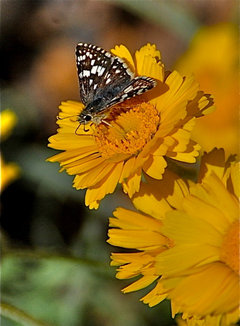
    Tom, your favorite nonnative plant, Russian Sage, attracts them better than any plant I've ever grown including lavender with one exception: watching bees go after Datura (Jimsonweed) blooms. The bees arrive in droves late each afternoon and spend a couple hours getting aggressively hostile, impatiently trying to force entry into each nights new crop of tightly closed giant blooms that won't open until they are good and ready teasing an army of bees into an insanely pissed off buzzing frenzy, its noisy & boisterous and looks like an assault.

    Its well known that honey bees are not native to America. Interestingly (to me) in your face native plant zealots ---only 100% native is acceptable--- have no problem with honey bees and go out of their way to attract them.

  • 10 years ago

    Indeed-that bit of inconsistency has occurred to me as well! But getting back to those lavender farms, I'm not exaggerating-each single mature lavender plant might have 50 honey bees and a smattering of other bees on it. I don't get that in my own yard where I have lavender, but up there, it's just nuts, in a good way. Those people have really hit on an interesting business model.

    Door County is that "thumb" of land that juts out into LAke Michigan. As such, it has a modified climate. While lavender here in this city is already just a bit past peak bloom, the stuff up there was prime, the cooler lake serving to make things just a bit later. Also a land of cherry orchards as well as apple.

  • 10 years ago
    last modified: 10 years ago
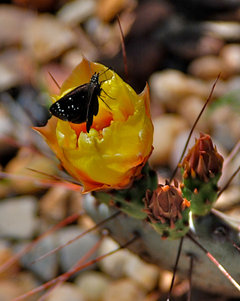
    I didn't doubt it at all, I bet its a busy place with the bees. In my garden its the Russian Sage more than the lavender, which is always short lived here because it doesn't like the heat + humidity. I found that Spanish Lavender does the best. The RS is covered in bees every day. In winter Rosemary (geeze, I'm listing yet another nonnative) blooms and it really attracts the bees. Honestly I'm trying to think of a single native that attracts bees heavily like the RS and I can't think of a single one, not among my plants anyway. Years ago I had a Wintersweet Shrub and it attracted lots of bees in February.

    Here is a sad story I read on Oklahoma Forum about 3 or 4 years back. A guy was wanting to cut down his field to get rid of the tall grass before fall set in. He says he couldn't believe the thousands of monarchs on the sunflowers and they were flying up as he cut with his tractor, said he was surrounded but he kept cutting. It nearly made me sick to read it. I mean, heck, in fall they are just traveling through and you always get a couple of peak days like that when they are really heavy and he could have waited just a couple days. This was the year I saw hundreds of them on a large planting of Agastche up the street, I've never seen anything like it in the city, it was a one day only event and that same day I saw them was the day I read the post on the forum.

  • 10 years ago

    Oh, that is sad! I have lavender and catnip plus various sages, and they attract all kinds of bugs. I'm loopy on pain meds, so I'm going to sleep.

  • 10 years ago

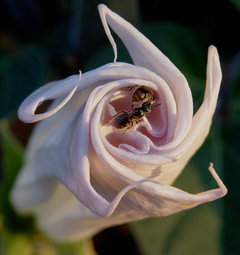
    I got bees, I got mason bees, dragon flies , katydids , cicadas , kissing bugs ( major bummer) and I woke up this morning with a scorpion on my leg!. He did not tag me but I tagged him good once I found my glasses... no guilt here. We have bugs. I do not have a lot of agriculture around me . Not much spraying of chemicals. Pollinators. I cleared the cedar and I now have tooth ache tree, a larval food for Tiger swallow tails and I see them much more than before.. I have milkweed natively on the fields and 2 milkweed vines (native not invasive in the valley) and 2 native aristolochias. My salvia chiquitas are huge bumble bee tractors. The Ageratina havenese, frost weed and Guitierez sarothae (sp?) are big late fall attractors. I find the skippers love my invasive KR bluestem. I have seen the bees get inside the coiled Daturas and rip the flowers apart from the inside out in a drugged out brawl. They wander home to their hive and then they don't come back for a couple of weeks. I imagine them either lost sporting a long hangover in the wrong hive.. These were collected off a hillside on a large ranch not far from me.


  • 10 years ago

    Super duper Kool.

  • 10 years ago

    I've got tons of bees too -- Culver's root has been a big draw recently.

    I
    keep wondering where all the butterflies are this year. It's early yet
    for monarchs, beyond that I don't really know much about when to expect
    others like swallowtails. Down the street there are yards full of
    wildflowers (though not necessarily native) that should be big butterfly
    draws. One yard I walk past is almost completely covered with Phlox
    paniculata. I haven't seen a butterfly on them yet this season.

    I've
    seen a few cabbage white type butterflies, a little blue or two, but
    that's it. You'd think the Joy Pye weed (Eutrochium purpureum) would be
    bringing them in, but you'd be wrong.
    I'm interested to see
    whether things heat up as the Liatris (pycnostachya and ligulistylis)
    and swamp milkweed are just coming into bloom now.

  • 10 years ago

    Insect life is down-way down-everywhere. Foolish folks will applaud this bit of news, but we know better-that any time the base of a food pyramid is lacking, the whole structure is in danger. Something's drastically wrong, and a bunch of nitwits clamoring for the banning of one type of insecticide is going to completely miss the mark.

    For some reason, I keep thinking about all the explosion of microwave energy bouncing around from cell phones to cell towers, to other phones, to other towers, then back again, ad infinitum. What could go wrong?

  • 10 years ago

    Yes, it does seem unlikely to me that all that extra EMF being beamed in every direction could be entirely harmless. Personally I'd bet on pesticides, but it's clearly a very complicated problem.

    It could just be some sort of natural variability, of course. Some years are bigger butterfly years than others. We'll see how the rest of the season goes...


  • 10 years ago

    My money is on pesticides too along with habitat. I am noticing that at night there are very few insects flying around the outdoor lights this year. Its sci-fi disturbing, like an eery kind of stillness and silence.

  • 10 years ago
    last modified: 10 years ago
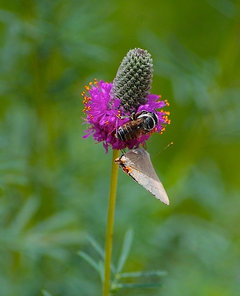
    TR, habitat loss is the single biggest threat to species on this planet. Not poaching, or climate change or anything else. One thing I have always wondered about is the "green" movement. My two favorite oxymorons are "Green" energy, where fields of solar panels and windmills fragment and degrade vast tracts of land, or "green" development whereby a building is deemed good for the environment because it has 50% more windows and saves water. I'm sure the critters that were displaced by the bulldozer are glad we were thinking about them after we tore up their home...

    What purpose is this pseudo-environmentalism when there isn't any environment left to worry about? Sorry for the soapbox, but this is something that really touches a nerve with me.

    Anyways back to pollinators....

    I was reading an article in High Country News about bee keepers on U.S. Forest Service land. Essentially the non-native honey bees out compete native bees like bumbles and may be contributing to the decline of native bee populations.

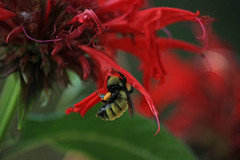
    I don't have a lot of honey bees, but I have tons of native bees. Bumbles are pretty common, and always a favorite of mine.

    (Bombus spp.)

    The halictid (sweat) bees are the most numerous and the best pollinators of my vegetable plants. They can be found in droves on my peppers, cucumbers, tomatillos. These sweat bees (agapostemon species are the most common at my house) are the work horses of the pollination world! And too think honeybees get all the credit!

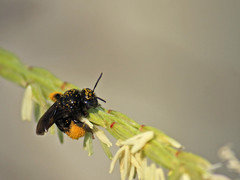
    Long horn bees are funny, since I only ever see them on corn tassels, if I don't grow corn, I don't see these guys at all.

    (Melissodes bimaculata)

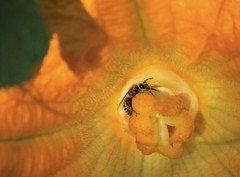
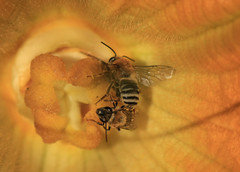
    Squash bees, as their new implies, dine pretty much exclusively on squash flowers. If you grow winter or summer squash, chances are these guys are the ones doing the work. The pollen is too large to stick to honeybees very well and the flowers are typically faded by the time they wake up anyways. I don't grow squash every year because of disease issues, but when I do I always look forward to the squash bees showing up! They are out there on the pumpkins as we speak ;).

    (Peponapis pruinosa)

    The cool part is while I'm talking about vegetables, pretty much all the ones I mentioned are ALSO natives! So, why wouldn't our native bees be better at pollinating them? But in addition to these guys we also have some other cool ones that hang around like leaf-cutters which cut little half circles out of the leaves to line their nest cavities and collect pollen on the underside of their abdomens and the only native bee I ever see getting any credit, orchard bees.

    Like I said, compared to all the others, honey bees are a rarity at my house, in fact I almost only see them on the lavender. Everything else, mostly native plants, is loaded with native bees!

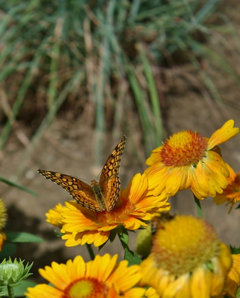
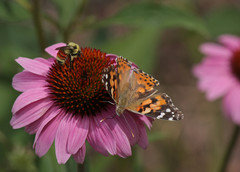
    Less common are butterflies, I see swallowtails gliding about, but they never want to land, and cabbage whites and sulphers flitzing erratically never stopping long enough for a decent picture. I have a couple pictures of skipper butterflies, but I can't find them right now. These are the only ones I have handy, a fritillary that I saw last year and this year a painted lady stopped by.

    (Speyeria spp. probably S. cybele, the great spangled fritillary)

    (Vanessa cardui with Bombus spp.)

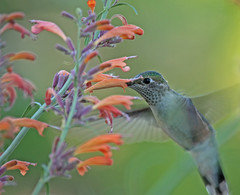
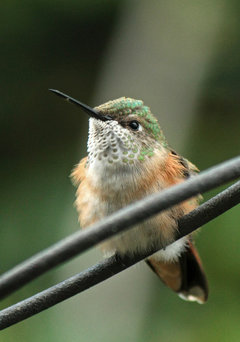
    While I was out getting some pictures of the squash bees this morning another neat pollinator showed up for her breakfast. We have only ever had ONE despite having a couple feeders and a garden full of flowers for them. Then yesterday 1-2 more showed up and she chases them off. She could take a lesson from that painted lady and bumble bee, sharing is caring.

    Broad tailed hummingbirds, which is what show up at the house, are the most common here on the Front Range. Every once in a while we'll get a rufous on this side of the divide and one of the rangers at the park last year got a really nice picture of one.

    At the house, they love agastache, salvias, zauschnaria, penstemons of all kinds, and the red Monarda.

    (Selasphorus platycercus)

    Looking at the pictures though, our "regular" may be a rufous, here she is below from a couple weeks ago. That might be why she is so feisty and chases the others off... I don't know, the females of both species are almost identical.
    (Selasphorus rufus?)

  • 10 years ago

    Outstanding post, Zach. And for the record, I was mentioning EMF and other radiation types as pure conjecture, but meanwhile, the habitat loss that you so eloquently speak of is assuredly an ongoing disaster to nature......and all the organisms contained therein, including man.

    Quite a nice treatment of the bees in your yard. And those feathered ones too!

  • 10 years ago
    last modified: 10 years ago
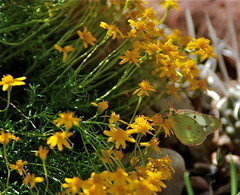
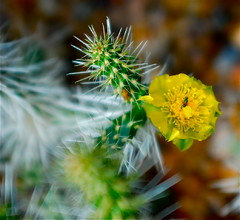
    Those are wonderful pictures Zach. I see several native bees around here along with honey bees. I'm not really familiar with types of bees so I googled native bees to take a look.

    This metallic green one is Augochlora Sweat Bee. I usually see lots of them when the cactus bloom May-June.

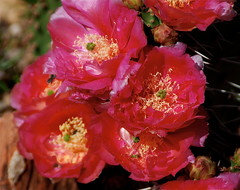
    Below is another sweat bee and a honey bee on cactus flowers which are always heavily loaded with pollen.

    That is an interesting comment about native plants attracting more native bees. I'm going to keep that in mind while observing in future. I do see honey bees on native plants but they are heaviest on Russian Sage in my yard. They do love Datura, I couldn't help noticing that.

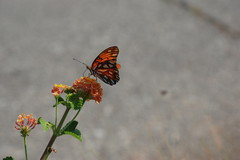
    This year I have not seen a single hawk Moth which is very unusual. Seems like even the Skippers are down. I've seen only one swallowtail so far. Its getting close to the time to start seeing the Gulf Fritillary, most years they are fairly plentiful.

    Another thing I've noticed that you can add to your scientific observations is the condition of car windshields and front grills. If anyone needs proof of insects being down, just compare how it looks after a trip going 70 MPH today compared to how it would have looked years ago. Back in the day when we were kids one of the things we liked to do was study the mess on the grill, sounds awful but I do remember there was hardly a spot left clean after any trip. Seems my dad was always having to clean the windshield off and that was back when there were gas station attendants who scrubbed it clean at every fill-up. I've noticed driving here in the 'metroplex' at 70 MPH going 30 or 40 miles in any direction, the windshield is still clean by the end of the trip, nothing like back in the days of caked on bugs and windshield splats. The windshield tells the story. Add that bit of observation to the lack of numbers and varieties of flying insect at night around outdoor lights (another thing we liked to check out as kids because there was such a variety) and it hard to come up with any other conclusion than the numbers are way down.

    Gulf Fritillary from last year.

    A couple of Skippers


    Purple Prairie Clover is a favorite for both butterflies and bees.

    I remember hundreds of these sulfur types from when I was growing up. They are rare around here in OKC. Maybe you see them in smaller towns, I miss them more than any other type of butterfly.

    Spring of 2012 was a heavy year for butterflies, the first in years. People wondered why and some thought it was due to the severe drought which killed so many birds. Whatever the reason, it was a wonderful year to see them that spring, nothing has come close in a long long time. I shot this that spring. I think its the best butterfly shot I ever took.

  • 10 years ago

    Agree totally with the "windshield surveys" Where are all the insects?

  • 10 years ago
    last modified: 10 years ago
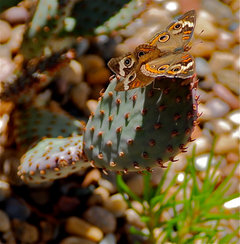
    Herbicides and insecticides?

  • 10 years ago


    Well, I think we can all agree that herbicides and insecticides are likely playing a role. But their presence is not a new thing. True, new products are always coming along, and in most cases, that is a result of attempting to solve some problem with older chemistries. It just seems we've crossed some threshold recently, a new paradigm of drastically fewer insects generally.

    It could be that the very factors which have been in play for decades now, are finally reaching a point where the results are plain to be seen.


  • 10 years ago

    Researcher sees end to 'summer of no butterflies'

    I did finally see a couple of what appeared to be indigo duskywing skippers this morning, on the Baptisia in the hell strip, plus a sulphur (perhaps clouded sulphur) on the swamp milkweed. I have quite a bit of partridge pea that I've let seed around and have seen sulphurs on them before.

    Hopefully a sign of things to come. I think the main monarch wave that came through last year was in mid-August to early September.


  • 10 years ago

    Wow! So many wonderful photos! My sun plants were really suffering from extremely high temps and no rain for many weeks, but we finally had some rain, and those tough plants perked up.

  • 10 years ago

    I've finally started seeing monarchs this past week, mostly on the Asclepias incarnata (swamp milkweed), though I did see one briefly visiting Salvia azurea. Aside from that it's still pretty much been cabbage whites and the tiny blues.

  • 10 years ago

    I saw a the first monarch this weekend too, just one so far but I've been indoors trying to get this job out so I'm not watching as close as usual. I'm starting to see some Gulf Fritillary's, they always show up about this time of year. I saw a black Swallowtail which just did a quick check fly over and a little brown one that was flying too fast to see what it was. There are still no bugs around the outdoor lights at night. Its disturbing, usually they are enough of a nuisance when we open the door, part of the swarm fly into the house, its so bad we unscrew the bulbs but there are literally none this year, its just like in winter when the bugs are gone.

    I've seen two Preying Mantis.

  • 10 years ago

    Well I have two mature asclepias waiting for eggs. I have enough passionflower to welcome lots of Gulf Frits too.

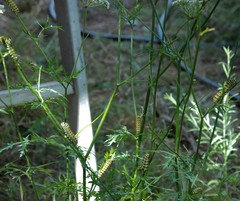
    I have some swallowtail caterpillars on fennel (planted for that purpose)...as of last week, they're growing and I hope I have enough fennel to mature them.


    It's been a very butterfly free year :(

  • 10 years ago

    I am putting out a whole bunch of rooted Ageratina havenense for the migration but it will be a couple of years before they are of mass for the flying mass. And the Daucosmo lacsiniata ( a native QAL look alike) is doing its job. One of them got totally inundated but came back and bloomed from the joints after being gobbled in a feast and managed to seed. I was worried there for a bit that I would not have any seed for next year.


    AND @ Zac, God I know about this "environmentalism". One guy here is so proud of his totally "GREEN" built 15,000 sq' mansion with a 1 acre leaky manmade lake on top of a limestone hill filled with shipped in water and water from the sinking Edwards Aquifer. Did I mention the 5 acres of constantly watered Saint Augustine and no wild plantings. I have tried to talk to them about it (in a pleasant voice). What is sad is he is one out of many of the blind wealthy moving into these hills. Each one has the ability and purse to do a lot of damage. A tiny house insulated with newspaper and heated with an open gas stove is greener. Let's see, Lan ce Arm-strong diverting a major tributary to a watershed and sinkhole, then making a huge slanted , smooth lawn out of pocketed brambly cedar brake and wondered why the neighbors sued him when 5' of silt plundered their stream and sinkhole. Then there is the wind power huge slaughter of birds.... I could go on too. The ones in Hawaii are rust buckets. huge wastes of money that are hardly ever actually working..

  • 10 years ago
    last modified: 10 years ago
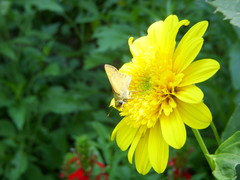
    Strange you guys have been seeing monarchs just now when we here in Colorado... well, I here in Colorado... saw the first one quite a while ago. They do seem to have picked up in frequency about two weeks ago when I was rolling out some fencing at work I saw several. Monarch butterflies are not exactly common here anyways, were not on their major migration route.

    We have a couple kinds of milkweed, but "showy" is the most common here on the Front Range, and that's what they seem to prefer.

    Swallowtails are much more regular, but are not interested at all in my parsley or dill which I intentionally leave open to them. I wonder if they utilize hemlock at all? We certainly have a lot of that around...

Sponsored
More Discussions