

Dreary Summer TV?
11 years ago
last modified: 11 years ago
Featured Answer
Sort by:Oldest
Comments (10)
 11 years ago
Related Discussions
Strange Acting TV
Comments (15)While the television tuner can become intermittent and/or fail, it really is somewhat rare. I highly recommend connecting your television to your husbands coax feed to see if the problem is still there - just part of the basic troubleshooting process. If it gone you know the television is OK and it is a signal issue. As far as who to call, there is not a simply answer anymore. Cable companies used to wired the cable to multiple rooms for you. Now they have typically taken the telephone company approach of a demarcation point at your house where their line responsibility ends on the outside of your home and your responsibility begins. Since your husband's television is working OK, and I'm suspecting your television will work OK on his coax feed - the problem is then on your side of the demarcation point - or simply the wiring which is your responsibility. That should be something your "local TV guy" should be able to address. One possible reason why the problem may occur more on commercials is that local ads are inserted into the network program stream and slight variations in the signal may occur....See MoreA few blooms for these dreary winter days. (part 1)
Comments (5)Here's part 2. Next is a series of poinsettias. All are naturally rebloomed. I have tried to induce blooming, but it was trying and the results were not as good as these. Yes, I understand the flowers are different from the modified leaves (which I am describing). Some of these are new and some a few years old. A white irregular flower type. A hot pink, irregularly margined type. I think this one also has some subtle variegation, but has not showed it much this year. This one is a beautiful blaze orange, but the camera does it no justice. The leaves are also thinner than normal. It also is growing in a nice weeping form due to some mishandling when young. Last one is a red and cream chimera type. Red with specks or half and half. OK. I'm out of blooms, but here are some more nice pics. Two fruiting type bananas that seem to not mind being inside. In gallon pots. First is a dwarf type and second is a red type. Next is a white-margined Japanese aralia. Gorgeous. Oh, I missed a hibiscus. This one is a stunner. Hibiscus schizopetalus. I never expected this one to bloom this early. Very fast grower. Pendulous, very divided and frilled petals. One of my most favorites. Ok. I swear. This is the last one. New growth from one of my lychee plants. One full year of growth after starting from seed last fall. A great choice for a houseplant. The two differently colored leaves are from the same plant. They are in two different stages of maturity. Thanks for looking and hope you enjoyed....See MoreSouthern Hemisphere Rose Growers: Post Some Pics! It's Dreary Here! :)
Comments (17)oops, I haven't been posting this week, so I missed this! I smiled when I saw your pic, Nanadoll, cos it kind of looks like the nature strip in front of the house here..(I think you call it the "hell strip") before it gets mowed- ie mostly dead..too expensive to keep watering it in summer! Ohh I've got Grimaldi too, Daisy! usually a good flowerer in spite of the heat, but mines been off its game badly this summer- badly needs repotting... Your arrangements are lovely! I got very disappointed- my favourite Mary Magdalene was just about to go into a full flush- the sepals dropped- then it got baked, then we had all that rain, then it got baked again- result; bush covered in little crunchy paper brown buds that will never open, sigh Anyways, it seems to be cooling down now, so the roses are coming back to life; I have a few pics, but nothings up loaded yet....See MoreStory time: How long does a Samsung TV last?
Comments (29)Wow, what a bunch of mis-information in a single comment. I normally would leave it at this, but I don't want people to search the archives and get confused. A plasma TV's temperature is not an indication of lower energy efficiency. Temperature isn't an indicator of energy efficiency, but heat output very much. Any energy consumed by the device has to be released somehow, either as mechanical energy (not applicable for a device that doesn't have a motor), as light energy (a smaller percentage, even for a TV), or as heat (the bulk of the energy). As this is hard to quantify, I looked at watts/h instead. That's the definition of energy efficiency. And with the exception of really small screen sizes, plasma TVs are consistently a lot more wasteful than any modern technology. [ Lots of hand-wavy vague discussions how TVs are complicated. ] If anything, the reverse is probably true. Older TVs had tons and tons of discreet parts, whereas modern TVs are highly integrated and frequently only have a very small number of highly integrated components. This has been a general trend and explains why TVs can be built so much cheaper today. Just to put this into perspective, if you look at the size of a settop box from only about 15-20 years ago, it was the size of a small shoe box, and it probably cost on the order of $100. Today, the equivalent device is the size of a USB stick and costs on the order of $20 -- and it probably does a lot more, too. You'd observe the same thing, if you opened up a modern TV. Very little electronics that are left in there. I have a hard time finding a tear-down of a modern TV, as it simply is so boring that nobody wants to document it. But here is one for a 4 year old model: https://www.ifixit.com/Teardown/Changhong+UD42YC5500UA+4K+42-Inch+LED+LCD+TV+Teardown/64167 Notice how little there is to making a TV. [ Statements equating weight with quality. ] The bulk of the weight of a plasma TV came from the insanely heavy front glass panel that is needed to build all the plasma cells. That simply isn't necessary with LCD or OLED technology and explains both the smaller depth and the much reduced weight. And while weight isn't really an indicator of quality, being lightweight is a real advantage for many consumers. A modern TV can easily be hung on the wall, but a plasma TV is almost impossible to mount that way. That also partially explains why larger format plasma TVs never took off in the market. Nobody would be able to carry a 90" plasma TV without hiring professional movers. [ Then OLED and QLED came along and completely solved that problem by using multiple different layers of TV panels within a single TV panel. ] What a bunch of crock! There is no such thing as multiple layers of panels. A plasma TV had an array of pixels that had alternating colors of phospors in front of each adjacent plasma cell. A LCD (that includes QLED) panel has a white backlight and alternating color filters in front of each adjacent LCD pixel. An OLED display has alternating colors of adjacent organic LEDs. Do you notice a pattern? Exactly! It's all a similar design of differently colored pixels right next to each other. But some of these pixels are more efficient than others. OLED are by far the best approach, but they are costly to manufacture. LCD is cheap to manufacture at scale, is lightweight and very thin, and color quality is close enough when using a good backlight and good color filters. This is where QLED comes into the picture. The idea of FullHD is an illusion. The human eye cannot process the colors that "FullHD" purports to put out onto a TV screen. I really hope that was a typo. FullHD has absolutely nothing to do with colors. But yes, there are difference in color gamut and in dynamic range. Historically, that was one of the areas where plasma had a distinct advantage. It used to have a much better dynamic range than LCD technology, only OLED was equivalent (or better). But OLED didn't really exist as a viable consumer product at that time. Color gamut is the big elephant in the room though. Traditional standard definition TV has a really narrow color range, and that's really noticeable when compared to film. These days, you can get a similar visual experience, if your TV is HDR capable, and if the source material includes the necessary information. In general, this is only available for 4k-enabled systems. So, independent of resolution, 4k does bring important picture improvements. And even if you no longer have 20/20 vision, most people will easily be able to tell the difference between standard and high dynamic range. All of a sudden, details in dark scenes are possible to be made out without washing out bright spots in the same scene. A good starting point to learn more about high dynamic range and color gamut is https://en.wikipedia.org/wiki/High-dynamic-range_video Make sure to click on the links though. There is a lot more information hidden on Wikipedia that is relevant to this topic. The human eye can only process at most, 480p It should be self-evident that this statement is obviously incorrect. The human eye doesn't have a fixed resolution in pixels. It does have a limit though as to what the smallest detail is that it can discern. This means, the closer you sit to the screen the more pixel you can discern. But nobody sits a foot away from their screen. In fact, because of our limited field of vision, there are guidelines how far away you should sit given a particular screen size. In practice, many people sit back a little more than the optimal distance. The average distance from the screen in the US is about 9 feet. For people with normal 20/20 vision and with a normal ~50" screen, that means that can easily distinguish between 480 scan lines, 720 scan lines, and even 1080 scan lines. But most of us wouldn't be able to tell the difference of 2160 scan lines in a 4k image. But don't take my word for it. Have a look at this very informative Wikipedia article: https://en.wikipedia.org/wiki/Optimum_HDTV_viewing_distance...See More 11 years ago
- 11 years ago
- 11 years ago
- 11 years ago
 11 years ago
 11 years ago
 11 years ago
- 11 years ago

Related Stories
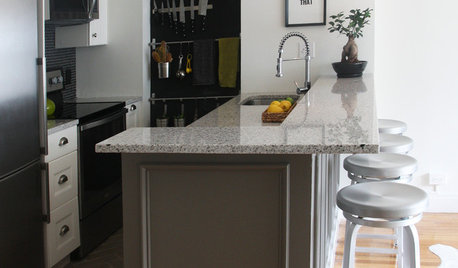
BEFORE AND AFTERSA Boston Kitchen and Bath Go From Dreary to Darling
See how a $25,000 renovation budget gave 2 outdated spaces in a small Massachusetts apartment a brand-new look
Full Story
SMALL HOMESMy Houzz: The Antidote to Dreariness, in One Small Brooklyn Apartment
1. Stir spirited colors together. 2. Sprinkle in playful decor. 3. Top off with the striking creativity of the gifted artist who lives there
Full Story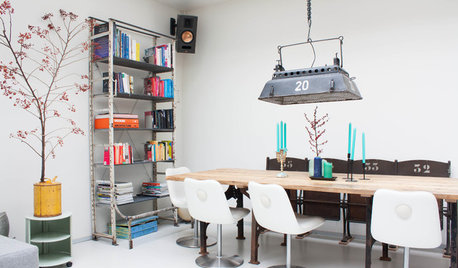
HOUZZ TOURSMy Houzz: From Dreary Storeroom to Modern, Light-Filled Home
Tricks with light and space turn a former storage area into a bright and airy-feeling living space for two
Full Story
WORLD OF DESIGNHouzz TV: Dream Summer Scenes Around the World
Take an instant vacation through a roving postcard of homes and landscapes around the globe
Full Story
TRADITIONAL STYLEHouzz Tour: Classic Shingle Style for a Seaside Summer Home
Mixing traditional and coastal casual, this new Rhode Island home welcomes extended family with ease
Full Story
PRODUCT PICKSGuest Picks: Outdoor Summer Fun for the Kids
Set out these tents, swings and other playtime goodies and watch the kids flock outside
Full Story
DECORATING GUIDESSo Your Style Is ... ‘Wet Hot American Summer’
11 ways to bring nostalgic early-’80s camp fun to your home
Full Story
LIFEHouzz Call: Where (and What) Are You Reading This Summer?
Whether you favor contemporary, classic or beach reads, do the long and lazy days of summer bring out the lit lover in you?
Full Story
ENTERTAININGHow to Welcome Summer Weekend Guests
Thoughtful touches and smart planning will help make your visitors feel at home
Full Story
ORGANIZING20 Great Storage Spots for Summer Gear
From bulky surfboards to small sand toys, your summer stuff will all find a neat and accessible home with these ideas
Full Story
chisue