

Irrigation controller queries
14 years ago
Featured Answer
Sort by:Oldest
Comments (9)
 13 years ago
- PRO11 years ago
Related Discussions
How much should the temperature of irrigation water controlled?
Comments (12)Hello, Has anyone gained any insight on this topic over the past year? I'm trying to figure out how to set things up for the season and would like to move many of the containers off of the deck and out to the edge of the yard. The containers are multiplying so rapidly that space on the deck is becoming limited. Last year the routine was to add the fertilizer concentrate to the watering can, fill it inside with tepid water, carry it out to the deck and water, then repeat as needed until all the plants are happy. The new location will be on the other side of the yard, which is too far to keep running back to the house to fill the 2 gal. watering can. I'm considering getting an EZ-Flo fertilizer injector which feeds into the hose bib. Then 150 ft. of hose (I still have to measure that to make sure) and a watering wand should do the trick (can anyone recommend a good watering wand?). The plants are primarily conifers, maples, and chile peppers, and my concern is the water temp. As others have noted , water from the hose bib is cold even in the summer - will this have implications on the plants' vitality? I'm especially concerned for the peppers. Plan B is to get a reservoir (probably a garbage can, but it could be a rain barrel), install a hose bib near the bottom, and place this in a shaded location near the plants. I envision sitting the reservoir on a table for ease of accessibility. I might have to fill a watering can, I don't know if it would generate the pressure to use a watering wand. Fill the reservoir with water and in a day or so I'll have a source of water at ambient temperature. Ideally, one could add fertilizer concentrate to the can, but in practice though, the can doesn't have a tight lid, and evaporation will result in concentration of the contents. On the other hand, there's an adapter you can get for the fertilizer injector to allow it to function in low flow applications (think drip), and that might be applicable. Plan B requires somewhat more work, but does not have the cold water liability. Also, what with the reservoir up on a table, I wonder what will happen when that big storm rolls through. I'll make a decision soon so I that can buy what I need. I'd be really interested in any additional info on use of cold water in the summer. Also, I'd love any feedback on Plan A or Plan B, or any other alternatives. Alex...See MoreLightning strike fries irrigation controller
Comments (12)Codes say that CATV, dish, OTA antenna, and phone installers must use the single point earth ground. Same ground also used by AC electric. Unfortunately this does not happen for many reasons. For example, technicians do not even know what impedance is; therefore do not appreciate the importance of that earth ground and a short as possible hardwire that is not inside metallic conduit. One cable installer literally routed his ground wire to dirt in a porch flower box. Two Comcast installers, who had just come from a lecture, were drinking coffee. As I explains this stuff, one would turn to the other and say, "So that is what they were saying." Installers had assumed, for example, that a coax wire into a second floor could go straight in. And its ground wire routed two plus stories down to the earth ground. If not obvious (due to impedance), that coax must first route down near the earth ground before rising back up to enter the second floor. TV cable has best protection by connecting directly to earth. Other incoming wires must connect via a protector. A commodity called a 'whole house' protector is easy and obvious. Simply go to any big box hardware store or electrical supply house and ask for their 'whole house' protector. That is consumer level (TVSS, arrester, SPD, surge protector) protection. Every effective protector has a dedicated wire for that low impedance (ie less than 10 foot) connection to earth. Not wall receptacle safety ground - earth. Since a typical surge (ie lightning) can be 20,000 amps, then a minimal 'whole house' protector is 50,000 amps. What else must one know? What can best fit in a breaker box or meter pan? An honest recommendation is defined by specifications. What else would anyone need? All numbers are layman simple. 50,000 amps defines a protector's life expectancy over many decades and multiple surges. That low impedance (ie hardwire has no sharp bends) connection to and quality of earth ground defines protector effectiveness during each surge. Ethernet ports already have robust protection (typically rated at 2000 volts). A protector at each port is ineffective. It obviously has no low impedance connection to earth. If an ethernet wire leaves / enters a structure, then an ethernet protector with that dedicated (often green) ground wire must also connect low impedance (ie less than 10 feet) to the single point earth ground - at that service entrance. Ethernet wires inside a building need no protection. Because effective protection means no surge current inside. Nothing based in science and numbers disputes that. Experience says nothing if one did not / cannot trace a surge to locate a reason for failure. No damage to one appliance protected by a plug-in protector says anything useful. Also called cherry picking - a classic example of junk science reasoning. One can only say that protector was effective if every other appliances is destroyed - without exception. How did so many less robust appliances without a protector survive? What protected a dishwasher, door bell, furnace, every GFCI, refrigerator, LED & CFL bulbs, vacuum cleaner, dimmer switches, microwave, clocks, garage door opener, central air, and every smoke detector? Were those protected by invisible protectors? If not, then a conclusion was made by 'cherry picking'. Ignoring every example that contradicts that observation. Nobody can honestly say a plug-in protector did protection using observation. But we traced damage by literally replacing every IC. By restoring all electronics that never failed again. What did we learn? In one classic example, plug-in protectors compromised (bypassed) superior protection inside all powered off computers on a network. A few plug-in protectors destructively earthed a surge through all powered off computers on that network. One excellent outgoing path was a phone line via another computer's modem. And yes, we even repaired that modem - it never failed again. So yes, adjacent (plug-in) protectors can even make surge damage easier. We did not use observation or cherry picking. And our conclusions were also confirmed by numbers from datasheets. Martzloff, in his first conclusion in his 1994 IEEE paper, defines quite bluntly what 'point of connection' protectors can do. Conclusion: 1) Quantitative measurements in the Upside-Down house clearly show objectionable difference in reference voltages. These occur even when or perhaps because, surge protective devices are present at the point of connection of appliances. More. Observation defined in an IEEE brochure notes an attached TV was not damaged. That protector did not earth a surge destructively through its attached TV. Instead, is earthed that surge 8000 volts destructively through a TV in the next room. IEEE even gives a number - 8000 volts. Another example of why observation (without learning facts and numbers) results in junk science conclusions. Facts (and experience) says a plug-in protector can even cause damage to other nearby appliances. A plug-in (point of connection) protector should never be used without a properly earthed 'whole house' protector. An IEEE Standard defines how much protection - more numbers. A properly earthed 'whole house' solution does 99.5% to 99.9% protection. So yes, even a 'whole house' protector is not perfect. Meaning a plug-in protector might do another 0.2% protection - while costing tens or 100 times more money per appliance. IEEE then says Still, a 99.5% protection level will reduce the incidence of direct strokes from one stroke per 30 years ... to one stroke per 6000 years ... Protection at 99.5% is the practical choice. Any recommendation without perspective (numbers) is best treated as a despicable lie. Show me any science or spec numbers that justifies a plug-in protector? Good luck. Even its manufacturers do not make that claim. Conclusion only from observation is classic junk science. One said he had no damage for three years. Fine. Potentially destructive surges occur maybe once every seven years. Another number that exposes junk science reasoning. Effective protection always answers this question. Where do hundreds of thousands of joules harmlessly dissipate? Answer, that applies to every protector, is obvious and simple. A protector is only as effective as its earth ground. I can easily double number of reasons for that conclusion - with specifications and citations. Hearsay, wild speculation, advertising, and subjective reasoning never create an honest recommendation. Did this stuff for quite a few decades. Too long to be scammed by products from APC, Belkin, Tripplite, Panamax, Furman, and Monster. Informed consumers buy products from other companies known by any guy for integrity. How many more reasons does one need to ignore soundbyte lies - and learn from over 100 years of well proven science. A protector is only as effective as its earth ground. OP asked, "Does anyone have any experience". Yes....See MoreIrrigation Control Valve Box Exploded?
Comments (1)Hard to say as the link you provided to the photo is broken. You could try to attach it directly to your post....See MoreIrrigation/Misting Controller Recommendation
Comments (0)I’m looking for a recommendation for an irrigation/misting controller. I have a small (12’ x 16’) greenhouse that I would like to automate for a small amount of propagation as well as general misting and watering. The irrigation part is easy. It’s incorporating the propagation misting (e.g. between 9am and 5pm, mist for 20 seconds every 60 minutes). Ideally I figured one unit would be best (one plug, one controller to learn) and I’ve found a few (Galcon, Phytotronics, etc.) that have combined units. Or is it better to just get two units? I would probably be ok with 6 stations. I would rather pay up for better quality, but my needs are pretty basic. While I’m asking, if anyone has a recommendation for a vendor that was particularly good at helping with a project like this, I would like to know. Thanks!...See More- 9 years agolast modified: 9 years ago
- 9 years ago
- 9 years agolast modified: 9 years ago
- 9 years ago
- 9 years ago
- 9 years ago
Related Stories
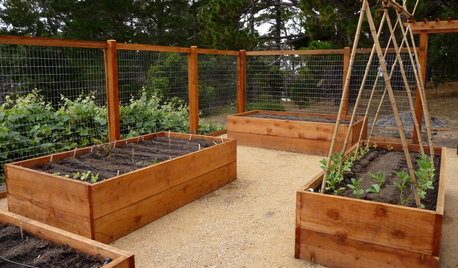
GARDENING GUIDESHow to Install a Drip Irrigation System
Save time and water with a drip watering system in your vegetable garden — a little patience now will pay off later
Full Story
GREEN BUILDINGHow to Harvest Rainwater for Your Garden
Conserve a vital resource and save money by collecting stormwater for irrigation in a barrel or tank
Full Story
MONTHLY HOME CHECKLISTSTo-Dos: Your April Home Checklist
Kick spring cleaning into high gear, and troubleshoot cooling and irrigation systems for the warmer months ahead
Full Story
LANDSCAPE DESIGNEasy Ways to Manage Stormwater for Lower Bills and a Healthier Earth
Send cleaner runoff into local waterways and spend less on yard irrigation with these simple landscaping approaches
Full Story
EARTH DAYGrow a Beautiful Garden With Ecofriendly Greywater
Reducing home water waste means lower bills and a healthier planet. Here's how to set up a greywater home irrigation system that can help
Full Story
SAVING WATER6 Reasons Why You Should Save Your Rainwater Now
Collect and store during the rainy season so you’ll have water ready for irrigation when you need it
Full Story
GARDENING GUIDESTexas Gardener: What to Do in July
Beat the heat with sun-loving blooms, pest control, good lawn care and sun protection. Pick up the pace for planting and planning
Full Story
GREEN BUILDINGBuilding Green: How to Design a Healthier Landscape
Plant selection, water management, fire-prevention measures and more can ensure that your landscape is good for the planet and for you
Full Story
GARDENING GUIDESSouthwest Gardener's April Checklist
Welcome the return of roses and herbs, and consider a new use for vines as you rejoice in your newly green spring garden
Full Story
GARDENING GUIDESSouthwest Gardener's August Checklist
Manage monsoon effects, remember to fertilize and don't let the heat deter you from planting for fall
Full StorySponsored
southpark