

pump keeps stopping when trying to fill gas tank
17 years ago
Featured Answer
Sort by:Oldest
Comments (12)
 17 years ago
- 17 years ago
Related Discussions
pump stopped
Comments (5)Do a partial water change and then let put a hose mist on the water. Can you also shade the pond or at least part of it with a tarp on poles (don't cover the water directly) to keep out heat from the sun. The warmer the water the less oxygen it holds. Ditto - replace the pump and agitate the water with something else right away. Fish can be revived by forcing water through their gills. Do this by moving them back and forth in the water (holding on to their tail) until they recover. If you don't do this and they are belly up but alive they WILL die as they cannot get enough oxygen through their gills themselves at this point. I reserected a fish that was out of a fish tank and had no color by doing the above (partial water change and moving it back and forth (for 3 hours)....See More18.5 hp Briggs with tank above....can I disconnect fuel pump
Comments (14)***"replaced needle and seat but its still happening.....even tho I have a fuel shutoff installed"*** OK, I refer to the last sentence in the post above: "even tho I have a fuel shutoff installed". In that statement, are you saying that you actually installed an inline, manually operated.........fuel shutoff valve? Or are you saying that the carburetor HAS a fuel shutoff valve already incorporated into it? If you mean that you installed an "inline fuel shutoff valve", and the crankcase continues to be filling with gasoline.............then you are either NOT shutting off the valve.............or the valve itself is defective..............or (least likely) you installed the valve between the pump and the carb, and a defective pump is leaking gas into the crankcase. Proper placement of an inline shutoff valve is somewhere between the fuel tank and the fuel filter (this placement also allows for easier replacement of fuel filter in the future). Now, if you meant that the carburetor already has a fuel shutoff valve in it.......................you have fallen into the trap of thinking the device is a "total fuel shutoff valve" along with many other people. The fuel solenoid valve (on carburetors so equipped) DOES NOT shut off all fuel. It only shuts off fuel to the MAIN JET, the pilot or idle jet can still pass a very small volume of fuel............and this small volume of fuel flow will still "drown" an engine crankcase in fuel while the machine is not running....if there is a defect in the needle and seat components. The fuel solenoid is actually called an "anti-afterfire" solenoid valve and its sole purpose is to minimize the occurrence loud backfire bang out the exhaust when shutting down the engine....See MoreNew ROTH tank and burner keeps shutting off`
Comments (16)I have installed a Roth 275 gallon oil tank a few years ago, and have had numerous problems with this tank especially when the tank gets below 100 gallons. I had a oil fired furnace and a Toyotomi on demand water heater which does not have it's own oil pump. Sometimes they would shut down. I just removed my oil fired furnace and replaced it with a high effiecent LP gas fired hot air furnace. Now I have no hot water, because the Toyotomi will not run, because the Roth tank will not gravity feed. I have repiped to only supply the Toyotomi water heater. And no luck trying to get the burner to run, because there is no oil to it. I don't want to have to install a seperate oil pump for this Toyotomi water heater. These Roth tanks are not good for all systems. Any help from others ?...See Morewater wars! constant pump vs pressure tank?
Comments (13)Hi Sparky823, your questions are valid, I will try and explain, as best I can. 1. I can drill a well on my own land, but water law would then expose me to lawsuits from neighbors with shallow wells. They could claim I dried up their wells even if their wells have been dry for decades. They may even be waiting for me to do it so they can cash-in on the lawsuit. There is no way to prove either way, of course, but legal precedent in these matters is on their side. Besides, this is a small community and if I alienate someone, I am gonna have to live with them for a very long time and living in a neighborhood where people hate you is the pitts. Soon someone will buy one of their houses and maybe join us non-well-owners side and the balance of power will have shifted. But this is Santa Barbara, and even a piss-poor shack in the woods goes for $2million nowadays so it may be a while. 2.They have wells because their houses were built before mine long ago and my house was probably a guest house or something. There are about 6 houses with shallow wells and 6 without. These wells are shallow, dry or drying, and contaminated but allow the owners of those properties to not have to pay anything for the sketchy water system, even though everyone knows they use the same water from the spring as the rest of us. Those of us who do not have wells pay $25/house/month + $15/person/month for upkeep of the existing water system, such as it is. And who controls the sketchy water system? You guessed it, the shallow well owners! So they are making bank off it to boot. I cant do anything about it, water wars are the history of California and it wont change. So when water is trucked in, they want 1st dibs on it even though us non-well owners are who is paying for it. Its not fair and I may, as I said, go to war over it; but I have only lived here for 7years and some of these bastards have been here for 70+years. I think I can just wait em out, but every year I get angrier. I may drill a deep water well (6-800 feet) if I could hide the operation in my basement or something, but I doubt that its feasible, and I obviously dont know how to drill wells. So they claim they are living off their wells and dont want to lose their "freedom"; and for now I am trying to "get along". But I will not put up with this nonsense much longer and will appeal to the state health board or some government agency to override them if water still runs out....See More- 17 years ago
 17 years ago
- 15 years ago
- 11 years ago
- 11 years ago
 11 years ago
- 11 years ago
 8 years ago
- 5 years ago
Related Stories
MOST POPULARThanksgiving Tales: When the Turkey Tanks
Houzz readers prove adept at snatching victory from the jaws of entertaining defeat
Full Story
LAWN ALTERNATIVESStop Fighting the Patchy Lawn!
Here are 3 situations where a garden may be a better idea than more turfgrass
Full Story
CONTRACTOR TIPSBuilding Permits: When a Permit Is Required and When It's Not
In this article, the first in a series exploring permit processes and requirements, learn why and when you might need one
Full Story
HOUSEKEEPING10 Problems Your House May Be Trying to Show You
Ignore some of these signs and you may end up with major issues. We tell you which are normal and which are cause for concern
Full Story
VINTAGE STYLEVintage Style: High-Tank Toilets
Homeowners are adding the feeling of yesteryear in today’s bathrooms
Full Story
REMODELING GUIDES5 Ways to Protect Yourself When Buying a Fixer-Upper
Hidden hazards can derail your dream of scoring a great deal. Before you plunk down any cash, sit down with this
Full Story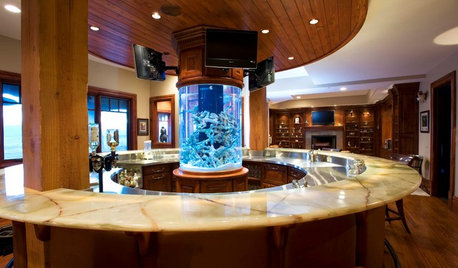
DECORATING GUIDESDesigning Nemo: 30 Fish Tanks Make a Decorative Splash
Bring an otherworldly glow and a calming vibe to your home with the living art of an aquarium
Full Story
KITCHEN DESIGNHow to Keep Your White Kitchen White
Sure, white kitchens are beautiful — when they’re sparkling clean. Here’s how to keep them that way
Full Story
DECORATING GUIDES5 Decor Trends to Try — and 5 to Rethink
Some style trends are worth jumping onboard. Others you may want to let fade from your memory
Full Story
LIGHTINGWhat to Consider When Lighting Your Home
A designer offers a few illuminating insights on this key design element
Full Story
spankeeees