Houzz Logo Print
carolb_w_fl_coastal_9b

PSA - 10 most contaminated foods causing illnesses

Comments (65)

  • last year

    In answer to the question of how people survived in the past; they didn't.

  • last year
    last modified: last year

    A lot of times, the producer voluntarily re-tests and recalls products.

    Elmer, while reading your post, I was reminded that years ago a friend who often hikes alone (?Colorado) came across a whole patch of delicious looking watercress in either a stream or a pond. I believe she asked me if I thought it would be safe to eat. This was perhaps over 15 years ago, so my memory is not all that clear. But I believed I did a bit of research and learned (fuzzy part coming) thatif there is farmland or livestock such as cattle nearby, the watercress may be contaminated with some sort of parasite ?? liver flukes?

    I don’t think she ever ate any.


    ETA — Yes, I remembered correctly — liver flukes!

    And, now, to round out your reading before you sit down to a salad of foraged watercress from that stream downhill from the pasture, here is some scintillating information on liver flukes.


    ➡️ https://my.clevelandclinic.org/health/diseases/liver-fluke


    carolb_w_fl_coastal_9/10 thanked petalique
  • Related Discussions

    Sewage-contaminated vegetable garden -- help --

    Q

    Comments (35)
    My daughter called me this evening about her garden. Her peas are 7' tall and loaded with peas; her tomato plants are 4'tall and nearly as wide and loaded with tomatoes. The owner of the place just informed her the reason her garden is so lush is because she planted it over the septic tank. So she called me to ask if it will be safe to eat the foods she has planted? There is no leakage, no smell or odors; infact she had no idea it was even there until now. The question is: "Is it safe for her family to eat the foods in her garden?"
    ...See More

    The 6 Most Horrifying Lies The Food Industry is Feeding You

    Q

    Comments (50)
    Sally2, I went and checked my son's other allergies. Regarding the cobalt allergy, it's easy to avoid clothes that have rivets and metal zippers and when it's not avoidable you can cover the metal with clear nail polish. Toluene free, preferably. And I forgot to mention the BIG one that he's allergic too: Fragrance. Fragrance is not always listed as Fragrance, sometimes it is listed are Parfum. I don't know why the French spelling is in otherwise English language labelling, but there you are. As an aside, there are chemicals called Pthalates that are the carrier for the fragrances. Pthalates are bad for you, I think they are petrochemical based and carcinogenic too, you want to avoid them even if you aren't allergic. They are in most personal care and scented home products. For cleaning more often than not I used organic Dr. Bronner's with either the Peppermint or Tea Tree essential oil. You can even use this as a body wash and some people brush their teeth with it, it's that safe.
    ...See More

    I'll show you mine/you show me yours - Su 10/13/24

    Q

    Comments (19)
    We’re entering a period of extreme drought. No rain is forecast for the coming week. Some are saying for the rest of the month. Dry times like these cause Armadillos to seek out moist soil to forage for food. Last night it was one of our flower beds. Looks like someone ran a tiller through it.
    ...See More

    PSA: Butter Recall - Fecal Bacteria

    Q

    Comments (53)
    It is the fiduciary responsibility of managers and board members to look after the interests of the company and all the investors first. That is the standard in businesses with investors in this country. Pretty straight forward stuff and too many managers seem to think that cutting corners does just that. Also lying to the public as RJ Reynolds did for so many years as they killed millions of people with their product that they had ample evidence would do so. Opiods are another example. Millions dead and they knew it was maddly addictive. Oh well. I agree that this is all tiresome. You never know when you arent going to be allowed an opinion by Elmer. I do not question the verasity of Elmer but I do feel moved to occasionally point out that if I cant quote an internt source per Elmer then why does he get to. We would have precious few conversations if no one but Elmer was allowed to look things up for verification. I routinely do that just to be sure my memory is accurate, or not. People stop posting and I feel responsible but what would be the point if the only opinion was Elmers? I have an opinion as well. Elmer wants to tell me what sort of weather I am allowed to like. When do I get to stop being polite about it. This is I think worth discussing at this table but that is just my opinion and I am ready to hear other people say it is not something they want to talk about. patriciae
    ...See More
  • last year

    " In answer to the question of how people survived in the past; they didn't. "

    True in many respects.

    On the topic of the health dangers of contaminated water, cholera epidemics occurred repeatedly in cities (at least in Europe) until the mid-19th century. Which was when its cause was discovered, and appropriate countermeasures could be taken.

    An enjoyable non-fiction book on this topic, which also describes the beginnings of the field of epidemiology because of the book's tale of what happened during a cholera epidemic in London, is The Ghost Map by Steven Johnson

    carolb_w_fl_coastal_9/10 thanked Elmer J Fudd
  • last year

    Oh Elmer. While todays beer keeps in its cans and sealed bottles beer was made approximately monthly or depending on the size of the household even weekly. It did not keep. Grains kept properly would keep for years especially wheat. But that would not be normal except for keeping seed. The sour taste of pickled things comes from the fermentation of the starches in what ever was being pickled. Pickles which used to be made out of the most astonishing variety of things including young walnuts (the original basis for catsup) was mostly done with salt. That sort of pickling takes weeks. Pickled salads are not sprinkled with vinegar, they are soaked in it for an hour or more. Plus a properly made green salad is tossed in vinaigrette until it is coated. Vinegar changes the ph and will actually kill bacteria and even some virus. I was just musing on why we use salad dressing like we do. I am in the midst of rereading a favorite book on Medieval cooking which brought such things to mind. Young men used to pride themselves on making a salad which sounds strange. They might do the whole business at the table themselves blanching the greens in pans heated with charcoal, chopping the eggs, garnishing with the meats and dressing with the sauce of the day. The only vestiges of that left is the few men who know how to carve a turkey without touching the meat.

    I learned to preserve for the fun of it and made pickles and jellies and leaches and sweet meats, the super concentrated jam variety which are served sliced like meat. I had a good deal of time on my hands.

    Oh, and apple cider, made from the also ran apples and of course the invaluable crabs eventually turns into vinegar. We have our own cider press.


    pztriciae

    carolb_w_fl_coastal_9/10 thanked HU-279332973
  • last year
    last modified: last year

    Elmer wrote:

    <<An enjoyable non-fiction book on this topic, which also describes the beginnings of the field of epidemiology because of the book's tale of what happened during a cholera epidemic in London, is The Ghost Map by Steven Johnson>>

    Review

    ➡️ https://hbr.org/2007/03/the-ghost-map-by-steven-johnso

    Summary:

    ➡️ ♦️ removed see elmer’s caveat. I ordered a used copy as this sort of stuff fascinates me. Forensic epidemiology.

    carolb_w_fl_coastal_9/10 thanked petalique
  • PRO
    last year

    Medieval people absolutely ate greens. From the time spring starts to give chicory, dandelions, corn salad, miners lettuce, lambs quarters, good king henry, and more... till the last of the sorrel, kale, cabbage, cold hearty greens, and root veggie tops of the fall. Lots of other greens, cresses, and herbs during the warm months. Sculpit is another favorite here :) It was more common for greens to be cooked, fermented, or otherwise preserved rather than regularly eaten fresh. But some greens were eaten fresh too, once dressed properly. Vinegar can help inhibit or kill bacteria.

    Yes, they spread dung in their fields. Farmers still do it today. It's usually done in the fall after harvest. It has time to sit and lose its potentially harmful things by the time spring tilling came around. Usually in more recent times, when there is a fecal contamination, it's because of watering with contaminated water. Not from the fall application of dung.

    Also, they tended to utilize three field rotation a lot more than modern farms do. And in their strip gardens, they tended to spread out plots and help each other so that if one family plot did poorly, others can support that in that year. I just caught an interesting lecture on this. There was some great drama about plow development too, but that's getting rather off subject here.

    carolb_w_fl_coastal_9/10 thanked beesneeds
  • last year
    last modified: last year

    Rinsing the dirt is fine. Washing does nothing! If there is anything virus or bacterial in greens or fruit, it is inside, not on the surface.

    I prefer no chemical bug spray, but chemical fertilizer instead of manure.

    I think manure is fine, but I do not trust factory farms to do it correctly.

    carolb_w_fl_coastal_9/10 thanked Sherry8aNorthAL
  • last year

    I'll caution that anyone interested in reading the book should best avoid looking at the second link above, described as Summary. It indeed summarizes the book and has enough spoilers in it to ruin, in my view, the experience of reading the book.

    carolb_w_fl_coastal_9/10 thanked Elmer J Fudd
  • last year

    I will remove that link.

    carolb_w_fl_coastal_9/10 thanked petalique
  • last year

    No harm, no foul petalique (in the words of the great Chick Hearn, the former voice of the LA Lakers). It was just that the summary did indeed summarize the book in a way that would obviate any need or interest in reading it.

    carolb_w_fl_coastal_9/10 thanked Elmer J Fudd
  • last year

    I wasn’t paying close attention. sokay.

  • last year

    I recommend reading, not listening, to the Great Map. Listening to it while driving was fascinating but I had to give up because I kept wanting to look at a map, and look back at information provided earlier in the book.

    carolb_w_fl_coastal_9/10 thanked bpath
  • last year

    Carol, we are still here. (Btw, another interesting book is The Omnivore's Dilemma.)

    carolb_w_fl_coastal_9/10 thanked bpath
  • last year

    I think manure is fine, but I do not trust factory farms to do it correctly.


    There seem to be unforeseen dangers with the use of sewer sludge, too.

    carolb_w_fl_coastal_9/10 thanked lucillle
  • last year

    I don’t care how they pretty it up, I don’t want any sewer sludge product. People toss all sorts of stuff into toilets and drains.

  • last year

    If you want a little more than sludge to chew on, a number of areas here in the West have put processed water from sewage plants to use. In the south Bay, it’s used to water landscape features at commercial buildings, and also grass at parks and golf courses.Farther south, there’s one district that is injecting processed liquids from sewage treatment plants into the water table to be removed at a later date for use as municipal water. Still another water district is taking the processed water and putting it directly into the freshwater supply.

    carolb_w_fl_coastal_9/10 thanked Elmer J Fudd
  • last year

    Water treatment plants produce potable water?


    patriciae

    carolb_w_fl_coastal_9/10 thanked HU-279332973
  • last year

    Yes.

    carolb_w_fl_coastal_9/10 thanked Elmer J Fudd
  • last year

    I should mention that once it leaves the sewage treatment plant, it is subject to the same pre-treatment as water from more conventional sources before it’s put into the water mains. Not more and not less.

    carolb_w_fl_coastal_9/10 thanked Elmer J Fudd
  • last year
    last modified: last year

    Coincidentally, I just listened to this today - 1st segment is about Lake Michigan water use and 2nd segment is about recycling wastewater into drinking water...

    https://www.npr.org/2025/04/25/1247139357/here-now-anytime-04-25-2025

  • last year

    Not a question Elmer.

    When I was in college It was said the water served to you in New Orleans had been through at least six or seven people. I expect a few turtles and fish as well.


    patriciae

    carolb_w_fl_coastal_9/10 thanked HU-279332973
  • last year

    patricia, you said

    " Water treatment plants produce potable water? "

    I responded Yes.

    Then you said

    " Not a question Elmer. "


    Did I misunderstand?

    carolb_w_fl_coastal_9/10 thanked Elmer J Fudd
  • last year

    I had a college friend who excitedly took a job that started immediately after graduation. The job was located in New Orleans and so he moved there.

    He lasted 12 months before quitting. He found that living in New Orleans wasn't to his liking. The phrase he used was along the lines of "The Mississippi doesn't flow on its own through New Orleans. What it is, is that New Orleans sucks and that's why the water comes."

  • last year

    I too, think I had food poisoning. Who gets stomach flu in May? Didn't get it from grandkids. I think the culprit was out of date bagged salad (it looked ok) or deli meat. Doesn't last more than a day, but terribly sore muscles around ribs from the "action" . Horribly tired. I just don't bounce back like I used to.

    carolb_w_fl_coastal_9/10 thanked ladypat1
  • last year

    Elmer, I was making a joke with the "question"

    I am absolutely astonished your friend hated New Orleans but even more astonished you posted that here. His lack of being able to enjoy the relaxed ambience there has nothing to do with contaminated foods or water for that matter. I always thought of New Orleans as travel to a foreign country but the money didn't change.


    patriciae

    carolb_w_fl_coastal_9/10 thanked HU-279332973
  • last year

    I missed your facial expression suggesting your comment wasn't serious. Maybe try a smiley face.

    You mentioned New Orleans and I added to it. I'll say I've been there a few times (pre-Katrina) but even when it was perhaps at its best, I'll just say it wasn't to my liking either and it wasn't a close call.

    On to food poisoning -I've had it once. It was from a hot dog at a campus eatery. It seemed a bit off as I was eating it and about 4 hours later, I found myself sitting on the can, shaking uncontrollably, and producing outflow from two places, what a mess. About 8 hours of misery and perhaps a day or two to recover my strength. A miserable experience.

  • last year

    I believe listeria is the pathogen that's not checked by cold temperatures, and can continue to grow and multiply in refrigerated items.

  • last year

    I didnt know that about listeria. For years it didn't seem to register much with people and botulism and salmonella seemed to be the food poisons of choice. I know cold cuts are susceptible but didn't consider why.


    As an aside I hope people dont mind, Elmer mind sharing what you and your friend disliked about NO? Just wondering.

    I swear we will go right back on topic.


    patriciae


  • last year
    last modified: last year

    Unless you insist, I'd rather not provide fuel for those who like to pounce, which could happen if I mentioned specifics. I'll just say there were at least a handful of things I found shocking, off-putting and intolerable for a place that touted itself as a tourist/visitor destination. And little or nothing in the way of enticements or tempting positive things available to do to warrant a return visit. Both of my trips were business related but with several days during each spent doing touristy things. I came away with a very negative view. I had and declined later opportunities to go on someone else's nickel and decided I had no interest in making repeat visits on my own.

  • last year

    Thanks for the answer Elmer.


    Back to contaminated foods.

    Someone above mentioned contaminants being inside leaves and vegetables etc which made me wonder and low it is a heavily researched thing partly because of that huge outbreak of contaminated baby spinach several years ago. They learned that roots of spinach plants will uptake bacteria from the soil but it does not enter the spinach leaves that way. That research concluded that you would need to do separate research on each food. Carrots dont uptake bacteria. I had never considered it as a risk.

    Leaves do take in contaminants through the stomata, the pores on the leaves that let the leaves breath in and out though. Interesting.

    The CDC does consider vinegar to be a good disinfectant.


    patricia


  • last year
    last modified: last year

    How you mention the CDC is a bit of a red herring - misleading.

    Besides recommending that safe food handling procedures be followed - to include common sense, temperature control and caution with the "usual suspects", you seem to suggest indirectly that the CDC recommends actually "disinfecting" and rigorously cleaning many types of food as you've mention you seem to do quite compulsively. If so, I don't think I've heard any such communications. To include, "disinfecting" raw food with vinegar, something I've never heard of as a regular practice before.

  • last year

    Elmer, you live in a well protected environment.

    Changing the PH environment is a real thing in the kitchen. Bacteria in particular mostly live in a very limited ph range so changing that range causes it to die. We might use chlorine bleach, (a known base) or use the safer vinegar to make the environment more acidic. We could drink the vinegar without worry which we cant say about the bleach so if you are using a wash you could consider an acidic wash. Soap, which is not a base by the way although you think it is, will grab any old what ever and just haul it away. Soap is not a base because proper saponification leads to a neutral soap. Use neutral soap. Homemade soap if carefully made with close measuring is as neutral as any commercially made soap. You can get test strips. Covid turned out to be susceptible to soap because the virus has a fatty exterior. Science is amazing.

    Anyway do an internet search on vegetable washes. I was more interested in the idea that washing the exterior will not add safety to eating raw fruit and veg. So I looked it up. It is not a done deal but the consensus was that bacteria did not seem to migrate out of the roots. Interesting to me is hydroponic growing is only as safe as the practices of the hydroponic grower because with the slovenly it is actually more dangerous because of stomatic incursions. That misty environment.


    patricia

  • last year
    last modified: last year

    " Anyway do an internet search on vegetable washes "

    I appreciate that the suggestion is relevant to your point of view but I honestly have no interest in the subject or in doing any of the practices you think are so necessary. Honestly, I think more people do as I do than do as you do. The Darwin Awards has yet to focus in on people who don't first scrub food with a disinfectant as source of upgrading the human gene pool .

    I'm quite happy to take common sense precautions. And to rinse vegetables with just water, whether they're to be cooked or eaten raw. Beyond that, I don't expect to ever be one of the 2000 Americans who become ill with the contaminated food the Consumers Report Chicken Little article is so exercised about and thinks people should lose sleep over.

  • last year

    I used to be a major gardener. I loved to grow my own organic food. I washed the produce I grew. If you go to the trouble to rinse it I can say why bother if you dont use something that will kill the stuff you are trying to rinse off. I also boiled the food I home canned. I was meticulous in my canning but making any mistake could kill me. Why not make it safe? It is like keeping an eye out for idiots on the freeway and double checking I have turned off all the elements on the stove. If you don't want to do this don't. I think it is sensible. Vinegar and soap are cheap insurance. It wont help in the case of nasty herbicides though. You cant wash them off.

    Anyway, no one is making you Elmer actually clean your fruit and veg. Calm down. Other people might be interested in the science behind what we do and decide if what they are doing is on board with the latest science. People have been dying of food borne illnesses for millennia. I would rather it not be me and mine or anyone I have contact with here. I am always ready to learn new things like Listeria is not impeded by cold temps. Well. File that one away.


    patriciae

  • last year

    While they may appear smooth, leaves have pores(stomata), so they are permeable. That's why you can foliar feed many plants by spraying/watering them with liquid fertilizers.

  • last year

    Patricia, I'm quite calm and wonder why you're burdened with so much worry.

    We're talking about fresh produce, not canning.

    This is one of those things about which some say might you can have your own opinions but you can't have your own facts. If you're interested in "science", the Consumer Reports article suggests that in total, in a country of 340 million people, there were 2000 cases of food contamination illness from the Top 10. That's a probability of .000588235%. Two leading zeros removed because a percentage already has two decimals to the right of the period.

    There's no risk to insure, no probability to be concerned with. That's the science.

  • last year

    Did they mention that most cases of food poisoning are never reported. Commonly known as stomach flu? Even you Elmer said you had food poisoning. Did you report it? I had food poisoning when I was four. All my sibs got it at some hamburger place in New York. Not reported.

    We were also not talking about New Orleans.

    Wash your produce.


    patriciae

  • last year
    last modified: last year

    Sometimes I don't. But I do sleep well while you apparently expend time and energy worrying about what needn't consume so much attention. Again, you're as welcome to your opinions as you wish but we share the same relevant science and relevant facts.

    It's enough but I am sorry you're so concerned about things you needn't worry about.

  • last year

    You are so kind and caring Elmer. Thank you so much for your concern.

    patriciae

  • last year

    Another matter of concern that occured to me - I think you've mentioned you live in a small town or other rural setting. I hope your home water supply is from a municipal or commercial source that's required to monitor and treat for contaminants on an ongoing basis. And not from a private well, which can be most dangerous.

  • last year
    last modified: last year

    Add in people who get "food poisoning" from spoiled food from public food establishments not rigorously following the simple rule of "hot foods very hot, cold food very cold, nothing lukewarm ,"

    You're still talking about miniscule numbers. To the comment above that even I got "food poisoning" once, I'll say Yes indeed. It happened 50 years ago. And I "eat out", prepared food from restaurants or places that sell same, perhaps more than once a day.

    I think one can be prudent with home food handling. Raw food isn't sterile, never has been, doesn't need to be. Handled properly and reasonably treated when indicated, for 99+% of the population, eating food and even handling it in a manner some might consider to be frivolous is orders of magnitude safer than getting in a car. It just is.

    Risks are what they are, not created or inflated by imagination of what could be.

  • last year
    last modified: last year

    So there's an acceptable amount of harm that should be allowed for; noted.

  • last year
    last modified: last year

    Don't change my words.

    What I said was that there's no such thing as leading a risk-free life. Inflating risks beyond what's reasonable, and focusing on miniscule risks in fear, is a fool's errand. Paranoia-caused risk inflation and resulting needless compulsive habits do no one any good. No one should concern themselves with risks of extremely unlikely probability. "Extremely unlikely" is a factual assessment, not an emotional or fearful one.

    Governmental regulation of food is needed. What we have here has never been anywhere close to adequate. It should be better. Maybe because the victim numbers are so small, it's hard to muster support to fund doing more.

  • last year

    And attributing emotions/mental states to others without evidence is...what exactly?

  • last year

    Feel free to offer your suggestions about what leads to irrational attitudes.

  • last year
    last modified: last year

    Ordinary common sense concern is not some sort of emotional state. To be careful is not neurotic. No one is losing sleep over this. We simply practice safe methods.

    As to who is affected remember very few including Elmer alert the government to their plight. Most cases of food poisoning go unremarked and uncounted. Governmental entities point this out.

    patriciae

  • last year


  • last year
    last modified: last year

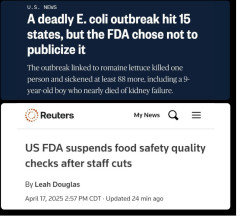
    I shared a link about that too. The parents of the little boy who was harmed said they would have preferred that it had been publicized to let others know...

  • last year
    last modified: last year

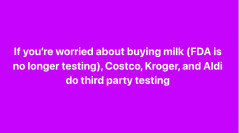
    Carol, I see that now...I skipped over a lot of the posts because of...well, you know who and missed yours. I did appreciate the juxtaposition of the news about ecoli and the fda suspending food quality checks in the meme I posted.