

Pickle ball or ... ?
2 years ago
Featured Answer
Sort by:Oldest
Comments (7)
Related Discussions
Vinegar and Salt for Refrigerator Pickled Peppers
Comments (21)This is just a little bit of info I found. Being diabetic I really am careful with my food. Elizabeth Andress did not give any information about the refrigerator pickles at the conference. One of the things I wanted to ask was about that subject. LISTERIA What is Listeria monocytogenes? Listeria monocytogenes (Listeria) is a pathogenic (disease-causing) bacterium that is food borne and causes an illness called listeriosis1. It is frequently overlooked as a possible cause of illness due to its unique growth capabilities. First, it is somewhat difficult for laboratories to grow, and when they do so, Listeria can be confused with common harmless contaminants and disregarded. Second, most bacteria grow poorly when temperatures fall below 40°F, while Listeria survives in temperatures from below freezing (20°F) to body temperature and it grows best at 0°F to 50°F,1 including the temperature range that we use for refrigeration. As a result, Listeria may be transmitted in ready-to-eat foods that have been kept properly refrigerated. Its ability to grow in such diverse environments is just one of the many challenges presented by this dangerous bacterium. It is estimated that Listeria causes approximately 1,600 cases of listeriosis annually, resulting in 415 deaths. Where does Listeria monocytogenes come from? There are many opportunities for contamination with Listeria during the process of food production because Listeria monocytogenes is ubiquitous in the environment.1 For example, it can be grown from wild and domestic animals, birds, insects, soil and wastewater, and vegetation. As it is a bacterium found in soil and vegetation, it is easily contracted and transmitted by herd animals. Listeria is found in grazing areas, stale water supplies, and poorly prepared animal feed. It can live in the intestines of humans, animals, and birds for long periods of time without causing infection. The bacterium is often isolated in cattle, sheep, and fowl, and is also found in dairy products, fruits, and vegetables. Here is a link that might be useful: About listeria....See MoreFreakout while canning
Comments (6)Ok, yesterday we prepped just less than 1 bushel of Roma tomatoes for salsa. Got that all prepped and then when I added the spice packages (we make a HUGE batch at a time), I added pasta instead of salsa spices. So we will have a totally different salsa this year, hope it's good....See MoreCloudy pickles
Comments (27)Verbatum, as I read from the BALL PACKETS of CHILL DILL pickle mixes, which are meant ONLY for making a REFRIGERATOR PICKLE. The instructions on these BALL packets were stated above, and had absolutely no mention of any boiling brines or heating anything to make a refrigerator pickle. You cannot just quote from a Ball Blue Book or other recipe book and say that its the only way to do something, especially if there is also conflicting instructions by the SAME EXACT BALL company, and on one of their mixes. I still insist that absolutely no boiling or heating of a brine is required when making a batch of refrigerator pickles. The reason is quite simple, heat will break down the cukes and other vegetables, and tends to cause softening of the vegetables. Starting out with a brine that is made at room temps and added to packed jars at room temps, makes for a crisper pickle, if its headed directly for the fridge.. Obviously your way may not be the same way that others make refrigeratar pickles, but for many years, even my half sours have never seen any heat whatsoever, and they are just fine every time. Sorry Kay, its not MY way, its the way BALL instructs the person to make these refrigerator pickles, its quoted from their packets of CHILL DILL MIXES. I for one trust their judgement on this one. Even for that, these mixes contain no preservatives of any kind. If you don't believe me, I can photograph the package and post it here if you like, just to prove to you that I am not making this up, nor is this MY way to make a refrigerator pickle. You can make a pickle any way you choose, but to say that my way is wrong or incorrect, isn't whats at stake here, its different METHODS involved in achieving the same end results. A simple, pickle......See MoreBread and Butter Pickles BWB? Grainlady?
Comments (8)Ilana, this is the recipe I use from the Ball Blue Book. If you store them in the refrigerator and eat them cold, they are crisper, and Pickle Crisp also helps. Bread and Butter Pickles (Ball Blue Book of Preserving) 2 pounds 4 to 6 inch cucumbers, cut into 1/4 inch slices 1 pound onions, thinly sliced 1/4 cup canning salt 1 cup sugar 1 tablespoon mustard seeds 1 teaspoon tumeric 1 teaspoon celery seed 1/2 teaspoon ginger 1/2 teaspoon peppercorns 1 1/2 cups vinegar 1. Combine cucumber and onion slices in a large bowl, layering with salt. 2. Cover with ice cubes and let stand 1 1/2 hours. 3. Drain, rinse, drain again. 4. Combine remaining ingredients in a large saucepot. Bring to a boil. 5. Add drained cucumbers and onions and return to a boil. 6. Pack hot pickles and liquid into hot jars, leaving 1/4 inch headspace. 7. Remove air bubbles. Put on 2-piece lids. 8. Process for 10 minutes in a boiling-water canner. 9. Allow 4 to 6 weeks for flavors to develop * Makes about 4 pints I like the ginger, but you can leave it out, and you can double this recipe for a canner full. I think the onions are the best part, but I've subbed jalapeno slices for some of the onion and Elery loved them, sweet and hot. Annie...See More 2 years ago


Related Stories
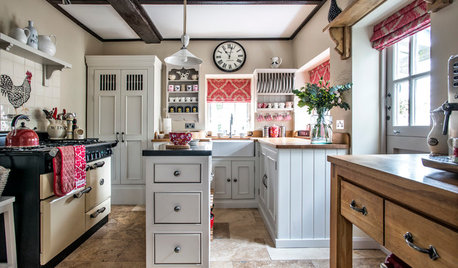
SMALL KITCHENSSmall Kitchen a Good Fit for a Jam and Pickle Business
If well-designed, a compact kitchen can be beautiful and practical, as this one in a converted English hayloft shows
Full Story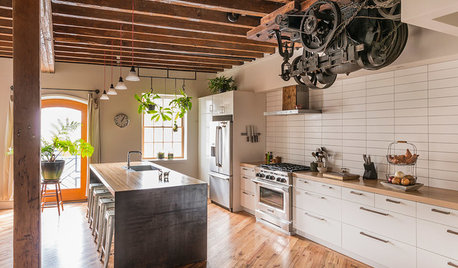
GREEN BUILDINGHouzz Tour: Pickle Factory Now an Energy-Wise Live-Work Space
A charming but poorly insulated 1880s Philadelphia commercial building becomes a spacious energy-efficient home and studio
Full Story
TRANSITIONAL HOMESHouzz Tour: Elegant, Earthy Ranch House for an Empty-Nest Couple
Design styles, warm neutral colors and special details blend in a Minnesota ranch-style house with a finished basement
Full Story
LANDSCAPE DESIGN9 Design Moves That Give a Flat Yard More Depth or Height
Sunken patios, stacked beds, berms and other features add interest to outdoor spaces
Full Story
GARDENING AND LANDSCAPING9 Traditional Design Ideas for Your Garden
If modern landscapes leave you cold, here are ways to weave in classic character
Full Story
WORKING WITH PROSInside Houzz: No More Bumper Cars in This Remodeled Kitchen
More space, more storage, and the dogs can stretch out now too. A designer found on Houzz creates a couple's just-right kitchen
Full Story
PRODUCT PICKSGuest Picks: Corral Kitchen Utensils in Style
Caddies and holders for silverware and more add character and keep your kitchen organized
Full Story
PRODUCT PICKSGuest Picks: Canning, Preserving, Steaming, Dehydrating
20 products to help make fall produce last through the season and beyond
Full Story
FEEL-GOOD HOMESimple Pleasures: Make Do and Mend
Experience the satisfaction of fixing, repurposing and creating things yourself around the home
Full Story
COLOR11 Terrific Paint Color Matches for Wood Details
Pair your wood trim and cabinets with the right shade of wall paint to bring out the beauty in both
Full Story
rob333 (zone 7b)