Houzz Logo Print
jakkom

CA tomato growers reel from extreme weather

5 years ago

Get ready to pay more for tomatoes, as California growers reel from extreme weather

Tomato growers are feeling the squeeze: Low inventory, pandemic hoarding and now extreme drought

Washington Post 28July2021

CA tomato growers reel from extreme weather

(excerpt)

Tomato sauce is feeling the squeeze and ketchup can’t catch up.

California grows more than 90 percent of Americans’ canned tomatoes and a third of the world’s. Ongoing drought in the state has hurt the planting and harvesting of many summer crops, but water-hungry “processing tomatoes” are caught up in a particularly treacherous swirl (a “tormado”?) of problems that experts say will spur prices to surge far more than they already have.

The drought threatens to imperil some of Americans’ favorite ingredients — pizza sauce, marinara, tomato paste, stewed tomatoes and ketchup all hang in the balance. And this comes not long after a bizarre, and completely unrelated, shortage of pizza sauce and individual ketchup packets during the height of the food-delivery-crazed pandemic.

This also comes on top of already steep increases in the price of fruits and vegetables, which have been rising since the coronavirus pandemic was declared last year.

For tomatoes, higher prices could start taking hold soon if not already, said Wells Fargo’s chief agricultural economist Michael Swanson.

“If you’re a producer or a canner and see these problems coming, why would you not raise prices now in anticipation?” he said, adding that consumers don’t see the price tag for a lot of the processed tomatoes consumed away from home. “It’s embedded in the menu board — but it is one more reason prices at Chipotle and Pizza Hut will go up.”

In a normal year, Aaron Barcellos, a farmer in Firebaugh, Calif., grows 2,200 acres of processing tomatoes. This year he’s decided to drop to 900 acres on his farm, which is on the border of Merced and Fresno counties. He’s left the remaining acres unplanted, choosing to focus all of his precious water on almonds, pistachios and olives grown on trellises — crops that command higher prices and represent already-significant sunken costs.

“We get eight inches of rain in a normal year. Last year we got 4½ inches,” he said. “We got zero percent of our water allocation, which forced us to buy a lot of expensive water, and it doesn’t make sense to put it on tomatoes.”

Comments (51)

  • 5 years ago
    last modified: 5 years ago

    Interesting story, jakkom. Thanks for sharing it.

    I passed by that way twice in the last several weeks, on the Hwy 5 segment south of Hwy 152. Empty tomato trucks driving southbound, loaded ones going north. They must have been driving the harvest to the Los Banos processing facility mentioned in the article. .

    It was over 100 degrees both times. I know that's normal but wow, I don't know how anyone with a choice would live in the Central Valley unless their occupations are related to ag.


    PS, edit to add-

    The weather isn't extreme, it's just another regularly recurring drought period, as I think I've mentioned before. One year or several. Central Valley growers are accustomed to this and adjust accordingly. If prices go up because of product supply shortages, well, that the world of ag products of all kinds.

  • 5 years ago
    last modified: 5 years ago

    Add - agree with Zalco, Cento tomato products are terrific. Pomi products - also from Italy and often in aseptic-type packages - are maybe a step down from Cento but also good. Certainly better than the average American brand. American branded tomato products are typically bought from processers, a heterogenous commodity supply their competitors also use. The Italian brands come from the output of set and proprietary supply chains with prescribed tomato types, integrated all the way down to the farm level.

  • Related Discussions

    How are your N. CA tomatoes?

    Q

    Comments (17)
    hello fellow tom growers - west contra costa county (hercules) checking in and i'm here to do some commiserating, and get some inspiration. i have 5 toms - yellow pear, super sweet 100, sweet 100, sf fog, and roma - that i put in giant wine barrels. they get plenty of sun, about 6-7 hours daily, and they're growing nicely, just not as densely as my plants last year. they all have tons of flowers, but only the sweet 100's and the romas have set fruit, small though. the sf fog has only 3 clusters of flowers, 2 of the clusters are dried up and not going to set fruit, and the last cluster is flowering nicely, but so did the others. So far all the plants look healthy and are growing well, but aren't the monsters that the plants i had last year were at this time of year - and i had toms this time of year. oh well..... ~ angela :)
    ...See More

    Central CA update (lots of pics from the yard) 4/11

    Q

    Comments (33)
    NZ, no dishes of water (West Nile virus) but I do occasionally wash down the plants or the cement floor under the arbor. Plus there are grape and passion fruit vines above it and grass in front of it, not to mention lots of plants. I do have plans for drip lines and probably micro misters for early morning or evening (no direct sun). Yes LL, they are from Juan's pulasan tree, I try to pretend I dont care about them, so they wont die. It would be a complete miracle if I can get them to fruit and even more outrageous if they taste as good as Juan's. Some of the PR seedlings are growing pretty well, plants in the photos are in 5gal pots. Even the mangosteen are growing moderately well, the slowest growers.........herrania umbricata and kwai muk. Charleslou, all of the lychees except the Mauritus are in pots.
    ...See More

    First post, first time grower. . .staking my tomatoes?

    Q

    Comments (10)
    I could be wrong about the zone - on a zip code lookup map it tells me 9-10. I am near the coast, and the weather here tends to be much more mild. Those "zones" are pretty broad classifications. Here's a fairly accurate description of where I live: "Salinas, CA climate is mild during summer when temperatures tend to be in the 60's and cool during winter when temperatures tend to be in the 50's. The warmest month of the year is September with an average maximum temperature of 74.60 degrees Fahrenheit, while the coldest month of the year is December with an average minimum temperature of 39.40 degrees Fahrenheit. Temperature variations between night and day tend to be fairly limited during summer with a difference that can reach 19 degrees Fahrenheit, and moderate during winter with an average difference of 22 degrees Fahrenheit. The annual average precipitation at Salinas is 15.12 Inches. Rainfall in is fairly evenly distributed throughout the year. The wettest month of the year is January with an average rainfall of 3.00 Inches." We do get some 90 degree days, but only a handful. I had read the FAQ about blossom drop. . .I don't think too hot is going to be my biggest problem. My neighbor (who's in something like his 60th year of planting tomatoes in his backyard across the street - he's 92) said he usually doesn't even plant until around May 1 because it's not warm enough to really get 'em growing; in his words, "they just sit there and look at ya." Maybe I'm misunderstanding the term "frost date." Is it a technical term, or just the last time that you wake up to frozen stuff around you? Stupid question, I know, but I have a feeling I'm not communicating something correctly. Yes, the plants get direct sun for at least 6-8 hours a day (I need to be a little more scientific about it), but it's been a cold spring - it's been in the 50's all this last week with a high of 63 projected for the next week. On the few hot days we have had, the plants have practically grown before my eyes, but they don't grow much during these chilly times. So. . .I can put in a stake without messing up their little root systems? Thanks, Christopher
    ...See More

    Does cold weather stunt tomato plant growth ?

    Q

    Comments (78)
    I have been eyeing this thread since it started in hopes of gaining knowledge for next year. I'll add my 2 cents: I started my tomato seedlings in flats in a greenhouse in late February, moved them to large pots (quart yogurt tubs, small coffee cans, etc) in early March, and planted out in the first week of May. (They ended up being a little long in the tooth, I mean stem: I will start several weeks later in future. I had to deep-plant most of them.) Anyway, I noted that the forsythia was starting to bloom when the tomatoes had been in their pots for about a month, and they did look like they were reaching a respectable transplant size at that point. But there was a lot of weather weirdness forecast, so I did not chance it and instead stuck to my family's tradition: plant on May Day. What I noticed was: this was right about the time that the forsythia was going *out* of bloom. There was not another frost, and every tomato established well. Perhaps the *end* of the forsythia, rather than the beginning, is the tomato indicator. And I picked my first tomato on June 12, and have been getting about a pound of fruit a day for the past week. (Mind you, I have close to 50 plants, so this isn't at all impressive! They are just outliers of the main deluge I anticipate. But it will be enough for our cookout hamburgers this Monday!)
    ...See More
  • 5 years ago

    Watch the tomato product hoarding begin!

    I usually freeze about 20 lbs. of whole tomatoes a year but haven't started yet this year. I use them in chili, pasta sauce, etc. I do buy tomato paste, ketchup, and pizza sauce though.

  • 5 years ago

    And my garden tomatoes are being so slow this year. Moreover, the romas I planted do not seem to be the variety I paid for.

  • 5 years ago

    Ditto on the Cento tomato products.

    My tomatoes have almost run their course. We have had plenty of rain, but the racoons have had their fair share. The heat now is keeping more new blooms from pollinating. I still have some cherry tomatoes so will see what happens in the next month with a possible fall crop of smaller, late tomatoes.

  • 5 years ago
    last modified: 5 years ago

    ATK had a show featuring canned tomatoes, and they noted that imported canned tomatoes are required to have citric acid added, which I do not like. I buy 6 in 1 tomatoes, which can be difficult to find, but I did find them on Instacart, and so I can have them delivered. This is also the brand of tomatoes preferred overwhelmingly by people at the Pizza Making Forum, many of whom own pizza restaurants. 6 in 1 tomatoes do not have citric acid, and therefore they have an even sweeter flavor than they would have otherwise.

    I would grow my own tomatoes if I stayed in one place long enough, but for now, I will just buy tomatoes at the farmers' markets. They've had plenty the last few times I've gone there.

    I've tried Cento tomatoes and found them to be not nearly as good as 6 in 1, although I will say that it has been many, many years since I made this comparison.

    The best tomatoes that I have grown myself were called "Dona" but I have not seen these plants in the nurseries here for a few years. I do not always look, however, as I find it much more convenient to buy tomatoes at farmers' markets. Anyway, the Dona tomatoes may not be any better than the heirloom tomatoes I have been buying recently.

  • 5 years ago
    last modified: 5 years ago

    Well lars, as you know, the two dirty secret ingredients often used by many excellent chefs to boost flavor are butter and a little bit of sugar. You can add a touch of each, or excellent olive oil in place of butter, to get tomato sauce or tomato based concoctions you will be happy with.

  • 5 years ago

    As someone who never uses ketchup and who gets drizzled olive oil and pesto on my pizza, it won't affect me. However, I adore homegrown tomatoes and presently have 34 sitting on my kitchen counter. We have a dozen plants of every variety, three at the house and nine at the community garden three blocks away. I will eat them a couple of times a day till frost and then never have one again till next summer.

  • 5 years ago

    I guess I should grab a few extra bottles of Heinz catsup to have around. I got my first tomato this week. Usually what we don't or can't eat we give away or leave them rot on the vine if no takers. Maybe I will skin and freeze them this year.

  • 5 years ago

    Would California tomatoes be a good product for hydroponics? I would think there is more control over the water in such setups.

    +1 for Cento tomato products.

  • 5 years ago

    I've never heard of any of the above mentioned products. I'll have to look next time I'm in Trader Joe's if they have those brands. I don't use a lot of canned tomato products anymore because it's just me here right now. I will need to stock up a little soon though. Plan on making some lasagna when these two kids arrive.


    I have tomatoes just ripening in the garden now! I don't buy fresh anymore. They're just horrible tasting. I started way too many plants this year, so I'll have them coming out of my ears soon.

  • 5 years ago
    last modified: 5 years ago

    Tomato fields in CA's Central Valley cover thousands of acres!! There is no way on earth one can convert that same production acreage to greenhouses! If one is not familiar with CA agriculture, it's difficult to imagine just how much of US produce is generated there and how much impact climate change and drought will have on these crops going forward. Price increases are inevitable.

    And it is all well and good to be proud of one's homegrown tomatoes but the vast majority of the American public do not "grow their own" or certainly not to the volume of being able to put up their own canned toms or sauces and so rely on canned products. It is unfair to dismiss them out of hand as being inferior when that is one's only choice!

  • PRO
    5 years ago

    Tomatoes do very well in greenhouses, and in hydroponic conditions. Meijer has been buying from greenhouses in Ontario for several decades that have been in ground and more recently hydroponic, and built itself a hydroponic greenhouse for tomatoes around a decade or so ago to supply it's own stores with tomatoes year round. The shift from in-ground to hydroponic has worked well for these companies.

    If you ever see/buy SUNSET tomatoes at places like Meijer, Whole Foods, Aldi, Costco, Sam's Club, Trader Joe's, Walmart, and Target... those are hydroponic greenhouse tomatoes from Canada.

    A problem for California though is that when it's too hot for plants outside, it makes it much more difficult to keep it climate controled in a greenhouse where it needs to stay cool enough for the plants to produce. Even being much more savvy with the water control in the hydroponic setup the climate control can be a real bugger.

    But back to regular in-ground ComAg. California is reported as a bit under contract, but not too bad so far. In comparison, Canada is already reporting a 20% crop loss. Here's a recent world crop report on tomatoes: http://www.tomatonews.com/en/wptc-crop-update-as-of-23-july-2021_2_1411.html

    Also, those Italian tomatoes... are having difficulties with a can shortage right now. Suppliers not being able to fill contracts, and/or increasing prices on their cans. So there might be an uptick in price on Italian tomates as well. https://www.bloomberg.com/news/newsletters/2021-06-09/supply-chains-latest-can-shortages-threaten-italian-tomatoes


  • 5 years ago

    China produces 5 times more tomatoes than the US, and India produces 2 times more than the US.


    dcarch

  • PRO
    5 years ago

    True that China and India produce a ton (pun intended) of tomatoes. However, U.S. currently has bans/restrictions on most tomatoes from China, and does not really import much from India. France, Germany, and UK are the main importers from India. Netherlands export a lot too, but not much to the U.S.. The majority of U.S. imports is from Mexico and Canada.

  • 5 years ago

    Tomatonews! Fantastic. I guess every industry segment has its own publications and organizations and this one apparently is from Europe and began from the Mediterranean tomato industry.


    We occasionally buy what I believe are greenhouse tomatoes, often of the grape tomato size, at Costco. Costco often carries a brand based somewhere in BC, Canada. The packages are labeled as to origin and with the same brand, we've had tomatoes from BC, from the Santa Maria area of the central Cal coast, and also from Mexico. So it apparently has at least these three grow locations, if not more, to supply its US customers. Whether from one place or another, the product seems the same.

  • 5 years ago

    The question: What is the really real tomato production in the US?


    I produce enough tomatoes to supply four families every year from my garden. :-)


    I don't think I am the only tomato home grower.


    dcarch


  • 5 years ago

    No home production or growth of any item figures into industry stats.


    It's funny, living in the county's most important ag state as I do, other than the odd few fruit or citrus trees, or the few tomato plants that some people have, backyard vegetable gardening isn't real big here.

  • 5 years ago

    Elmer, maybe that's be because we get such wonderful produce relatively easily. I remember my first trip to California with my husband and how we raved about the fruit plate we were served at some completely nondescript, diner-like restaurant in Menlo Park.

  • 5 years ago

    I produce enough tomatoes to supply four families every year from my garden. :-)

    Made me think of Wickard v Filburn :)

  • 5 years ago

    We have also have farmers' markets close to us that are open every day of the week, except for Monday, and so it is easier to go to those for fresh vegetables than to grow them myself. I do grow chilies, however, because I use a lot of those, and I grow special ones. Also, the plants generally have a long season of producing chilies.

    I do grow herbs in my back yard, however, especially in the winter, but many grow all year, such as rosemary, oregano, thyme, and mint. Lately I've been buying live basil plants in the grocery store and keeping them in water in a kitchen window. They keep there for longer than a month, or until I use them up. I find them easier and more convenient than basil plants that I keep in the back yard, as I generally grow those only in the summer and fall. I cannot grow basil outdoors in Cathedral City, however.

  • 5 years ago

    "maybe that's be because we get such wonderful produce relatively easily."


    We certainly do, zalco. The variability of tomato quality in stores though is what drives a few people I know to grow their own, often in above ground planters. Or go to farmers markets, where taste quality can be better.


    The cultural diversity we have also gives us exposure and access to many formerly rare or exotic items that become a regular part of home menus. I try not to take any of it for granted.


  • 5 years ago
    last modified: 5 years ago

    Tomatoes are sooo easy to grow. Just plop the little plants in the ground, water once and as long as they have some sun daily and rain every week or two they are happy. I have a small garden at home that the soil hasn't had compost added to in the 7 years I lived there. I don't fertilizer either. As long as they aren't planted in the shade, they really don't care where they are planted. I have a couple at camp that I stuck in between ditch lilies and irises in rocky soil and they are growing great.

    As far as the difference in tomatoes from one area to another. Yes, there is a difference. If you ever tasted the tomatoes we get in winter from Florida (yuk) to the tomatoes we grow locally in the North East in the summer, there is a huge difference in taste and texture.

    Yes, I buy some produce at the local farmers market because I ain't going to fight the wildlife, dz bugs or dig up large patches of lawn to grow them. Usually sweet corn. But tomatoes, peppers, cucumbers and zucchini aren't one of them, because they are easy to grow.

  • 5 years ago

    What's rain? We don't usually get much from April through October here in No California. The farmers markets charge an arm and a leg for their lovely tomatoes. I do grow my own and am usually very generous with the neighbors, but it looks like I'll be doing a lot more freezing/canning this year!

    The only thing that will be growing in greenhouses in this county will be pot!

    Ahhhhh rolling hills of vinyards and greenhouses of pot! Such a lovely landscape!

  • 5 years ago

    Why does CA grow so much when they don't have the water or rain to support the crops? I'm not being vicious, just curious. Is it because you can grow most of the year or you have the migrant workers to pick the crops?

  • 5 years ago
    last modified: 5 years ago

    Function, what California grows is clearly in flux at the moment. And while we do not have great rain, we do have access to water via an intricate acquaduct system, which is one of the world's greatest feats of modern engineering. Low wage workers are beside the point. Technology and money win the day every time.

  • 5 years ago

    Zalco/bring back Sophie! From what I read that the aqueduct system or the water source can't support the great need for water anymore. That there is dissension between the farmers and non farmers for water. That most homes have zero landscaping and water rations where it was unheard of a decade ago. Or were the articles false?

  • 5 years ago
    last modified: 5 years ago

    Function, as I said what grows in California is clearly in flux. Climate change is changing us.

    From what I read that the aqueduct system or the water source can't support the great need for water anymore. That there is dissension between the farmers and non farmers for water. That most homes have zero landscaping and water rations where it was unheard of a decade ago. Or were the articles false?

    All this is breathless hyperbole and falsehoods. We are still the number one agriculture state. Iowa is second, with half of our value. Is that metric clear enough for you? Are you going to suggest this is because we are closer to cheap labor 🤣.

    My house is landscaped with drought resistent plants and grasses, that means lots of roses and lavender, not cacti and scrub.

    There is no water rationing where I live. I invite you to show me where there is. Death Valley perhaps ;-)

    There is no dissention between farmers and residents. We are all grown ups, we all know the contraints with which we live, and clearly thrive.


  • 5 years ago
    last modified: 5 years ago

    "From what I read that the aqueduct system or the water source can't support the great need for water anymore."

    Keep looking for better information sources because what you're relying on doesn't tell the right story. The water systems are oldish but they work pretty well. The problem is that the flow of water into them this year is well below annual averages.

    As I've tried to explain a number of times in the past few months, California's winter-only rainfall is cyclical. Regularly occurring draught years, often consecutive, are on record as part of the cycles going back more than 150 years. The majority of the in-state sourced water (excluding what's from the Colorado River) comes from snow in the Sierra Nevada mountains, a long and high range that includes several areas that receive (on average) more snowfall than anywhere else in the US.

    This year is a draught year, water supplies are down and permissible usage has been reduced. There was very little snowfall this winter. The snowpack in the mountains is measured in many spots regularly, often weekly, through the winter months. There were areas usually deep in snow in early spring that had no snow at all this year.

    The water systems manage the snow run off. There's nothing to manage when the runoff is sparce. That's where things are.

    "Why does CA grow so much.."

    California is the USA's largest producer of agriculture products, an 80% or more producer of some and the only producer of many others because of the weather and availability of water. Crops aren't washed out by heavy spring or summer rains nor wilted from less than normal summer rain because all are irrigated and it mostly doesn't rain during the main growing season. Weather is predictably sunny and dry and provides ideal growing conditions of various types (the state does not have just one climate region). Citrus and avocados in the dry and mostly frost free south, leafy greens along the cool coast and in the Salinas Valley, winter growing of mild summer crops in the deserts. Premium wine grapes in the wine country and other newer wine growing regionsf (where vintage years are not as significant as in Europe because of more year to year weather consistency).

  • PRO
    5 years ago

    California is indeed a big state, and with more than just tomatoes going on. But keeping on the OP and tomatoes...

    The general Sacramento-San Joaquin Delta watershed is in trouble. Delta, Russian River and Scott River watersheds have already been curtailed in June, and expanding curtailments in the Scott and Shasta river watersheds happened in mid-July. Those have been on junior water rights holders.

    Next week the review and decision happens for if senior water rights start getting curtailed, those are the folks that have had water rights pre 1914 to 1883.

    For folks that may not already know about the Central Valley situation, here's a report that was updated last month on the topic: https://fas.org/sgp/crs/misc/R45342.pdf

  • 5 years ago

    Tomatoes may be easy to grow if you have sunshine. My yard is so over shadowed with huge evergreens that are growing in the lot behind me that I am lucky to even get a ground cover to grow to prevent erosion.

    I buy at a local farm. It is not cheap, at all. It is a luxury that I allow myself to indulge in because there is so much goodness in a jar of my summer canned tomatoes.

    Greenhouses can be set up in many differnet clmates and in many locations, thus, providing "locallly grown produce". It looks as if the greenhouses are good for some crops and some may be best left to a field. Greens are one thing that can be grown in a controlled environment.

    Turning California's fields into greenhouses is probably not the ideal situation or the objective.. But, for produce that is not destined to become ketchip or pizza sauce for the fast food chains, this presents an option that needs to recieve more attention.

    The greenhouse may seem an unnatural solution, but so is the irrigation system that California relies on. Neither of these scenarios are provided by nature. They both rely on technology that harnesses the elements and are built by humans.


  • 5 years ago
    last modified: 5 years ago

    Greenhouse growing tomatoes saves lots of water:


    dcarch


  • 5 years ago
    last modified: 5 years ago

    We have a huge tomato greenhouse in my town. Oh, and btw, they utilize mostly Mexican workers that they house on site under some kind of special dispensation. They are not "illegals" as people are want to say, but not many locals are benefiting with jobs from its presence either. They had a big covid outbreak at the start of the pandemic there. Despite trying to avoid it. But given the working and housing conditions it was pretty much inevitable. Greenhouses are a big plus for my state, which is in the upper Midwest. Cheaper to heat a greenhouse in the winter than cool one in the summer. They use a HUGE amount of energy with the growing lights since tomato seedlings are very light hungry. The whole town has a glow at night from the light pollution. Later in the season it dies down. This is in contrast to those who use greenhouses to extend the season but don't heat them over the winter. I've seen quite a few tomato growing set ups in my region that use hoop houses which are uncovered in the middle of the summer but covered early and late. I do the same at my house on a smaller scale.


    I would hardly posit fossil fuel intensive agricultural methods as a "don't worry, we'll come up with a technological fix" black box answer to climate change concerns. We can change to alternative methods, but the large massive farming with irrigation model may not be it. And as I have said before, the issue is not just the supply of water or the basic cost of the water, but also the expense of the infrastructure to keep it flowing to the crops, along with the infrastructure to keep all those acres free of pests and weeds and to harvest. Then there is the transportation infrastructure. The model calls for large outlays of money, which is why smaller and medium sized operations were the ones that went under and continue to go under. As far as pure production, not an issue as the large fossil fuel inputs results in huge production, even with glitches. It takes a major, major problem to have a large impact because so much production. Not necessarily a high quality product, but edible and what we are now used to.

    I decided long ago to grow my own tomatoes because the quality is far superior, partly due to the glass jars not imparting a stale kind of taste from sitting in the can a long time. Also I'm able to control the quality of the produce that goes into it.

    There are other places in the US that were once big produce growing regions outside of just CA. Particularly when there were smaller regional canning factories. My own state is a big produce player, as was the "Garden State" of NJ at one time. Much of that great soil located within great regional growing conditions has been converted to suburban housing, and the trend has not reversed, more and more farms fall as the older farmers die out. Very difficult for new farmers to get started and once an area has ceased to be primarily agricultural, the costs of everything one needs to run the business go up once again due to transportation costs and lack of competition.

    I was once involved in a training program for new farmers, but it's an uphill battle to compete with the factory farming model. People now work on farms but don't own their own operations. Most of the farmers I know who have small or med. sized operations are not the breadwinners of the family, that income is supplied off farm. I know some folks who are paid to farm on wealthy landowners farms. I know a few who have tried, but the level of income is just not there to support a family and the hours are incredibly long and hard. When one compares what one could make in other less taxing professions, the decision to get out of farming becomes the sad but logical one. But there are still gads of huge factory farms so the production so far isn't suffering. I do predict rising costs even in that sector though. Not immune from increasingly expensive infrastructure, and when costs are cut, it often leaves these operations vulnerable to large scale problems that can impact supply.

    Cue anecdotal response from folks not in the agricultural economy but have definitely bought food and driven by farms.

  • 5 years ago
    last modified: 5 years ago

    "The greenhouse may seem an unnatural solution, but so is the irrigation system that California relies on. Neither of these scenarios are provided by nature. They both rely on technology that harnesses the elements and are built by humans.."

    Mankind has been diverting and managing fresh water for agriculture and domestic use for thousands of years. It's essential anywhere there is human habitation.

    Many parts of the Roman aqueduct systems survive to this day and are breathtaking to behold and think about. Have you seen any of them? Massive architectural and system sophistication and accomplishments judged by today's modern world but all the more so when the limits of human knowledge and capabilities at that point in history are considered.

    Your concerns and the opinion you seem to want to express are not clear to me.

  • 5 years ago
    last modified: 5 years ago

    "Greenhouse growing tomatoes saves lots of water:"

    That's an interesting video, especially the part showing individual hand picking of tomatoes off the vine that were then placed in box flats. You may not know that the growing of tomatoes for processing is a completely different business, done a completely different way.

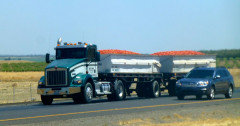
    Here's a photo, and below it a link to an article, that should provide information to some of you who are carping without understanding what's involved. Processing tomatoes are grown in huge fields, picked by machine, loaded into hopper-type trailers (like the kind that carry gravel or dirt), and taken immediately to the nearby processing plants. The photo shows a sight familiar to anyone who has driven Hwy 5 through the San Joaquin Valley in the summertime - the procession of these tomato laden trailers.

    California's tomato production


  • 5 years ago

    "Cue anecdotal response from folks not in the agricultural economy but have definitely bought food and driven by farms"


    Well, you've demonstrated your understanding and insights with respect to expressing concern recently about farmland being converted to subdivisions in Huron, CA. Little more than a wide spot in the road, an hour's drive through farmland away from any even town-sized location.

  • 5 years ago

    "There are other places in the US that were once big produce growing regions outside of just CA."

    It is not realistic to make comparisons of CA's agriculture to other states. With 43 million acres devoted to the ag business, that is more agricultural acreage than most states are large!! And it accounts for the majority of agricultural production anywhere in the US. The western drought has major implications for both productivity and costs and that is not going away any time soon.

  • 5 years ago
    last modified: 5 years ago

    Exactly right, gardengal. California has been the nation's most significant source of produce and ag products (mostly food for humans) for decades and decades and decades. And will continue to be. Because of weather and available lands long under very productive cultivation.

    For the products California provides the vast majority of, production in other states is a drop in the bucket or less. And not because of conversion of farmland to subdivisions.

  • 5 years ago
    last modified: 5 years ago

    I never once compared CA to other states as being interchangeable. And if I say that other areas of the country once contributed more to agricultural production than they do presently, that somehow equates to being of the same size?? The critique here is laughable with the leaps of exaggeration and logic. I believe it is the straw man technique. In fact, if you drill the science down far enough, one can't interchange necessarily one field to another on certain farms depending on their geology and topography, let along farm to farm or region to region in ANY agricultural area let alone one as vast and varied as CA. Also, California "exceptionalism" is not exceptional if you study agricultural economics. It follows standard agricultural economics if you factor in the size of the state and variety of crops that can be grown there and the history of US agricultural practices in general. CA does have unique features but they are not mysterious and unknowable to only those with some special inside knowledge. CA agriculture is studied by ordinary bobs all over the world, considering the size and scope of its impact both in research knowledge and production. Sometimes CA is ahead of the curve, sometimes behind, and it too varies vastly considering the size and topographical diversity of CA.

    I once mentioned that conversion of farmland to subdivisions has affected CA agriculture in a previous post. Yeah, it has, your point to the discussion of the past, present and future of CA agriculture?? All of a sudden this is the sum total of the argument? Not sure what the logical fallacy is of simplifying complex issues into single red herrings that you harp on over and over, but I certainly wouldn't come here to learn much about CA agriculture. I might however, read this,

    https://s.giannini.ucop.edu/uploads/giannini_public/19/41/194166a6-cfde-4013-ae55-3e8df86d44d0/a_history_of_california_agriculture.pdf

    Or this "California's Edge Problem"

    https://citeseerx.ist.psu.edu/viewdoc/download?doi=10.1.1.182.6278&rep=rep1&type=pdf

    Or this "Sustaining California Agriculture" (Pacific Institute)

    https://pacinst.org/wp-content/uploads/2014/04/sustaining-california-agriculture-pacinst-full-report.pdf

    Or this "Water for Farms" Public Policy Institute of CA

    https://www.ppic.org/wp-content/uploads/californias-water-water-for-farms-november-2018.pdf

    Or this "Irrigation in California and It's Relation to Energy" (US Dept. of Energy)

    https://www.energy.gov/sites/prod/files/2019/05/f62/22-fupwg-spring-2019-anderson.pdf

    Or this

    https://www.cdfa.ca.gov/Statistics/PDFs/2020_Ag_Stats_Review.pdf

    Or this "California Agricultural Production and Irrigated Water Use" (Congressional Research Service)

    https://fas.org/sgp/crs/misc/R44093.pdf

    I could go on all day. The point is, if you read these articles you will get a complex and nuanced view of CA agriculture, so I find it laughable the idea that it could be rolled into such simplistic arguments as are presented with hubris here.

  • 5 years ago

    "I could go on all day"


    Good idea. Maybe you'll stop to glance at one or two and when you do, also give some thought to the perspectives (political and otherwise) of what you're reading. That's neither good or bad, but sources need to be considered before swallowed whole.


    "I once mentioned that conversion of farmland to subdivisions has affected CA agriculture in a previous post. Yeah, it has, your point to the discussion of the past, present and future of CA agriculture?? All of a sudden this is the sum total of the argument?"


    No, not at all, but it was just one of several items you've taken out of context and misunderstood.

  • 5 years ago
    last modified: 5 years ago

    I'm not sure what the point of bringing up agricultural practices anywhere other than CA makes. They don't even enter into this discussion at all!! The fact that CA is experiencing an ongoing drought of many years and that irrigation water is in short supply and dwindling fast is unique in that it majorly impacts our biggest agricultural producing state. Who cares what happens in Iowa? It has NO bearing on what's happening out west!! It is just not feasible to even imply greenhouse growing may work or that even if it was a significant factor, there is no way it could match the volume of inground production. Prices are going to go up. And will continue to.

    And I don't need to read 15 links to figure that out!

  • 5 years ago
    last modified: 5 years ago

    I did glance. In fact, some folks spend their lives objectively studying the very things we are discussing, so I'd go to them for nuanced policy analysis, was my point.

    Edited to add that the relevance of other tomato growing areas of the country to CA's tomato output is basic economics. Given the size and percentage of CA's tomato crop, even slight decreases in CA's tomato output could drive up prices, but also could provide economic incentives for other areas of the country to pick up SOME of the slack. Depends on a LOT of other economic and social factors with markets etc. Only time will tell, but such agricultural production shifts are not without a plethora of precedents.

  • 5 years ago

    I'm not sure what the point of bringing up agricultural practices anywhere other than CA makes.


    It could be that by sharing insights and ideas, new and better ways to address water issues might arise.


    This thread is a conversation, and interesting. Many of us are not familiar with large scale agriculture, and are not familiar with California. I am grateful to those especially our California residents who address greenhouse growing queries, and other agricultural questions, by generously supplying facts.

    The California water question here is of interest to us all who live in America. Should this (hopefully) be just a bad run of dry years, we can all expect higher prices. However, if some of the unfortunate weather is due to pervasive and long lasting climate change, an exchange of ideas now may lead to ways to cope that will maintain California production.

  • 5 years ago

    Some of us in the second tier tomato growing states view what happens with CA's tomato crop with quite a bit of interest.

    https://www.worldatlas.com/articles/the-top-10-tomato-producing-states-in-the-united-states.html

  • 5 years ago

    The year the Oroville Dam failed, 2017, the Sierra snowpack was one of the largest on record. Not that long ago.

  • 5 years ago
    last modified: 5 years ago

    Thanks for mentioning the Oroville Dam problem, it demonstrates the wide swings in precipitation from year to year.

    As I recall, 2017 was a year of heavy precipitation in the Oroville catchment area, following a few years of drought. The dam didn't fail, it remained secure and stable. Heavy year then, light years since.

    The problem was that to relieve the pressure of a rising water level behind the dam, water was diverted down the main concrete spillway (which was there for that purpose). The rushing volume of water broke loose the paving and severe erosion happened. They stopped the diversion for awhile and relied on the emergency spillway, which was basic - water spilling over the top of the dam was caught in a channel there for that purpose and ran downhill in an unpaved pathway. Because the overflow was running out of control, and not knowing if the dam would hold up, downhill and down river inhabited areas were evacuated. Fortunately, it's not a particularly populated area (by state standards). The failure analysis afterward discovered major mistakes in the design and engineering of the spillway. I'm not sure if all the needed repairs have been made.

    The Sierra Nevada mountain range is very long and weather patterns are by no means uniform from one end to the other. The far north - up near Shasta - is hundreds of miles away from the south. Hetch Hetchy near Yosemite, where much of the Bay Area's water comes from, though that's just one valley, is still a good bit north of the bottom of the range. Uncaptured water from the north and the south flows to the Delta area and its from there several water projects harvest water for use throughout. Everywhere is sub-average this year and last. It won't last forever.

  • 5 years ago

    Correct, the dam didn't fail. IIRC, there had been an unusual am't of rainfall and a record snowpack in the Sierras. So rising water, ground water pressure & the erosion of the spillway. As well a some negligence in maintenance and allowing vegetation to encroach around the spillway area??

    I followed the story in real time; the situation was dramatic. Was late in the day for me yesterday; I was tired. Used 'Oroville dam failure' as a search term to pull up the date. Which will work for anyone who wants dig out more info.

    As an aside from the ancient past, we were living in the Lake Tahoe area 1964-1965 (I think). Left in early '65 (January). Lots of snow when we left; I recall walking through a canyon of snow piles taller than I was from the front door to catch the school bus. The house we lived in was two story with an exterior door and small exterior balcony on the second floor. There was no exterior staircase. Was told it was there as an emergency egress from the house for when the snow got really deep. I believed it!

    After leaving, I exchanged letters for a time with a friend there. She wrote that soon after we left, it had started raining and that ALL of the snow was gone. I couldn't believe what she wrote knowing how much snow was there just a short time before. And, being a kid, I didn't even think of where all that melt had to have gone.

  • 5 years ago

    There are tomato farms on the east coast, as well. There are many out over the eastern shore and the state of Delaware.

    These tomatoes are harvested by machine. You can see the field where the machines came through. There is no hand picking for these large fields.

    The farm that I buy from does use hand pickers.

    I would assume that the machine harvested tomatoes are the determinate variety that proudce all at once.

    I used to be able to buy a brand of tomatoes that were raised and canned in Delaware but have not seen those for years now. I remember that it had a beautiful old fashinoned lable on the can.