

Amazon’s new pilot program for Prime & Whole Foods
8 years ago
last modified: 8 years ago
Featured Answer
Sort by:Oldest
Comments (24)
Related Discussions
Palm Pilot users.......
Comments (5)My Contacts are divided into Business, Personal, and a very few Unfiled (the few services which don't neatly fall into either category, like Palm's tech-support contact info). I just haven't felt the need to subdivide more than that (nor, for that matter, have I felt the need to aggregate doctors or family or such). As for Memos, they're all over the map. Generally the rule is "stuff I want with me when I'm not near my computer." So, to that end, I have lists of books I want; videos I might like to rent sometime; albums I have (and their condition, so I can buy a better one if I see it at the used-record store); restaurants I want to try (with addresses and perhaps recommended dishes); etc. I have quotes; a note on what keys to press to switch on the lights at work; encrypted lists of accounts and IDs for places where I don't have 'em memorized yet (I use a separate software package for encryption). There also are a few bits of info I've encountered which I'll remove as soon as I sync to my computer and put them in a more appropriate place. Categories here are Business and Personal; just haven't needed to organize differently. Tasks is where I make the biggest differentiation. My categories there are Business, LTPM (my particular group at work), Personal, and a category for tasks for my food co-op (at which I am on a Board) and one for another social organization in which I'm an Officer. Tasks receive priorities based on when they need to be done. Priority 1 has to be done today or maybe tomorrow. Priority 2: do them soon. Priority 3: whenever. Priority 4: maybe someday, but some time element is associated with them (seasonal activity, etc.). Of course, priorities can change with time. "Buy snow shovel" can be a 3 until about October, when it needs to become a 2. While Tasks can have due dates, many times I will want to mark some time in my schedule to work on that task (calls, shopping, taxes, etc.), so I will put a Priority 1 or 2 Task on my calendar instead. I won't duplicate the entry. There are third-party programs you can buy for your Palm that work off the internal Calendar/Tasks/Contacts list but present the information differently and offer attractive features. For example, a program called Datebk5 offers a floating to-do that automatically assigns itself to the next day if you don't check it off today. Other programs are better at connecting Contacts with events or presenting your Calendar in more flexible formats. I use a program called Month.Planner, which I've liked very much. I'm currently trying a program called TMP to see if I like it better. There is quite a selection out there, at prices that range from free to around $60. Let me know if you'd like additional help in identifying worthwhile programs to try....See MoreFood prices - are they really going up that much?
Comments (66)Jim, the money supply can go up but if velocity is down, it doesn't drive inflation. I've linked below to an article on this. And how much is the money supply going up, really? The Fed is trying to drive up money supply, but the private sector is pulling it down. You can find charts of money supply, here is one: http://www.shadowstats.com/alternate_data/money-supply-charts Money supply has declined quite significantly in the past couple years. dcarch, no question the rapid growth of China and India is adding to demand. However, that growth is coming from a very low level. The consumption of goods and services by the average person in China or India is far, far less than the consumption of the average person in the US, Europe and Japan. Use GDP per capita as a rough proxy for consumption. India is about $3,500, China about $7,000 vs US about $46,000, Western Europe and Japan about $35,000. China's population is 1.3bn, India's 1.2bn, US 311mm, Western Europe 500mm (use the EU), Japan 127mm. So we can get the GDP of each region. Suppose China and India's GDP grows 60% in the next 5 years, which is 10% per year (about the current rate) while the US, Western Europe and Japan's GDP only grows 10% over the period or 2% per year (unfortunately, also about the current rate if not better). The result would be the combined GDP grows 24% over the period or 4% per year. (approximate, I don't have a spreadsheet here, just an iPhone and a pencil). (We could use other proxies for consumption, like energy consumption per capita. Which is why I did the above as a per capita calculation, instead of simply starting with country GDP.) Can the world supply 4% more ''stuff'' per year without driving inflation to very high levels? Overall, sure. There is plenty of production capacity in electronics and plastic molding and LCD screens to supply (far more than) 4% growth in iPhones and similar. There is plenty of assembly and component manufacturing capacity to supply (more than) 4% growth in automobiles. Similar for concrete to make housing, fiberboard to make furniture, etc. 4% will not stress global capacity, especially after a deep recession as we've just had. We'll see periods of volatility in some prices, as supply and demand adjust. Pork, rice, cotton, etc. This volatility will be upwards and downwards, but the price rises will get more media attention. Remember a couple of years ago, when rice was skyrocketing in price, countries were hoarding, everyone was talking about rice shortages? Rice soared to $22. Then it fell to $12, that didn't get much news. Rose to $16. Fell to $10. Rose to $14. Yet during the period 2008 to present, as rice price were cut in half, China and India have continued to grow and consume more of everything - and they eat a lot of rice. The commodities that are soaring today will collapse the same way. Commodities are more volatile today, their prices moving more than fundamental demand-supply would suggest, because more investors are playing those markets, and financial money flows are huge compared to the relatively small commodities markets. In the end, fundamentals still control. Here is a link that might be useful: Article...See MoreThe Thrive Market, non-GMO food
Comments (31)Oooh! Sweet potatoes with chipotles? That sounds interesting! I'm with you, Annie, about not adding sugar to sweet potatoes, but I have to say, really good butter all melty makes one go from garden variety tuber to amazing dessert. Tempura turnips also sounds interesting. Whenever any food is compared to another, I balk. Cauliflower is very strongly cauliflower and nothing else. I was treated to cauliflower Italian pizza crust. It tasted pretty good, especially the almost charred edges. Quality food. It had cheese but no sauce. It was fine. Really well herbed and seasoned. But it was cauliflower. And tasted like cheesy cauliflower with Italian herbs. Better than that actually, because it was dryer and had a better mouthfeel than ordinary cauliflower. So it was really good cheesy cauliflower. I don't even mind it being called cauliflower "pizza". I have a narrow definition of "pizza" (I don't think an English muffin, spaghetti sauce and cheese is pizza. A goopy cheese sandwich, but not pizza). The cauliflower pizza had enough in common with real pizza to earn the word...but only with "cauliflower" in front of it. Because it really wasn't much like pizza. Just pizza shaped and seasoned cheesy cauliflower. Cauliflower doesn't taste any more like potatoes than it does like pizza crust. Nor do parsnips. People think just because it's white, and pureed, it must taste like mashed potatoes. I say stop smoking, it interferes with your sense of taste. That's the only explanation I have for such statements. It's white and the speaker can't taste anything anyway. Mind you, I like a good parsnip puree! It's excellent with strong flavored meats like lamb and duck. But it doesn't taste anything like potatoes. I do believe that radishes could taste similar to turnips. They do have similar flavors raw. Different, but at least in the family. OTOH, I think you could make a mash out of Japanese yams that would be mashed potato-ish. Adjacent. Like radishes to turnips. Sibling resemblance, not twins. Lars, great news on the progress, especially the driving! That should make life easier for both of you....See MoreYoung lady needs ideas to stretch her limited food budget.
Comments (58)One tip would be to avoid boxes of cereal for breakfast, they are soooo expensive and advertising makes them very cravable to kids - will take courage to resist :). Instead, cook a large pot of oats (I like steel cut but kids might prefer rolled) and let them warm up a serving size in a bowl on school mornings in the microwave with whole milk a pat of real butter bought on sale, brown sugar, raisins etc. It'll be delicious and filling! My mother used to cut whole milk with powdered - don't know if there is a need to go that far but us kids didn't know until later when she fessed up. Offer them a boxed cereal for their birthday, or a special treat from time to time. (I grew up on sugary cereal and we were on food stamps off and on - don't know why my mom indulged us in that junk, probably she gave in to us asking and asking - the ads are relentless - btw, my favorite was cap'n crunch, now known as ewwwww)....See More 8 years ago
 8 years agolast modified: 8 years ago
- 8 years agolast modified: 8 years ago
- 8 years agolast modified: 8 years ago
- 8 years agolast modified: 8 years ago
 4 years agolast modified: 4 years ago
 4 years ago
 4 years ago
- 4 years agolast modified: 4 years ago
 4 years ago
- 4 years ago
- 4 years ago
- 4 years ago
 4 years ago
- 4 years ago
- 4 years ago
- 4 years ago
- 4 years ago
- 4 years ago


Related Stories
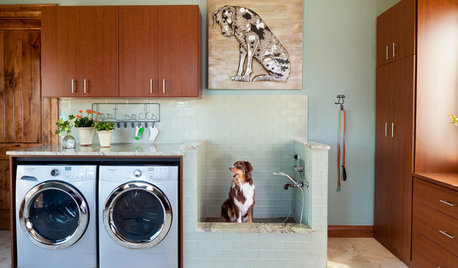
PETSIt’s a Dog’s World in These Hardworking Laundry Rooms
Canine amenities include pet beds, crates, bowls, washing stations, doors and even a designated pet water bowl filler
Full Story
ARCHITECTUREWhat’s Fueling Austin’s Edgy Modern Architecture?
A look at the blossoming design scene in Texas’ capital city — and what’s behind all the experimentation
Full Story
VACATION HOMESHouzz Tour: 1950s Maine Nostalgia Guides Tiny Cottage’s Design
A designer taps into her memories to give her clients the vintage coastal-cottage look they yearn for
Full Story
GARDENING FOR BUTTERFLIESGardening for the Bees, and Why It’s a Good Thing
When you discover how hard bees work for our food supply, you may never garden without them in mind again
Full Story
APARTMENTSMy Houzz: London Living for an Architect-Turned-Food Stylist
We tour this unconventional designer’s apartment and find out why she loves her home kitchen
Full Story
ROOTS OF STYLEDesign Through the Decades: The 1970s
Concern for the planet spurs a shift toward ecologically and socially responsible architecture and products
Full Story
DECLUTTERING5 Ways to Jump-Start a Whole-House Decluttering Effort
If the piles of paperwork and jampacked closets have you feeling like a deer in the headlights, take a deep breath and a baby step
Full Story
MOST POPULARExclusive Video of Wright’s Jaw-Dropping Hollyhock House
Immerse yourself in the stunningly restored Frank Lloyd Wright masterpiece
Full Story
MOTHER’S DAYWhat to Do for Mom Around the House on Mother’s Day
Show appreciation for your mother and make her day extra special with these ideas
Full Story
REMODELING GUIDES10 Tips to Maximize Your Whole-House Remodel
Cover all the bases now to ensure many years of satisfaction with your full renovation, second-story addition or bump-out
Full Story

User