

Teachers pay
Not certain if this is better here or over in Hot Topics but I see where the West Virginia Legislature passed a bill raising teachers salaries. Although it may have changed in Missouri each district used to set the salaries for that district. What states other than West Virginia has a statewide salary structure for the public school teachers? I am meaning grade through high school not college. I think there may me more teachers in this group.
Comments (64)
 8 years agolast modified: 8 years ago
We formed a union because of the overall corporatization of the university. It seems like administrative positions are proliferating like the frogs that invaded Egypt (the second plague). Yes, we need unions in the public sector. It is a slippery slope argument that if you don't like the job, leave. Teachers are trained for that job; many in my position have doctorates, or like me, started the doctorate. So, what are we supposed to do? Leave academia. Or, as in the past, let teaching be a secondary income job. Yes, academic is not the real world; that's why I left the abusive world of business. Not everyone is suited for it. Teaching is a vocation, not a job. I also believe in unions for corporate America so secretaries don't drop dead at their desks from typing documents all night. It has happened. No exaggeration here.
Related Discussions
WANTED: Teacher Neeing Plant help
Q
Comments (5)I have a couple sedums you might like. I have autumn joy sedum and dragon's blood. Dragon's blood blooms and turns from green to a dark color, almost red. If there's anything on my list you'd like for your classroom just ask. I teach recycling to kids and we do hands on projects like making a plastic pop bottle into a lightning bug with a glow stick. It's fun to watch the kids get excited, make connections and ask questions. Heidi...See MoreHow Will Teacher Benefits Dock SS Payment?
Q
Comments (2)It's hard to know without more info. If your husband has "substantial earnings" as defined by SS (see link below), it seems that he can take the pension benefit without it affecting his SS benefit. But for the money involved, it would be a good idea to consult with a lawyer who specializes in pension benefits law. This is a very complicated area and really requires the services of a specialist. Here is a link that might be useful: Windfall Elimination Provision...See MoreMinimum wage
Q
Comments (8)I live in Ontario, where minimum wage is $11.00 currently. That seems pretty high in comparison to in the U.S., but of course I don't know the cost of living in individual States. My daughter often watches the t.v. show 'House Hunters' as she and her husband will be looking for their first home in a year or so, and they pick up helpful hints from these shows. However, it is disappointing for her to see that a very nice house can be purchased in some cities in Texas, for say $350,000 that would cost about $750,000 where we live! So I'm wondering if the wages are also much lower, in balance with the lower cost of living? For example, here in Ontario, the average starting salary range for new elementary school teacher is approximately $37,000 to $77,000 with the median salary being $57,000 per year. The range reflects location (teachers in major cities make more than those in small rural communities) and any additional skills/certifications that are valued over and above the standard teaching certificate qualifications. DD says if elementary school teachers in Austin Texas are making similar to the median range in Ontario, they're getting an amazing bang for their buck, when it comes to being a home owner!...See MoreOur teachers are going on strike
Q
Comments (27)One of my peeves is when people scream about "a teacher makes less than a______". and other apples/turnips comparison. They usually fail to mention that a teacher, whether you want to admit it or not is a part time job, not a full time job. so the "______" to whom you compare works 12 months a year (less vacation/holidays) where a teacher does not. I worked for school districts for many years. I taught and worked in other areas. People seem to forget that most teachers have the summer off. They have "convention" days off, 10-12 holidays, prep hours during the day (which street sweepers don't get) and then vacation on top of it. Calculate out the number of days, hours, months and you may be surprised how little they actually work. Of course that will vary from situation to situation but when I did a calculation when employed in the schools, teachers "worked" about 7 months a year. So when you compare salaries, compare them fairly, not emotionally. You may be surprised at what the numbers actually show....See More 8 years agolast modified: 8 years ago
"It is a slippery slope argument that if you don't like the job, leave. Teachers are trained for that job; "
Scott, these are the circumstances most employed people are able to live with. You say you (unfortunately) had a job in an abusive environment, that's awful but you knew how to deal with it - you left and trained for something else.
It's all well and good to follow one's intellectual loves and passions in college and beyond but the reality is, many of those undertakings don't lead to robust employment opportunities. That's something to think about before jumping in. Another part of the problem for academics (which I'm sure you're familiar with) is that there are too many of them. Too many people having to work in poorly paid and not full time adjunct/lecturer slots, if in fact they can get any teaching jobs at all since so many can't. When a tenure track position comes up, there are dozens and dozens of qualified applicants. Employers don't have to pay good wages because there's an excess of suitable people willing to work for poor wages.
I didn't train to be a blacksmith and neither did you, nor a steam fitter nor a train conductor. Why? No prospects for decent employment. The same is true for those wanting to be academics whether they want to understand it or not. Having a union doesn't fix the problem.
We can happily disagree and still be friends.
- 8 years agolast modified: 8 years ago
They tell us that taking care of, teaching, enabling and encouraging our children is one of the most important tasks that our society deals with, as we prepare for the future.
But when one sees the pay rates of teachers and early childhood caregivers, one would doubt that we put our money where our mouth is.
ole joyful
- 8 years agolast modified: 8 years ago
Maybe. But university slots were historically a male-dominated domain. While most college professors (most of whom of course have much more education) have somewhat better pay (if in tenured slots) than K-12 teachers, the pay isn't great. And at many schools, especially state ones, a large number of classes are taught by non-tenure track stringers, called adjuncts or lecturers. Many of these people need to grab slots for classes at multiple institutions in their areas to come close to earning enough to even barely get by. It's like part time pay with no job security.
- 8 years agolast modified: 8 years ago
What states other than West Virginia has a statewide salary structure for the public school teachers? I am meaning grade through high school not college.
In NC the state sets the salary schedule; it's based upon the degree one holds and the number of years one's been teaching. It's public knowledge, available on the internet, and tops out at $51,300.
However, most counties offer a supplement, which makes the wealthier counties slightly more attractive ... or, in the case of one large-but-always-a-mess county, it convinces people to take jobs they otherwise wouldn't have chosen.
What bothers me most about pay in NC is that our legislators have lied to the general public about our pay. Examples: NC teachers received an average of a 15% raise! In reality, the younger teachers got something like 20%, while teachers at the top of the scale received nothing. Another time, they cancelled our longevity bonus (which had been something like 5% of our pay) ... and at the same time gave us a 5% raise, so we had exactly the same amount of money .... but they told the general public they'd given us a 5% raise.
At these low levels it's often seen as a job of last resort for many, as in "I'll apply for a teaching job if I don't find anything better".
Eh, some people think that way ... but I'm like most teachers: I always was a teacher. When I was 6 or 7, I was already making my younger siblings sit down and listen to me talk about sentences or complete my homemade worksheets. My backup plan was librarian. I cataloged all our books according to the Dewey Decimal System and glued check-out cards into all of them. MOST of my long-time co-workers tell similar stories.
What states allow SS to be claimed by retired teachers and which do not.
In NC we pay into the teachers' pension fund AND we pay into Social Security; thus, we are able to draw a check from both the teachers' pension AND Social Security later in life.
There's so much wrong with our education system, I hold no hope that it ever will be better.
I fear you're right. Two thoughts:
- The problems in the school system mirror the problems in society. Too little parenting, too much indulgence.
- If the American experiment in educating everyone is to continue -- and succeed -- we need to accept the idea that we can't give everyone a passing grade regardless of their efforts /achievements.
If I were King, I would increase salaries for teachers/professors by 50% or more at all levels. I'd make hiring competitive and do away with tenure.
Yes, more money would bring in more candidates, increasing competition and bringing in better candidates. This is going to be a big problem in future years: Right now -- in NC at least -- we seem to have just about the right number of teachers, but fewer and fewer young people are going into education (the year my daughter graduated, exactly FOUR students graduated with the intention of teaching high school (of course, others were planning to teach elementary and middle school). This is a major university that used to be known for its education department; 20% of the current teachers in our system graduated from this university. In another decade or so, we won't have enough teachers to fill the positions.
On the other hand, the idea of losing tenure is scary. New teachers who don't have tenure are on one-year contracts -- that's a scary way to live. Should you buy a house and take on a mortgage, or do you think you might not have a job next year? And with contracts up for renewal every single year, the principal can get rid of a teacher because she is pregnant, has cancer, or simply because his nephew is graduating from college and needs a job. Or, the biggie: The principal needs someone who can BOTH teach Biology and coach swim team. If you're over 50, you know that age-ism in the workplace is very real ... tenure does excuse teachers from that societal problem.
Teachers who have tenure are still evaluated every year -- three times, in fact, and absolutely can be fired if their work isn't up to par. But a teacher at the top of the salary scale can't be replaced with a just-out-of-college teacher to save the school some money, a teacher can't be tossed out a couple years before she'd qualify for a full pension, and a teacher with tenure doesn't have to be afraid to give the school superintendent's son a C.
Could this be a carry-over from when teaching was 'Women's Work"?
Several answers:
- Yes, it's a carry-over from when teaching was women's work.
- Nothing dealing with child care pays well, and that's how many people view the school system.
- "Back in the day" teaching was a job for a woman who had no husband (or at least had no children). Many of the women who became teachers "back in the day" were from wealthy families (who else could afford to send a woman to college?), so the legislators felt some responsibility to "take care of" these husband-less women of good family -- but screw those factory workers! People figured that these teachers (without the help of a man) wouldn't be able to manage their finances, so the legislators arranged teacher compensation so that teachers would receive small paychecks ... but very good benefits (including a pension) so that teachers would "be taken care of" in terms of health insurance and retirement.
Today the small paychecks continue, but the general public doesn't realize that the benefits have been whittled away. I think that's true in many other jobs too, but when coupled with the small paycheck, it's a bummer.
User
Original Author8 years agoSome states would issue teaching certificates to provide teachers mostly in rural districts to people who were not college graduates. Although there were state schools actually called teachers colleges there were not enough people graduating to provide teachers for all of the school districts.
- 8 years agolast modified: 8 years ago
Seems like a questionable practice but as with the closing of so many small and often marginal in quality public facilities in such areas (like hospitals). I think there are a lot of consequences when people decide to live in a rural area and having to settle for a poor quality of public education and sub-par teachers for their children are among them.
- 8 years ago
I would say the opposite is true. The young, motivated great teachers are mostly in rural settings. They are getting their tenure, experience so larger Dist. will hire them. Districts in Cities and towns with a lot of amenities draw workers including teachers. These teachers stay long past their most effective teaching time. They get burnt out and exhausted by the ever-changing education philosophies and trends. They grow families, get lives, that take their focus from their students. This influences their commitment to new and innovative teaching. This is JUDGED from the outside in a way no other profession is. Teacher pay; hiring practices have never been based on Merit. There is no way to evaluate a good teacher. Teacher performance changes year to year, class to class. Until you spend a semester day in and day out observing all the obstacles to educating you will never understand.
- 8 years agolast modified: 8 years ago
On quality (statistically): http://educationnext.org/in-schools-teacher-quality-matters-most-coleman/
- 8 years agolast modified: 8 years ago
Some states would issue teaching certificates to provide teachers mostly in rural districts to people who were not college graduates. Although there were state schools actually called teachers colleges there were not enough people graduating to provide teachers for all of the school districts.
You're talking about the past, right? I mean, I remember as a child reading Little House on the Prairie and being shocked that Laura was hired to teach school, though she was not a college graduate. I'm not aware of any states that still do that today -- in public schools. Charter schools and private schools, of course, do hire teachers without college degrees.
And I won't say they're entirely wrong in some circumstances: For example, if you're a Spanish language immersion charter school, hiring a native Spanish speaker who isn't licensed in America may not be the worst choice.
What is happening in public schools is that they're hiring what's called "Lateral Entry Teachers". This means they hire someone who is a college graduate with experience in -- for example -- the business world to teach Intro to Business. Or a retired engineer comes in to teach math. The person must work towards a teaching degree while being thrown to the wolves in the classroom. Lateral Entry people often leave mid-semester. Why? You may be an expert in your field, but classroom management is a unique skill -- a skill that's considerably harder than knowledge in your content area.
Another thing we're doing to fill positions: Hiring Visiting International Faculty. That's been fun for us teachers.
I would say the opposite is true. The young, motivated great teachers are mostly in rural settings. They are getting their tenure, experience so larger Dist. will hire them.
Eh, this doesn't fit what I see here -- I've seen teachers of varying quality come through my schools -- though I won't say it isn't different in other areas.
I live in a moderately wealthy county just outside the biggest city in our state. The big city schools pay a higher supplement (plus, of course, the state salary), but it's a rough job -- larger classes, more difficult students, well-deserved bad reputation. People don't want to teach in that system, even for more money New people tend to end up there because they are ALWAYS hiring; seriously, they're probably hiring right now, and it's March!
My county -- and the other counties just outside the big cities -- are the ones where it's hard to get jobs. My area is known as a "bedroom community"; that is, professionals live here and drive into the city to work, so we have those professional's children in our schools.
As for rural areas, I think people go there because they personally are attracted to that slower, rural lifestyle. My SIL teaches in a beach community, and it's HARD to get a job in that area ... obviously, the beach is the big draw. They also pay a small supplement -- they don't need to entice people to their area.
They get burnt out and exhausted by the ever-changing education philosophies and trends.
No school is immune from this plague. Neither are any public schools excused from the curse of excess standardized testing.
There is no way to evaluate a good teacher.
I won't quite agree with "no way", but there's no effective way. Student scores aren't a reliable measure. No administrators have time to be in the classroom often enough to grasp EVERYTHING the teacher does from day to day. Parents tend to say "good teachers" are those who give their kids good grades, and "bad teachers" are those who gave their children low grades.
- 8 years ago
"There is no way to evaluate a good teacher"
I don't believe this for a minute. Performance in every kind of job can be and is evaluated. For tenured teachers, even if there are evals, there's little or nothing the schools can do to replace the many poor ones with better performers.
I understand that principals, like teachers, cover a bell curve of capability but if you ask a capable principal who their best and worst performing teachers are and why, you'll get an immediate answer and not a puzzled look.  8 years ago
You do realize that not all teachers have tested subjects? Or that all students and or classes are created equally?
Carol
- 8 years agolast modified: 8 years ago
Yes, I understand. I'll stick to what I said.
Objective test score performance can be one metric of many in classes that have them. There are many other measures too in such classes and of course in classes that don't.
It's not like the world of schools and teachers is in some alternate universe where unlike everywhere else in our society, performance evaluations aren't possible. They are as possible as with any other job or task. And as I said, if you want an indication of how easily teacher performance can be perceived, talk to any decent principal about teachers in their school.
 8 years ago
In my state there is a basic state mandated salary structure but any individual district can exceed that at will.
Teachers in my district are paid about the same as registered nurses; the longest tenured and highest degreed earn about the same as the clinical nurse specialists and nurse practitioners that I work with. In poor districts they are paid much less (also true for nurses who work in clinics, offices, and small hospitals).
Both professions have, I think, been impacted by being traditional "women's careers"; but also I think it is the sheer number of teachers and nurses needed in entry level positions that make higher salaries seem not practical or possible to the powers that be.
- 8 years ago
I think it’s helpful to try and balance the amount of class time taken up by testing. Our kids take some kind of baseline test usually 3x per class, once at start, then middle, then end. The results are evaluated per student, to see if progress is being made. Other measures are used to see if students are at, above or below expected standards for their grade. Teachers get all this data and some of it is used to evaluate their teaching (among other measures) and it’s all used to determine where teachers need to made improvements, or change methods, etc. as well as identify students who may need more help. Some of our better teachers use the limited tech resources we have to do quizzes (there are some fun apps that can easily and quickly make sure all students in class have responded to a question; and the teacher can instantly see if what they just explained/taught was absorbed; if not they can re address immediately).
- 8 years agolast modified: 8 years ago
I live in Canada and come from a long line of teachers and have worked in the school system all of my life. Every school I worked at, the majority of teachers just whined about their situation. Low pay (untrue) the kids, (Their job)) and the hours. What other job do you work 9-3 and get 2 months plus off for 100,000 a year? There are really good, well deserving teachers, but who’s to know
- 8 years ago
In our area, pay ranges from about 50K to 74K. Administrators go just over 100, and principals run around 115. I think most Admin and all principals work 12 months.
- 8 years ago
Hmmm, school hours might be 9 to 3, but I've never met nor heard of any public school teacher who doesn't put in considerable hours beyond that. Not that they don't exist, but ?
- 8 years agolast modified: 8 years ago
"There is no way to evaluate a good teacher"
I don't believe this for a minute.
I won't say it's 100% true, but it's close. Chew on these thoughts -- keep in mind, I teach high school.
- Some teachers teach AP classes, which are filled with smart, motivated kids from supportive families. They read well, rarely miss school, have their eyes on solid future goals, and have parents who support them. Other teachers teach the lower 30%, and I am terrified by how they seem to be worse year after year: We're about 30 days into Spring Semester, and some kids have built up 20 absences. I have only encountered two kids in my whole career who could not read, but most in that lower 1/3 do not read effectively -- this lower 1/3 seems to read at about 3rd-4th grade level, and they are embarassed by it /will do anything to hide it. Others don't speak English. So how can you compare the work of the teacher who spends her day with the strong, motivated kids with the very different work of the teacher who spends her day with the lower-ability kids? Yet they all take the same end-of-course test.
- I know, you're saying, "Test them at the beginning and the end and see how much they improve." A naive answer. The kids in the lower portion often /usually skip the day they know they're going to be given the baseline test ... and they often don't put forth their best effort (for example, knocking out a test in 5 minutes). These lower level kids sometimes refuse to take the initial test if they understand it's a baseline instead of a direct grade ... or they refuse to try if they're upset that day with another kid or with the teacher (perhaps for something like telling them to put away a phone). On the other hand, the AP kids "get it" and purposefully tank the initial test, knowing that they want to "show growth" at the end.
- Our kids are a product of the homes in which they're raised ... and that bottom 1/3 that I mentioned above is really not getting what it needs at home ... and I'm in a fairly affluent county! I have kids who are food insecure, kids who are homeless, kids who are living on their own /working full time, kids who are awaiting court dates /may be behind bars next month, kids who work as strippers in the evenings, kids who flat-out tell you their mamas told them not to listen to white people (especially teachers), kids who are very open about a diploma not being a big priority in their lives. Really, a scary large percentage of our kids are in BIG trouble, and our society is doing little for them. Yet people want to base my performance off the work I do with these kids? It's like basing the dentist's work off whether his patients get cavities.
- Sure, you can look at my lesson plans ... but some people are good at presenting a finished product /presenting it well on paper, but can't make it work in class. Others can take a post-it note full of notes and turn it into a worthwhile class discussion. And since you can buy lesson plans from the internet /teachers share this work within departments, this isn't necessarily a measure of a teacher -- I've encountered a few co-workers over the years who've been completely unable to write lessons ... so they've sponged off other people. And I had one co-worker once who sold my work to a teachers' lesson plan company! (She was fired for stealing from the cheerleading team's fundraiser, so too bad for her ... but, yeah, my work is out there under someone else's name.)
- In my district, you cannot receive top-notch evaluations unless you are actively working to move up towards administration and/or hold leadership positions on after-school improvement committees and/or are presenting workshops to your co-workers on Staff Development days. A teacher who likes being in the classroom /isn't looking to move into a "higher level job" literally cannot be given a top-notch evaluation.
- Administrators come in to evaluate teachers 3Xs per year ... so they see a smattering of what each teacher does. All the administrators (and the other teachers) know who's a strong teacher and who's a fledgling learner ... but it's hard to quantify /hard to justify in a fair way. Every one of us every year has some successes and some failures.
Teaching really is a unique job that's hard to compare to other jobs ... and it's a job that's really hard to evaluate. If administrators had unlimited time, yeah, they could absolutely do it, but within our current structure ... no.
For tenured teachers, even if there are evals, there's little or nothing the schools can do to replace the many poor ones with better performers.
If you mean tenured teachers can't be fired, wrong. I've seen it done. More than a few times. If you mean fewer and fewer teaching candidates are graduating from college, you're right.
And as I said, if you want an indication of how easily teacher performance can be perceived, talk to any decent principal about teachers in their school.
So you'd base people's salary /advancement in their career on casual conversations? When someone who's labeled low-performing challenges this, what evidence will you have?
Some of our better teachers use the limited tech resources we have to do quizzes (there are some fun apps that can easily and quickly make sure all students in class have responded to a question; and the teacher can instantly see if what they just explained/taught was absorbed; if not they can re address immediately).
Our tech resources have grown with leaps and bounds in the last couple years. We now have a laptop for every student in every class -- and it's a mixed blessing. Constantly as I walk around my classroom working with students, I see kids who've opened up summaries of our literature instead of doing the actual reading ... kids who google answers during quizzes ... kids who instant message one another during the tests.
So we have a program to monitor which students are on task /which students are shopping for prom dresses ... but that's one more thing for me to monitor. The kids are smart enough to see me heading back to my desk /leave their goof-off website, and when I'm monitoring my computer to see who's "on task", I'm not walking around talking to students.
Technology has brought new challenges, and while it's advanced our top students, I think it's hurt our lowest students.
What other job do you work 9-3 and get 2 months plus off for 100,000 a year
Just for the record, I teach 7:00 - 3:00 with 26 minutes for lunch, during which I supervise students every other week ... have two months unpaid time off each year ... and my state salary scale tops out at $51,400.
- 8 years ago
I'm reading this thread and learning a lot. Have been mostly adding links to things that helped me understand the issue. The exchange between Mrs. Pete and Elmers made me remember my own experience.
I was one of those students who had computer administer quizzes and grade homework in high school and I hated it. After every due date half or a full class had to be devoted to fixing tech problems or arguing what's fair. There wasn't a class in which I didn't hate that "technology." Fast forward to college --- suddenly the computer-graded system seemed to behave as it should. The difference was that in STEM classes, our "homework" was the work in the computer (writing code and analyzing data and proving that it worked). In humanities classes, computers check our papers over for plagiarism.
- 8 years agolast modified: 8 years ago
I am financially conservative, but I am all for paying higher taxes for increased teacher’s salaries. The salaries in my state are pitifully low. For gosh sake teachers have college degrees, some have masters, and some could be working for higher salaries in other industries. I also feel the same about college professors, but not administrators, the bloat of which I feel might be partially responsible for higher tuitions today.
I would also like to see school go year round in some fashion, so teachers work 12 months. Personally, I think the administrators could take a pay cut. My mother used to teach and I remember hearing horror stories about the out of touch administrators, some of whom were totally off base and clueless and had no understanding of classroom dynamics.
- 8 years ago
Here, the teachers get 3 paycheques in June to carry them until September. So, they are paid for the summer. And they still complain about not getting paid. And my hours were 8-4 and never saw a teacher until the bell rang at 9. Sorry, I’m jaded. My own father was a teacher and then principal and had that attitude of being downtrodden.
- 8 years ago
Mrs, Pete, we’ve wondered what a 1:1 in the District might mean, and it’s interesting to hear your thoughts on that. When they use quizlet or kahoots, it’s quite brief and everyone can see the responses go up on the large screen. One set of computers just for one grade level of science class only. Did everyone just get the explanation of entropy? If not, then the teacher can find out right then, instead of moving on. We are years and years away from 1:1.
I think the whole system needs to be addressed; it’s not serving anyone very well and we’d can’t afford to fail our teachers, and thus our kids, like that.
- 8 years agolast modified: 8 years ago
I was one of those students who had computer administer quizzes and grade homework in high school and I hated it. After every due date half or a full class had to be devoted to fixing tech problems or arguing what's fair. There wasn't a class in which I didn't hate that "technology." Fast forward to college --- suddenly the computer-graded system seemed to behave as it should. The difference was that in STEM classes, our "homework" was the work in the computer (writing code and analyzing data and proving that it worked). In humanities classes, computers check our papers over for plagiarism.
Yep, sounds like my life ... though I can't say I spend THAT MUCH time fixing tech problems. I spend more time listening to students complain that they weren't aware of the deadlines, couldn't finish their work in class, etc.
I would also like to see school go year round in some fashion, so teachers work 12 months. Personally, I think the administrators could take a pay cut. My mother used to teach and I remember hearing horror stories about the out of touch administrators, some of whom were totally off base and clueless and had no understanding of classroom dynamics.
I am of two minds about year-round school, but I'm not going to get into that topic.
In my experience, administrators start out great, but they seem to have a 2-3 year expiration date before they become beat down by the system. It's like they forget what the classroom is like, and they become distanced from the students. I think it'd be wise for every administrator to "go back to the classroom" every 3rd or 4th year.
Regardless, none of them would do their jobs for a pay cut. Their hours are horrible: We have four administrators in my high school ... they're in around 6:00 before the first busses, and one of them must attend every sporting event, every concert, every play, every dance, everything. They spend several evenings every week hanging around the school just looking to be sure everything's good. I take work home every day, but I can do mine at home ... they spend so much time away from their families.
And the way students and parents treat them. It's awful: plenty of our students /parents dislike teachers, but we have kids who like us too; in contrast, few-few-few of our students actually like their administrators. I've been punched in my classroom, and I've been threatened (both in school, and once by a father who came to my house) -- administrators have it much worse.
Here, the teachers get 3 paycheques in June to carry them until September. So, they are paid for the summer.
I doubt it. They're probably offered this option: You will receive X amount for the school year. Do you want your pizza cut into 10 slices or 12? It's still the same X amount of pizza.
I think my daughter, who is an RN, has a better life-work balance. She works three 12-hour days each week /is off four days a week. When she works, she WORKS, but she never brings anything home. She also makes the same money I do -- though I'm in my 25th year, and she's two years out of college.
And my hours were 8-4 and never saw a teacher until the bell rang at 9. Sorry, I’m jaded.
I agree that you're jaded. I am not a morning person, so I roll into the school parking lot about 6:58 every day, and I am noticeably the last one in. I can get away with this because I never leave without having my lessons 100% laid out for the next day. And because after 25 years I have an established reputation ... I can get away with coming in last minute, whereas the new guy can't do it.
we’ve wondered what a 1:1 in the District might mean
1:1 means every teacher -- or possibly every core class teacher -- has a cart in his or her classroom, which holds 30 computers. (Too bad I have 36 students in my largest class.) Students use these computers in class /leave them /the teacher is responsible for keeping them charged and in good condition. Since students take four classes each day, they could potentially use four different computers during the day. All their work is saved to the school server on a personal drive, so they can access their English work from their Spanish class or from the library.
think the whole system needs to be addressed; it’s not serving anyone very well and we’d can’t afford to fail our teachers, and thus our kids, like that.
Yes, I've seen the school system go downhill in my 25 years. Part of it is society and uninvolved parents. Part of it is a need to change outdated methods, but no agreement on just how to do that. Part of it is that we haven't figured out how to effectively integrate technology into the classroom.
My prediction: In another couple decades, high school as we know it today won't exist. Most of our students will spend most of their school day at home on a computer -- and it'll be a bad thing.
In the last five years or so quite a few alternative options have popped up for high school, and it's changing the face of our phase of school.
- 8 years ago
My point about the getting paid in June for the summer, is that you should be able to get by on $100,000 a year whether it’s paid b the month or in a lump,sum. Try budgeting!
- 8 years ago
Pay is district by district in this state. In my district, pay is now starting at $39,015. If I understand the chart I found, the top teacher pay would be $91,915 for someone with a PhD plus 28 years teaching. Apparently it doesn't matter whether grade school, middle school, or high school is being taught.
- 8 years ago
Florida teachers like my daughter with a Masters Degree and 12 years experience make $41,000 . She started at $40,000.
- 8 years ago
I try and teach the students who may have graduated from high schools like the ones described above. Note I said try. For some it may be too late. I make much less than a high school teacher. I do get paid during the summer but I work another job then. Seems kind of unjust as in many cases I am trying to play catch up.
- 8 years ago
I have been working in three school districts for 30 years. Believe what you want, but frankly, the powers that be can't even agree on what a "good teacher" is let alone develop a way to critique all teachers in all situations. The variables are too many and the ever-changing needs of students are impossible to factor in. Everyone knows a good teacher but no one can quantify one. What works for one principal in one school cannot be generalized. The reason some people think a given educational theory no longer works is not all theories/techniques etc work for all schools or all students. There is no point in an argument on teacher merit pay. The data is there to be found.
- 8 years ago
I can also offer this experience of many Principals. If the Principal was say a Business/tech teacher in their first life, and thus believes TECHNOLOGY is the way to reach students than the teachers who use screen to screen teaching as their GO TO are rated by that leader as A GOOD TEACHER. If the Principal began life as a Shop teacher than they will most likely believe EXPERIENTIAL learning teaches the "best" and will evaluate teachers on their "real world" lesson plans. It is SUBJECTIVE, not objective all the time every time. I have worked where "the best" teachers in a given school CHANGES as the Principals come and go. It is what it is people.
- 8 years ago
louise, at first I didn't pick up on your living in Canada. I agree, a person needs to budget their pizza, whether it's in 10 slices or 12. I think it's also true that the annual pizzas for USA teachers really should be much bigger.
MrsPete's characterization of the top, middle and bottom (roughly) thirds of students has been enlightening. Do you think this applies to Canadian students as well -- such a big gap between the top learners and the bottom?
- 8 years agolast modified: 8 years ago
My point about the getting paid in June for the summer, is that you should be able to get by on $100,000 a year whether it’s paid b the month or in a lump,sum. Try budgeting!
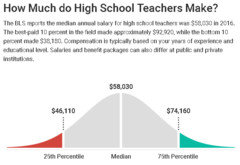
Yes, $100,000/year is a very high salary -- but few, few, few teachers earn that much. Note, too, that when the media discusses teacher salaries, they tend to lump administrators (who make a good bit more) in with the teachers, and that brings up the numbers.
- 8 years agolast modified: 8 years ago
"The variables are too many and the ever-changing "
Are you suggesting this is only the case for school teachers? How is it that performance evaluations are standard and seem to be possible for nearly all employee/employment situations?
" It is SUBJECTIVE, not objective all the time every time."
You're describing human nature in most contexts but also the reason why the best evals involve more than one evaluator and a consensus opinion. Evals are inherently subjective.
"There is no point in an argument on teacher merit pay. "
The best teachers welcome evals and merit pay (as do the best ...........) because it means an opportunity to earn more money. The average and below average ones oppose it because of the risk of decreased earnings. So do do teachers' unions, for the very same reason.
- 8 years ago
Being a retired teacher, I cannot even comment on some of the uninformed opinions here. So all I will say is teachers and police have the hardest emotional, gut wrenching jobs there is and get paid peanuts, and no one respects them.
- 8 years agolast modified: 8 years ago
Are you suggesting this is only the case for school teachers? How is it that performance evaluations are standard and seem to be possible for nearly all employee/employment situations?
I don't pretend to be knowledgeable on everyone else's job, but I do suspect some jobs are easier to monitor /assess than others. Teaching has a lot of "moving parts" that aren't visible every day /aren't visible to people on the outside. For example, if I had to pick the #1 thing that makes a good teacher, I'd say "competent multi-tasker", but that's not on any evaluation I've ever seen. Why? Because it's really hard to assess.
The best teachers welcome evals and merit pay (as do the best ...........) because it means an opportunity to earn more money. The average and below average ones oppose it because of the risk of decreased earnings. So do do teachers' unions, for the very same reason.
No. I'm perfectly willing to be evaluated on my own work. I'm less willing to be evaluated on the grades of students who attend only sporadically and don't put forth much effort -- and that's what it always seems to come back to: student grades.
Being a retired teacher, I cannot even comment on some of the uninformed opinions here.
Thing about teaching is, people seem to think that because they attended school, they know everything about what teachers do.
Makes me think about an episode of the Cosby Show in which Olivia -- was that her name? -- said 4th grade was just too hard, and she was going to quit school. When asked what job she thought she could get with her 3rd grade education, she replied confidently, "I'll teach 2nd grade."
 8 years ago
Both my parents taught for 40 years. I thought I’d teach but after experiencing what being in the classroom as a teachers assistant was like I realized that teaching was not the job for me. My dad probably would have been happier teaching high school and college, my mom taught pretty much all elementary school grades over her career and found it fulfilling though when she became a ‘literacy coach’ towards the end she said that was such an important role that as an experienced teacher she felt it was the best legacy she could leave when retiring. My aunt taught and then became an administrator, (just because she’s my mom’s twin doesn’t mean there weren’t differences in the way they do things!) but after retiring she has gone back as a principal in the school district she resides in. They both taught first grade at the same school for the first decade plus of their careers in education, then my aunt took a job closer to home and my mom stayed at the school she was at but taught other grades until moving to another school in the district. California has seen a lot of changes in teaching and not all of them have been good - the teachers union was both good and bad, i just doubt that many truly understand that the low pay and decent benefits aren’t what leads people to teaching, they stay and sacrifice because they believe in what they are trying to do - teach kids.
- 8 years agolast modified: 8 years ago
Dedication doesn't equal competence. Pay levels and the mess in many public school systems discourage the best and brightest of recent graduates from going into teaching. Union rules and tenure limit what can be done to move out poor performers.
Some private schools, many charter schools, and even some public schools with excellent principals, rise above the muck of the systemic dysfunction they face and do a great job. It's a tough job that at this point we're failing at. It's not an impossible task, most other developed countries seem to do much better than we do. But as demonstrated in this thread, with so many people saying that change isn't possible but also saying at the same time the plight of teachers will never be understood or appreciated. If nothing is changed, nothing will be different.
I think I have a basis for my comments. I've had many friends who were teachers K-12 and at higher levels. Some stuck it out career-wise and others left, often for better pay or to escape the frustration. I have many family members in these positions, including my wife who is a credentialed public school teacher. So, just as the whining teenager may say to a parent "but you don't understand", I'll reply "Yes, I think I do understand. We need to do things differently. Where do you suggest we start?"
- 8 years ago
I worry that the challenges we’re facing aren’t going to get new teachers to replace those now retiring - I honestly don’t know how to fix things, I went into law after all, once I learned what being in the classroom entails. So many decisions are made by non-educators at state and federal offices and we keep trying things that lower actual learning for the sake of chasing good test scores while ignoring examples in other countries who are educating their children well without breaking the bank (ok without spending quite as much as we do for poorer outcomes overall). Are these other countries much smaller than the US, yes, but there might be things to learn from them anyway.
- 8 years ago
Many on the KT are retirees. I suggest you join or start a program to volunteer in your local school. High school today is not what you remember. At the least you will see that reality. You may discover that you are challenged, energized and encouraged by the work.
DH is a member of Grand Times, a 100-member pool of *vetted* retirees who can be called upon by teachers in this 2000-population high school.
This is not 'sit and smile' volunteerism. My DH and another volunteer currently aid one teacher in two classes 90 minutes a day, two to three days a week. He's been doing this for five years, in classes of freshman-sophomore English.
This high school has risen to the challenge of serving a changing population. About 25% of students are immigrant background -- most of whom are the unmotivated kids Mrs. Pete described above. Rather than mourn the loss of the school's former top-five status, the district has risen is working to educate all who come. (Noble, in the face of the profiteering 'charter schools' prescribed by the current White House.)
The North Shore of Chicago is affluent. Retirees come from highly skilled professions. Some are not content to 'do lunch' with fellow board members or play golf 24/7. These seniors have lived advantaged lives and have so much to offer. All this goes to waste because nobody will step up to find out what schools need, and to organize, vet, and run a group like Grand Times.
Volunteers provide insights that *teachers* cannot. My favorite quote from a student to his teacher is, "Are the real people coming in today?"
- 8 years agolast modified: 8 years ago
But as demonstrated in this thread, with so many people saying that change isn't possible but also saying at the same time the plight of teachers will never be understood or appreciated. If nothing is changed, nothing will be different.
That's not what I'm reading on this thread at all.
We absolutely can change schools -- but we as a society aren't willing to do the tough things that'd be necessary to do that. And I don't think unions, teacher tenure, or teachers in general are the biggest problems in schools today.
So many decisions are made by non-educators at state and federal offices
Yes, as I said above, people seem to think that because they attended school, they know what's best in the classroom -- no need to ask actual teachers. Or, the very similar situation: I taught a decade ago, so I know what school is like today.
- 8 years ago
I can’t say my dad wasn’t pleased when I chose a different career, he just knew his daughter well enough to let her try it as an aide and come to her own conclusions. And he saw the writing on the wall with testing becoming the focus, while the trade offs for lower pay as public system employees like health benefits, pensions, and scheduling stability were starting to decline. My mom loved teaching, my dad loved my mom. Still does, just as she loves him for all his quirks and the man he has always been. They’re practical people and are lucky enough to have been financially prudent from the start for a comfortable retirement today. And thanks to watching them, I was lucky to have that opportunity in learning and planning. Of course the bit of money from a family estate didn’t hurt but thankfully my dad kept that until the right time or I might have blown it on a new car and clothes instead of college without needing loans.
- 8 years agolast modified: 8 years ago
"Yes, as I said above, people seem to think that because they attended school, they know what's best in the classroom -- no need to ask actual teachers. Or, the very similar situation: I taught a decade ago, so I know what school is like today."
My wife is still actively teaching. She's my source and I agree with her, she agrees with me. Do you discount her opinion because it differs from yours?
- 8 years agolast modified: 8 years ago
My mom loved teaching,
I like my job very much -- I don't want any other job -- but, wow, the problems that have emerged in the last decade ...
My wife is still actively teaching. She's my source and I agree with her, she agrees with me. Do you discount her opinion because it differs from yours?
I discount it by maybe 50% because it's her information funneled through your own perspective; when my husband and I talk about my job, I frequently say things that make him say, "Really? I didn't know that." I'm sure you're better informed than the general public, but your information is still second-hand.
And I also acknowledge that all states aren't the same.
More importantly, that comment wasn't directed at you personally. I hold to the idea that the general public genuinely believes they're completely knowledgeable about what teachers do.
- 8 years ago
So you've answered my question with a "Yes", you believe you can discount opinions of people who disagree with you. Apparently because you think they must not be as knowledgeable as you are - if they were, you figure then they would agree with you.
That's an awful attitude.  8 years agolast modified: 8 years ago
As in any profession, there are those who do a good job and those who do not. As a retired teacher who works as a substitute, I can speak with authority that I have worked with very, very, very few teachers who have been ineffective. I have seen the evaluation system work to weed out the poor teachers 100% of the time.
Focusing mainly on teacher performance, as so often happens, in discussions about school improvement is very short ended. There are many reasons a child fails to learn. For effective approaches, reforms, and solutions to originate, many other variables in the community/school, besides the skill of the teachers, have to be examined. No matter the ills of public education- low pay, lack of respect for teachers, poor student performance for some, this is true for the majority of teachers and students.
- 8 years agolast modified: 8 years ago
So you've answered my question with a "Yes", you believe you can discount opinions of people who disagree with you.
Not what I said.
As a retired teacher who works as a substitute, I can speak with authority that I have worked with very, very, very few teachers who have been ineffective
Yeah, by and large, the people who should leave education ... tend to leave education.
- 8 years agolast modified: 8 years ago
"So you've answered my question with a "Yes", you believe you can discount opinions of people who disagree with you.
Not what I said."
What you said was :
"I discount it by maybe 50% because it's her information funneled through your own perspective"
I'm repeating the gist of what she's said to me. Do you discount it because you think I have memory problems? Or back to my other speculation, because you disagree?
I think you have a biased "think inside the box" attitude that you're trying to defend not by being informatively persuasive but by denigrating my view that's not in agreement.













Elmer J Fudd