

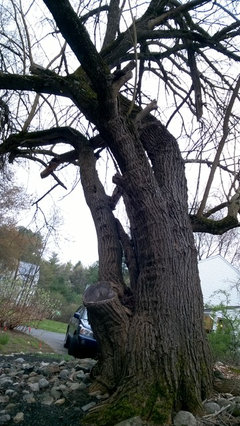
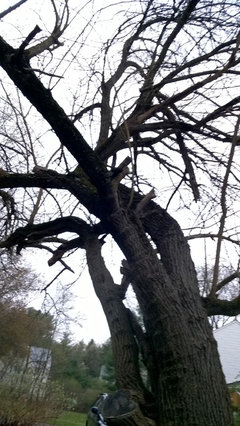
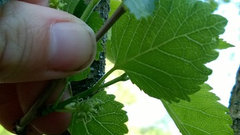
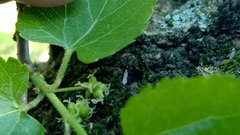
Possible to determine if true Morus rubra vs M. alba hybrid?
9 years ago
last modified: 9 years ago
Featured Answer
Sort by:Oldest
Comments (7)
 9 years ago
- 9 years agolast modified: 9 years ago
Related Discussions
Persian Mulberry M. nigra nursery
Comments (15)My understanding is that mulberries can vary from site to site and that you won't be sure of its performance until you grow it yourself. It does seem that the named cultivars perform better than wild plants and that Morus nigra is easier to root from cuttings than Morus rubra or Morus alba. I'm in the southeast (zone 7b Raleigh NC) and my M. nigra do okay but suffer from some form of rust which doesn't kill the tree but weakens it. I have seen one person growing 'Pakistan' in this state but it was much closer to the coast (possibly zone 8) and the tree was massive with no way to ever get up to the berries. I believe they said the fruit was tasty but that the tree did not produce much. I believe you will need to search out which cultivars are being grown in your area and find a way to taste them and see for yourself how they do. Top performers in my area are 'Illinois Everbearing', 'Wellington' and 'Silk Hope'. Some gardeners here have trouble with 'Illinois Everbearing' but mine seems fine but it is a slow grower. I have 'Dwarf Everbearing' in pots and they do fine. The flavor is good (not as good as any of the others I mentioned) and the trees are small enough to be kept in pots that I move in and out of my greenhouse for the winter. They seem to flush in and out of fruit every other month. Morus rubra is the most common wild growing species and sometimes you'll find trees with tasty berries. 'Dwarf Everbearing' is a Morus nigra and 'Illinois Everbearing', 'Silk Hope' and 'Wellington' are hybrids between Morus rubra and Morus alba....See MoreAny changes to this long list of fragrant roses?
Comments (20)You're welcome! It's not odd that cooler zones will report more fragrance from many than warmer areas. Those in the cooler places are probably smelling them when the oils and alcohols are most volatile and smell the most. We in the warmer areas often miss out because they evaporate faster as the heat increases. Also, as aridity increases, the scents burn out faster. The various components of each rose's fragrance evaporate at different rates, so one may smell very Damask at first, quickly morphing into orris or citrus, finishing a completely different scent before losing any detectable trace for the day. Any user can access the Advanced Search, but Premium Membership permits you to specify multiple traits and types, where basic membership only provides Advanced Search using one criteria. Kim...See MoreNorth American vs European rose hybridisers
Comments (50)I had a point somewhere when I started that thread on this subject which I can't find now. So I'll settle on Cactus Joe's thread. Anyway I came across an article on Kordes in my old Rosebank news letters. It was an article by Harry McGee in September, 1995. The occasion was a visit to Canada by Wilhelm III. It has a good history of the Kordes firm. It started with Wilhelm the first in 1890 in Hamburg. Wilhelm II joined in 1919 in Sparrieshoop. He was succeeded by a non-Wilhelm but still a Kordes, Reimer. Then came the III. All were in charge of breeding operations. Other family members ran the business side. What is relevant in all of this is that the hybridizer was preminent in the firm and therefore put emphasis on that. At that time Kordes was the largest rose nursery in the world selling 2 million roses a year. They made 50,000 crosses a year. After a rose is singled out as a prospect it is grown for 6 or 7 years of testing before it is introduced. They probably are still the largest. Possibly the odds of creating a superior rose are in favor of those who do the most crosses. Stands to reason doesn't it? Even just blind choice should produce now and then something of value. One thing Mr. Kordes said that was interesting is that many breeders have stopped breeding HT's. One reason is that fewer people go to exhibitions. The other is that they are more difficult to get anything worthwhile. Hard to make disease resistant, many are single, fragrance is rare, have fewer hips and what they have don't germinate well and finally they produce fewer flowers. The emphasis on disease resistance began as a result of the Green Parties efforts to ban spraying in many parts of Germany. Kordes then stopped spraying. The result was disaster. Their fields became nearly barren of roses. I guess things have improved since then....See MoreMulberries
Comments (18)Hi, I have a couple of questions regarding Mulberries: 1. I read that Morus rubra (the US native mulberry) only grows to 20' in the northeast - that it only grows to 50 or 70 in the south or mid west? I live in NJ and hope that the tree is a small one (as in around 20'). 2. Will the taste of Morus rubra's berries be significantly worse then the commercial M. alba x M. rubra hybrids, such as 'Illinois Everbearing'? 3. I really want(ed) to stick with the native variety (M. rubra), but don't want to significantly compromise on taste - could I graft a M. rubra limb onto my non-native M. alba x M. rubra hybrid (sapling) so that I have both varieties - I'll actually end up just keeping most of the tree M. rubra and only a single maintained limb of the original hybrid. 4. Will grafting the M. rubra onto the M. alba (x M. rubra) rootstock minimize the risk that M. rubra often experiences of root disease (spread by M. alba)? I figure that since the roots are not M. rubra's (at least I think they don't use M. rubra to do grafts) this would be an advantage. 5. Is M. rubra self-fertile - some sites say yes - and some say that it varies. I guess if it's female, the M. alba x M. rubra self-fertile limb would fertilize it. 6. Do you think that a 10' tall and wide Mulberry tree provides all the fruit one would want; if so, I might keep it pruned small. Thanks, Steve...See More- 9 years ago
- 9 years agolast modified: 9 years ago
 8 years ago

Related Stories

FALL GARDENING11 Trees for Brilliant Fall Color
Give your landscape the quintessential look of autumn with the red, orange and yellow leaves of these standouts
Full Story
CONTAINER GARDENS3 Steps to Creating Quick, Easy and Colorful Succulent Containers
Take a bright container, add a colorful succulent or two and have a professional, summery design in minutes
Full StorySponsored
More Discussions
wisconsitom