

It's a JUNGLE out there!
10 years ago
Featured Answer
Sort by:Oldest
Comments (23)
Related Discussions
pruning squash?
Comments (4)I dont know if your supposed to or not. The stems are very hollow. But I did the same thing. Except mine where my bell peppers. LOL I pruned the zuchini plants back. Didnt seem to hurt them. But I had 2 more on the other side just incase. It did seem to stimulate a lot of new growth from the middle of the plant. And production slowed a for about a week of so. Now 2 weeks later they are fine. I can see where it would be inviting for insects to get down inside the hollow stems to cause problems. Next time Im going to try to prune them as close to the main stalk as possible....See MoreIt's a jungle out there...
Comments (9)I noticed this morning that one has begun to discolor pretty badly on the lower leaves, so take that into consideration later when I snap photos. I tend to remove as much damaged foliage as I can during the season and it doesn't seem to bother them. The plant doesn't look as nice that's all. One thing to keep in mind about hollyhocks, they prefer poor soil and thrive on neglect. They pop up in the most unusual places around here, and no need to fertilize. They don't care for it. At least that's been my experience....See MoreThe Beans I grew this year
Comments (10)The cleaning & sorting are finally done, so these are the results. This will cover everything except cowpeas, yardlongs, and soybeans, so my apologies for the length. After germinating normally, all beans, and most cowpeas, went through an extended period of stunting for most of June & part of July. The degree of stunting, and its duration, varied substantially between varieties; many were over a month behind. Because of this, I considered DTMs this year to be aberrations from the norm, and did not record them. Common beans: * Bird Egg #3 - pole shelly. Initial planting with 2007 seed had poor germination. I culled the sub-standard 2010 seed (over 75% was discarded) and replanted the gaps, with good results. Plant spacing was 2 @ 12" this year, to judge the effect on yield & seed size. Seed size was notably smaller. The plants recovered from stunting & really took off in late Summer. The crop was much later than normal, and much was harvested after the first light frost; but I froze 20 pints of shellies, and harvested 5 pounds of dry seed. * Champagne - pole green snap. White seed. This was one of the first beans to recover from the stunting. When I first grew it, I observed that it had no trouble setting pods in our (admittedly moderate) heat, and that was verified in spades this year. Flat, green, Romano-type pods grew to 7-8" long, had great flavor, and the yield was heavy. However, this variety has a weakness: it is hard to get good seed from it. As in my original trial, about 75-80% of the dry seed was deformed, and had to be discarded; not sure if it is something in my soil or climate, but this is the only bean I've grown with this level of deformity, and it was repeated in different years. This might be the reason it was dropped commercially. * Clem & Sarah's Big Bean - bush dry/shelly. Somewhat rangy bushes, recovered fairly late from stunting, but still produced a fair crop. The white seeds are long & nearly cylindrical, about 3X as long as wide, many with blunt ends. The shape is so distinctive that I could probably mix them with Great Northern, and still separate them fairly easily. Since this was a seed increase, I only ate a few shellies; but those were sweet, and of good quality. * Czechoslovakian - pole purple snap. This was the least affected by the stunting, and growth was exceptionally vigorous in the heat. Flowering & pod set were heavy, and the pods showed no stunting whatsoever. I had previously grown this one in pots, and like Bosnian Pole before it, the increase in vigor when grown in fertile ground was striking. So was the seed increase; with over 5 pounds, it tied BE#3 for highest yield... but in only 16 feet of row, as compared to 72 for BE#3. I only ate one meal, wish I had tried freezing them. * Dolloff - pole shelly/dry. This was quick to recover from stunting, had a heavy pod set, and was the first pole bean to produce dry seed. I would estimate its DTM at about 90 days. While the seed quality was very good, the pods had poor seed count, probably due to the heat. This means the yield potential is most likely higher than what I observed... which would make it quite high. The seed is pink as a shelly, drying down orange -> tan w/brown spots. 12 feet of row yielded 4# 3 oz. * Fortex - pole green snap. This was severely impacted by the stunting; it was over a month late. I was picking yardlongs for several weeks before these even started (!!!) which is a reversal of what would happen in a normal year. They came on strong in September, so I was able to freeze a lot... still, the performance this year was disappointing. The row dedicated for dry seed produced 2 pounds, but more than half of the pods were still unripe when cut down by frost. * Isla - pole shelly/dry. In habit, pod, and seed, this resembles a slightly smaller, more purplish version of True Red Cranberry... I suspect they are closely related. It has a very late DTM, and being forced to recover from a severe hail storm this year certainly didn't help. There were no dry pods before the freeze, so I picked all of the pods that day & dried the ripest ones indoors. The seed appears to be mostly OK, about a pound or so. The flavor is really good, I wish this had a shorter DTM. * Light Brown Zebra - bush dry. This never really recovered from the stunting, and was far less vigorous than it was when I last grew it. The small seeds are beige with black stripes, held in pods which shrink down tightly around the seed as they dry & offer outstanding protection against rain. Collected a pound of seed, it should have been at least twice that. * Poletschka - pole, uncertain use. Started as transplants. I only grew a few plants in pots, and since I was trying for maximum seed increase, I only snacked on one pod raw. Can't remember my impressions of the taste, and apparently didn't write them down. :-( Green pods that shrink down tightly as they dry, with oblong, glossy, purple-black seeds that look almost metallic. The DTM was fairly late. With 3 ounces of seed, I hope to do a larger growout next year for seed increase & evaluation. * Portugal - pole shelly. Failed. This is a shelly similar to BE#3. The vines appeared to be diseased, so no seed was saved, and the plants were destroyed. * Schwarze Witwe - pole wax. I'm told that the name translates as "the veil of old widows", which is a reference to the seed coloration. This was stunted in June, then severely damaged by hail in early July just as it was beginning to climb. However, the plants sprouted new runners & made an impressive recovery. Small 4-5" yellow pods, curved, completely stringless in all stages. The seed is small, very glossy, with fine buff spotting over a deep purple/black background... almost the same purple/black color as Poletschka. Nearly all seed dried before frost, so under less difficult conditions, this should do well here. * Soissons Vert - pole shelly/dry. Finally got a large planting to mature!!! Seeds are lime green as shellies, pea green when dry. These were inexplicably trying to vine on the ground (one other pole bean did this), only beginning to climb in late July with considerable assistance on my part... after which they grew normally. They just made it before frost, but produced a heavy crop. Froze a lot of shellies (somewhere around 20 pints, I lost count) and collected over 4 pounds of dry seed. * Uzice - semi-bush shelly/dry. As discussed on a previous thread, I had to rename this. It was originally sent to me with no name, so I called it Serbian pole, after its place of origin... only to find out that name was already being used in Canada & the U.K. for a different bean (which I hope to grow in the future). Another seed saver in Canada had obtained the same seed from my source & named it Uzice, so I have followed suit. This cultivar was severely stunted, and while it never fully recovered, it still produced an OK crop. Allegedly this is a bush variety, but grown without support, I found the 4-5 foot runners to be unruly; I will probably grow it again on a trellis. The seeds are large, and resemble a slightly smaller version of Porcelain in coloration, mostly white seeds with a patch of tan with maroon specks around the hilum. That resemblance to Porcelain does not extend to the flavor; the shellies are sweet, firm, and of excellent quality. This was a fairly large planting (39 feet of row) but because of the severe yield reduction due to stunting, I didn't freeze any. Collected 3 pounds of dry seed, though, and had a couple meals of shellies just before frost. * Uzice Speckled Wax - pole wax. From the same GW source as Uzice above. These were started early as transplants. Like Soissons Vert, the plants were severely stunted early, and reverted to almost a bush habit until mid-July... at which time they sent out numerous creeping runners. Once trained to the trellis, these began climbing normally, and I would judge the vines as having fully recovered. Flat, curling, yellow, 6" Romano-type snaps of fine flavor. Good shellies, but had enough of other varieties that I didn't eat any. Was able to save 2.5 pounds of seed. * Woods Mountain Crazy Bean - bush snap. Glad I tried this in a hot year! Seeds were started as transplants. While they were stunted in early June, the plants were very quick to recover, and IMO were only minimally affected. Incredibly lush foliage, forming a dense canopy over the beans; planted on 12" centers, the canopies overlapped to completely obscure the ground. The branching was very heavy, like what I would expect of a pole bean or bush lima. The root system was the most extensive I have seen from a bush bean, which probably accounts for its heat tolerance. I was actually late finding the beans, since they were not visible until I tipped a plant over to examine it! The snaps are round, creaseback, 6" long, and borne in large numbers. The flavor was exceptional (comparing favorably with Fortex) with a moderately firm texture. My only complaint would be WMCB's late DTM, which made it a challenge to get dry seed... but then, I suspect this is a bean well adapted to the South, and poorly adapted here. The heavy canopy protected most of the pods from the first few frosts, so I was able to get 8 ounces of dry seed... but over half of the pods were lost to the hard freeze. While WMCB is too late for it to be practical here as snaps, it is a great bean for those in hot climates, and I will continue to grow it for preservation. Limas * Cave Dweller, Black Seed Coat - bush. A black-seeded variety from SSE's collection. Started from 2007 seed as transplants (peat strips with starter mix) and had poor germination. The seeds had been planted vertically (eye down) and seemed to have trouble breaking free. Replanted in pots filled to within 3/4" from the top with packed starter mix, laid seed on its side, and covered with screened play sand. This method resulted in about 90% germination, so it will be my default method for starting limas in the future. (Makes sense when you think about it, since flat seeds in nature would naturally fall on their sides.) These were transplanted into two locations; one of poor fertility, and one of better fertility. The best location was nearly flattened by hail, but the plants resprouted vigorously, and still surpassed those in the less fertile soil that had escaped the hail! Heavily branched bushes, densely covered by flowers. The flower spikes were longer than many pole limas I've grown, flowered over a very long period, and attracted large numbers of bees & skipper butterflies. This was followed by a heavy pod set. The seeds are deep purplish black, and slightly wider & flatter than Sieva, although their seed weight was comparable (at around 60/ounce). As shellies, they had stronger flavor than Sieva, though not as strong as some (such as the Hopi limas). Nearly all ripened (even with the setback due to hail) and there was almost no shattering. From 35 plants, had several meals of butterbeans, and harvested 3.5 pounds of dry seed. * Sieva, Mottled - pole. Started as transplants by same methods, and with same results, as above. Vigorous, heavily-branched vines; I experimented with both 24" and 30" spacing, and 24" seemed to be optimal. Fusion had suggested that I grow 75 feet of white Sieva two years ago, which failed due to weather... but I tried the same length of row this year with Mottled Sieva. With all of the extra heat, and with frequent deep irrigation, the vines were healthy & produced a good crop. While the mottling on the dry seeds was similar, there appeared to be two races; one with black mottling, and one with light maroon or lavender. The seeds are a little smaller than the white-seeded Sieva, (at 69/oz. vs. 60/oz.), and the yield did not appear to be as heavy; but about 80-90% of the pods had ripened before the killing frost. We ate a few meals, gave a lot of shellies away, and harvested just under 22 pounds of dry seed. You have no idea how much seed that is, shelled entirely by hand; by my math, I would estimate around 10,000 pods. (:-o My hats off to DW, who was absolutely tireless in that endeavor... a legumaniac after my own heart. Runner Beans * Bianco de Spagna - white seeded. Failed. Severe stunting, mostly fatal; they never really recovered. The few plants that just barely hung on (I didn't have the heart to pull them out) didn't even flower until very late August / September. The pods harvested just before the killing freeze were usable as shellies, but there was nothing mature enough to save for seed. The curse continues, this seems to be the only runner I can't get seed from. * Gigandes - white seeded. These were slow to start, but were less affected by the the stunting, and were the first beans in that plot to begin climbing. Unfortunately, the vines were stripped by hail in early July. The plants responded by sending out new runners, and made a remarkably rapid recovery... but they were set back by at least several weeks. Dry seed only began ripening about 10 days before the killing freeze. Was able to harvest a lot of shellies, and 11 ounces of dry seed... which will be used for a larger seed increase next year, hopefully under better conditions. Over all, despite a few setbacks, it turned out to be a really good year for seed saving. Of 106 seed crops I planted for preservation, 94 were successful. 59 of those were legumes, including 80 pounds of various beans, and 40 pounds of soybeans. Much of my older stock has been replenished (such as BE#3 & Soissons Vert), and I found a few new varieties that proved to be keepers. I will continue with the results for peas & miscellaneous legumes later in this thread; my final observations for cowpeas & soybeans will follow on other threads....See MoreIt's a jungle out there
Comments (10)SOOOOO fabulous!! Do you ever allow people to tour your garden? I am not traveling much because of gas these days but normally my hubby and I take road trips every weekend. If gas ever becomes reasonable again I would love to see your jungle. My priority next year is to find some truly hardy bananas for this area - the bananas I have now probably are not. I am new to tropicals. Just today I moved some more EEs and cannas and am preparing some areas to winter over bananas(successfully I hope). I think I have found my gardening 'home'. To me there is nothing more energizing and relaxing at the same time than a lush tropical garden....See More 10 years ago
 10 years agolast modified: 10 years agorhizo_1 (North AL) zone 7 thanked morz8 - Washington Coast
 10 years agolast modified: 10 years agorhizo_1 (North AL) zone 7 thanked moonie_57 (8 NC)
- 10 years ago
 10 years ago
- 10 years ago







Related Stories
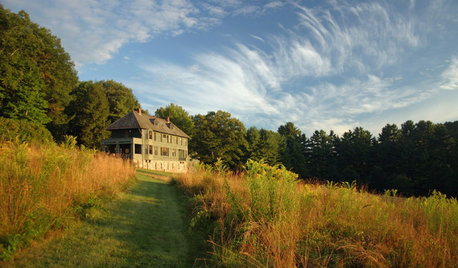
EVENTSSee the Vermont House Where Rudyard Kipling Wrote ‘The Jungle Book’
The author penned many works here, including his children’s classic, which Disney has remade into a movie
Full Story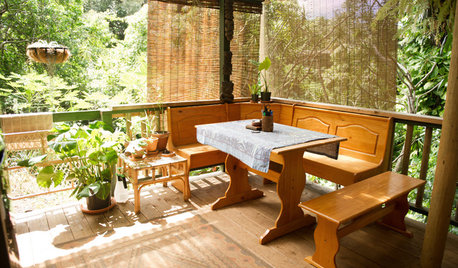
HOUZZ TOURSMy Houzz: A Surf Shack in a Hawaiian Jungle
This Maui artist’s compact home makes room for plenty of creative thinking
Full Story
DECORATING GUIDESLaws of the Jungle: How to Get That Lush, Tropical Look
Explore style's wild side by borrowing the colors, patterns and images of a tropical jungle
Full Story
DECORATING GUIDESConjure a Jungle in a Pot
Sprawling, climbing and with primitive-looking leaves, philodendrons bring untamed beauty to even the most civilized homes
Full Story
DECORATING GUIDESOn Trend: Cut It Out With Norwegian Seating
You may find these nipped-out chairs extra full of modern style and comfort, thanks to their savvy designs
Full Story
GARDENING AND LANDSCAPINGWorld of Design: 11 Balconies Straight Out of a Postcard
Pull up a chair and discover how people in Spain, Japan, Russia, Britain and elsewhere use and love their private lookouts
Full Story
GARDENING GUIDESLet's Weed Out 4 Native Plant Myths
Plant wisely for a garden that supports pollinators and requires less work
Full Story
DECORATING GUIDESBring Out Your Home’s Wild Side
Enjoy some creature comforts with these animal-inspired designs
Full Story
HOUZZ TOURSMy Houzz: Check Out a 'Project Runway' Winner's Brooklyn Studio
Does success in clothing design translate to a fashionable apartment? See for yourself in Gretchen Jones' New York City rental
Full Story
GARDENING AND LANDSCAPINGChill Out: 10 Cool Ways to Beat the Heat Outdoors
Step away from the A/C's artificial blast — and treat yourself to these more natural cool-down methods in the great outdoors
Full Story

socks