

How Do You Fix Your......?
10 years ago
Featured Answer
Sort by:Oldest
Comments (40)
Related Discussions
Do You Like Beets?
Comments (31)I'll bet you didn't know that in early America, prior to about 1830 potatoes were seldom used in this country. Instead, the early Americans relied upon a diet that was heavy with Pumpkins, squash, Beets, Parsnips, Carrots, Rutabegas and what we call Red Top Turnips, all of which held up much better than potatoes in crude cold storage in the root cellar. Not only were beets boiled and sliced in the manner we serve them today, they often cut them in half longwise, baked or roasted them and served them like we do a baked potato. They also boiled them then mashed them just like we do mashed potatoes, but then the early Americans would not waste their time on the little dinky beets we are so fond of today. Here is a photo of the beets that they grew in early America. Note that the barrel they are laying on is a 10gal keg that is about 15" in diameter. These beets average a foot long and weigh between 1 and 3 lbs each. Oh yes, and did I mention that they cooked the tops just like we do spinach or collard greens?...See MoreHominy
Comments (18)Have had this recipe saved for a long time, and it sounds good, but I just enjoy hominy with the sausage link and pepper and heated. Hominy casserole 2 (15 1/2-ounce) cans yellow or white hominy, drained 1 (4-ounce) can green chilies 1/2 cup grated onion 1 (8-ounce) carton low-fat sour cream 1 1/2 cups grated sharp Cheddar cheese 6 strips bacon, cooked and crumbled (optional) 1 1/2 teaspoons salt 3/4 teaspoon pepper Instructions 1.Preheat oven to 350F. 2.Combine all ingredients, except cheese, and spoon into a lightly greased 8-inch square casserole dish. 3.Sprinkle cheese evenly over the top. Cover with foil and bake 20 minutes. 4.Remove foil and bake an additional 10 minutes, until golden and bubbly. Tips From Our Test Kitchen: This hearty dish can be made lower in fat by using half the suggested amount of cheese, using non-fat sour cream and eliminating the bacon....See MoreDo You Like Fried............................................?
Comments (19)I agree with Patti...it's not really fried, I don't know why they call it fried except you put a big dollop of butter or bacon drippings in a skillet and stir it up with the corn and cook it slowly until it is nice and done and it's juicy and creamy. It really is more like the creamed corn most people know than anything fried. I didn't grow any corn this year but I put a whole bunch in the freezer to use when the fresh is gone. I cut if off the cob so I can fry it......See MoreIf you don't amend the soil then how do you fix it if it drains fast?
Comments (28)I can definitely say that I am in the average category for one part and in the slow category for the other part of the lawn. I'm in the middle of performing another one with three separate holes. After 30 minutes the top two holes at the highest point of the lawn have dropped three and 4 inches respectively and will definitely drain within two hours. The hole at the way bottom of the lawn where all the water runoff is has only dropped about a half of an inch. No grass grows at this downward slope portion. I did the shake the jar test last night and am waiting for the Clay to settle to determine the composition of the soil. The confusion stems from statements like these: "Properly draining soil drains at a rate of 1 to 2 inches per hour. If the soil drains at any other rate, modifications to the soil are needed." http://homeguides.sfgate.com/increase-soil-drainage-24306.html "If the water takes from three to 12 hours to drain, then the drainage is adequate for most landscape plants (about 1 inch per hour). If it takes more than 12 hours, then the drainage is poor." -http://essmextension.tamu.edu/treecarekit/index.php/before-the-storm/tree-identification-and-selection/identification-of-and-corrective-action-for-poorly-drained-soils-in-the-landscape/ In well-drained soil the water level will go down at a rate of about 1 inch an hour. A faster rate, such as in sandy soil, may signal potentially dry site conditions; http://agebb.missouri.edu/agforest/archives/v10n2/gh14.htm...See More 10 years ago
 10 years ago
 10 years ago
 10 years ago


Related Stories
LIFEHouzz Call: Show Us Your Nutty Home Fixes
If you've masterminded a solution — silly or ingenious — to a home issue, we want to know
Full Story
LIFEYou Showed Us: 20 Nutty Home Fixes
We made the call for your Band-Aid solutions around the house, and you delivered. Here's how you are making what's broken work again
Full Story
SELLING YOUR HOUSEFix It or Not? What to Know When Prepping Your Home for Sale
Find out whether a repair is worth making before you put your house on the market
Full Story
HOUSEKEEPINGWhat's That Sound? 9 Home Noises and How to Fix Them
Bumps and thumps might be driving you crazy, but they also might mean big trouble. We give you the lowdown and which pro to call for help
Full Story
SELLING YOUR HOUSE5 Savvy Fixes to Help Your Home Sell
Get the maximum return on your spruce-up dollars by putting your money in the areas buyers care most about
Full Story
HOUSEKEEPINGQuick Fix: How to Patch a Drywall Hole
Dents and dings disappear, leaving your walls looking brand new, with this fix that even a novice can do
Full Story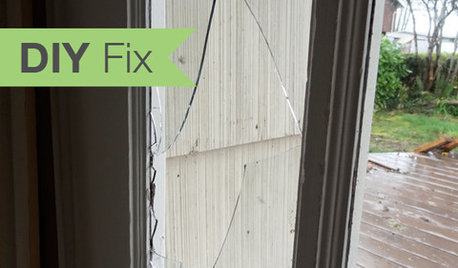
HOUSEKEEPINGDIY Fix: How to Repair a Broken Glass Door Pane
Don't let broken glass shatter your self-esteem. You can fix it more easily and more inexpensively than you might realize
Full Story
PRODUCT PICKSGuest Picks: Hot Chocolate Station Fixings
Treat family and guests to a fix of cocoa in a festive mug, accompanied by sweet somethings, from a well-stocked kitchen station
Full Story
DECORATING GUIDESQuick Fix: Correct Squeaky Floors and Sticky Doors
An Atlanta contractor shares his secret solutions to two common household annoyances
Full Story
DECORATING GUIDESQuick Fix: Update Bookshelves With a Coat of Color
Hungry for quick color? Turn your shelves into a mini accent wall
Full Story
satine_gw