

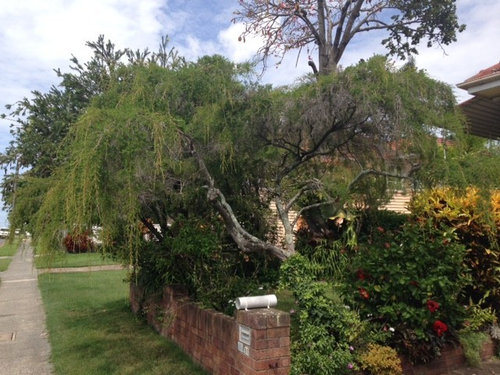
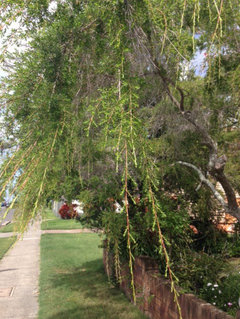
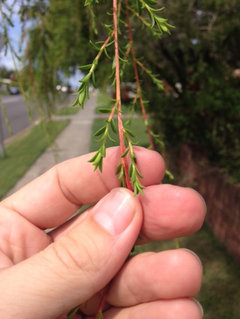
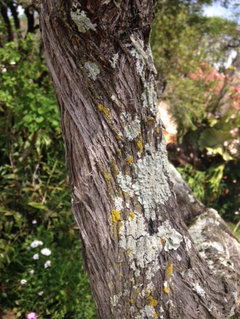
Is this a weeping Leptospermum or Melaleuca? Suggestion
11 years ago
Featured Answer
Sort by:Oldest
Comments (11)
 11 years ago
- 11 years ago
Related Discussions
Remove or Amend Beach Sand?
Comments (32)I want to thank everyone who took the time to post such detailed and wonderful advice here! My renovation is finally done and I am getting ready to plant. At last! I have been closely reviewing all the suggestions and advice and have come up with what I hope is a good plan. I had 6" of sand removed, added an equal amount of compost and have irrigation going in as soon as I finalize my planting scheme. I have been using Pinterest to gather images of all the plants you recommended and narrow down selections. The San Marcos Growers site as well as some of the other links posted have been invaluable as a resource for what is available in my area and in helping select appropriate plants. I am attaching my plan. The house faces the ocean but there is a parking lot & a lot of tourist foot traffic in between so we put up a 4' wall with another 2' of semi-open wood fence on top. Also, just to the south west of the house is a large lifeguard station / maintenance area that isn't pretty to look at so the tree is placed to soften the view of that. Finally, the sides of the house remain sand in this plan. On the north side, there is only 16" to our property line and on the south side, the same plus another 3' that belongs to our neighbor. That area is needed for access and I'm not sure what else to do with it. I am imagining gravel would just get mixed in and covered with sand soon anyway? I guess we could pour concrete?) I am also including a link to my Pinterest page with the plant selection. There are a couple extras as I can't quite decide which Leucadendron & which Protea I prefer. I would love to hear any thoughts or comments before I start buying plants! Thanks again!...See Moresan pedro coastal bluff - soil erosion/iceplant
Comments (2)I live on a coastal bluff in Solana Beach. I am looking to plant deep root plants to help stabilize the top of the bluff. I thought ice plants were not good for this? Rosea iceplant and Lampranthus is suggested above. Please any advice what to plant. thanks...See MoreNeed a tree that'll stand up to wind
Comments (7)I have planted Lyonothamnus right along the coast, and they can be abit fickle and variable in vigor in high wind situations. I would agree that they are probably best with some shelter from wind, rather than full force exposure. You might also consider some smaller wind tolerant evergreen trees such as Tristaniopsis laurina, or the taller growing Cow Itch Tree, Lagunaria pattersonii. The Agonis flexuosa and the dark form cultivar already mentioned could also be good. If you are planting these in a lawn situation, the Mayten tree would still be a good choice, as even with root sprouting, in a lawn, with regular mowing, this wouldn't be an issue. Another classic tree for coastal windy conditions would be some of the Leptospermums or Melaleucas, much used along the coast both north and south. Another classic tree for coastal wind is the New Zealand Christmas Tree, Metrosideros excelsa. I have also planted the South African Silver Tree, Leucadendron argenteum 3 blocks from the beach in Moss Beach, and they are thriving, but this can also be either a short lived or temperamental tree. In any case, regardless of what you plant, you will probably be better off if you plant it out as a 5 gallon sized tree, and make sure that it is not at all root bound or any kinked roots at time of planting, and stake it so that the trunk can move with the wind, thereby greatly increasing the rooting ability to withstand winds. Even your first choice of Eucalyptus polyanthemos might have been successful if thinned occasionally while young, or even headed back to allow regrowth as a multi trunk specimen. I am willing to bet it had kinked or encircling roots that made it structurally unsound from the start. Other Eucalyptus species to consider might also include E. ficifolia, E. pulverulenta or E. perriniana. Smaller growing pines such as the Shore Pine, Pinus contorta or Pinus muricata might also be considerations. Post again and let us know what you decided to plant, okay?...See Morehillside gardening - plants / terracing?
Comments (32)Update (2013 follow-up) of successful steep slope plantings on a dry sandy slope in So. Calif. In my previous post, I listed drought-tolerant Calif. natives used in my initial plantings. But the fire department does NOT like summer-deciduous plants such as sages. And as water was reduced, plants such as Wooly Blue Curls did not survive. It has been a 10-year project and this is how I turned a steep dry sandy slope into a drought-tolerant garden: 1) Basic Calif-native trees & shrubs were planted (a couple of Coast Live Oaks, lots of fire-resistant Toyons, McMinn Manzanitas, Sunset Manzanitas and the wonderful Hollyleaf Cherry are good choices). At the driest upper areas, Palo Verde Trees were planted for their deep tap roots and provide 25% shade cover when leafed out during the summer. 2) The slope is very steep. As I worked the sloped while planting and watering, a curvy informal foot trail started to form. As the trees and shrubs took hold of the soil, these foot trails were gradually deepened. Most native ground covers are sold as tiny little things that can't get a hold on steep slopes or are buried under a shovel of dirt unless planted at the base of an agave for protection. Tip: Buckwheat prostrate is a great steep-slope ground-cover that drapes down and hides the vertical cut edge of pathways. 3) The native flower shrubs (Wooly Blue Curls) died. Calif. Fushia is very dought resistant and is best if tucked under an agave to brighten up the driest desert plantings at the upper level. As the trees, shrubs and trails became established, lots of agaves were added to hold the surface soil. Cabbage-sized boulders were often used to hold new plants into the slope. 4) Erosion: A line of three monster Blue Agaves were planted in a horizontal line whenever a "dam" was needed to divert rainwater from running straight down the slope. The maturing slope contours (trails) were gradually deepened and dirt bermed up so that rainwater would travel across the slope and flow into collection basins behind trees and shrubs along the way. The pathway/contours took a lot of time to evolve but was well worth the effort. Instead of walking "on" the slope, the deepened pathways amongst the plantings now gives the feeling of a nature hike. 5) Gradually, non-native plants (aloes) were added to the semi-shaded areas. For the upper "desert" area, tons of barrel cactus and agaves were used as a ground cover alongside uprights such as pony-tail palms and colorful upright non-native Sticks on Fire & Crown of Thorns. This large (1/2 acre) hot dry, sandy steep slope was a real challenge and still is not finished. To make things look right on a large steep slope, you will need dozens of each plant to form groupings. You can use dozens of spikey Agave Geminiflora to give the illusion of a "meadow". Dozens of Golden Barrel cactus planted in an informal "swirl" along a switchback gives the impression of a flower garden from a distance. With a little imagination and a lot work, a steep slope can become a beautiful garden. Take courage, though, because it takes YEARS before others are able to "see" what you have planted. And on difficult slopes, it is better to overplant your basics of trees & shrubs because on a contoured steep slope, a sprinkler grid is too complex and you will lose some trees/shrubs when hand-watering is reduced....See More- 11 years ago
- 11 years ago
- 11 years ago
- 11 years ago
- 11 years ago
- 9 years ago
Related Stories
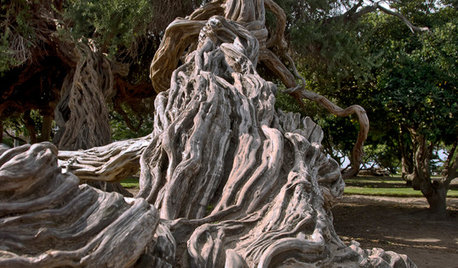
GARDENING GUIDESGreat Design Tree: Australian Tea Tree
A living sculpture with an unmistakable appearance, this coastal native creates an intriguing landscape scene
Full Story
LANDSCAPE DESIGN8 Reasons to Plant a Great Tree
Beauty is its own reward, but the benefits of planting the right tree in the right place go way beyond looks
Full Story
SPRING GARDENING7 Spectacular and Practical Spring-Flowering Trees
Put on a beauteous show in the garden with a landscape tree awash in flowers — just do your homework first
Full StorySponsored
blckrose