Houzz Logo Print
alcina_gw

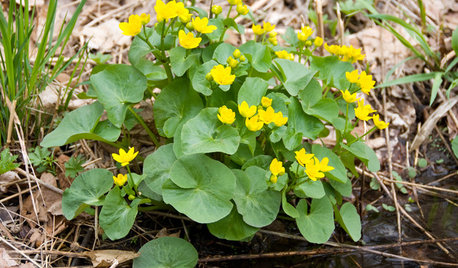
Ranunculus ficaria (Lesser celandine)

21 years ago

I've finally identified this little beastie in my garden! When I first moved in (3 years ago in March) one of the beds had this. I thought "Oooh...pretty yellow flowers, nice green foliage, all very early in the year". Now...it's *everywhere* :(

From what I've read (and tried!) digging it up isn't particularly effective as you have to get every single one of those little tubers, and they detach really easily! I think I'm going to have to resort to Glyphosate. Any spraying will have to be done in the next week or two as it's in active leaf growth now and will be flowering (and producing more little tubers) after that.

Unless anyone else has other suggestions/better experience at getting rid of this pretty but thuggish native plant? Of course having had weeks of no rain or wind (ie. perfect spraying weather) it's now howling like a wet hurricane out there...I think the weather is in league with the little plant!

Many thanks in advance

Alcina

Comments (23)

  • 21 years ago

    It's a bit like Oxalis, really. Try digging up the entire clump and consigning it to a plastic bag headed to the tip. Early spring is a good time to do this because the damp soil holds together and there are roots to help. Later on all those little bits find it so easy to get lost in summer-dry soil.

    Fill in the craters (about four to six inches deep) with your best compost and annuals. You'll need to check for strays next year and it's awful digging up something precious just coming into production.

    I'm not sure just how effective Roundup is on buttercups. They might look sick for a while but they'll be back, sure as.

  • 21 years ago

    Hmm...what to do, what to do....?? :( If I dig then I definitely can't use Glyphosate (no leaves left!), but then I tried digging last year and the results were...well...pathetic! That said, I was digging them later on in their short season. However, if the weather doesn't lift in the next week, the Glyphosate will be useless anyway. Sigh...what possessed the previous owner to plant the damn stuff!!!

    I appreciate it's not going to be a one-stop-shot. I think if the weather lifts this week I'll spray and then dig up anything that's looking "I'm not dead yet" in three week's time. Hopefully that's still before the new tubers are made. Repeat as applicable for the next decade :(

    Alcina

  • Related Discussions

    Yellow Flowering Spring Plant

    Q

    Comments (2)
    My most clever friend Naomi has identified it: Ranunculus ficaria (Lesser Celandine, Fig Buttercup) She identified it from the link that follows... Here is a link that might be useful: Most-Hated-Plant-Number-8
    ...See More

    Name that lawn weed

    Q

    Comments (3)
    Ficaria verna (used to be Ranunculus ficaria) Lesser Celandine. The flowers are closed in the picture. They'll open in the sun.
    ...See More

    Ranunculus or caltha?

    Q

    Comments (2)
    Looks like Ranunculus ficaria, Lesser Celandine. A bit of a thug as it reseeds rather aggressively, but since it appears only for a short while in early spring and then recedes into dormancy for the rest of the season, it's not that difficult to coexist with. And you can easily remove unwanted seedlings. I would avoid planting it near natural areas, however.
    ...See More

    Celandine Major and Minor; I.D.'ing the Weed and the Treasure

    Q

    Comments (13)
    Dear gg and gng, Well, you botanically conversant gardeners you, I�ll have you know that you have accomplished a rare feat. (Aside- over the winter i became a 3-4am bedder and 12-1pm riser.) YOU have gotten me up before 11am. Because i woke up fixating on, and finally realized, what you were telling me about these 2 plants. Now let me get this straight. You two botany savants are actually telling me that these two plants, that have leaves THAT I CAN HARDLY TELL APART, that have near identical flowers as well, that these two plants are actually NOT in the same GENUS?? that one is a poppy and one is a buttercup???? I am scraping my disadvantaged brain to find any similar case in the world of perennials. I mean, the 4" tall weed of japanese knotweed... is in the same genus as the much taller-larger form of polygonum bistorta superbum. IN THE SAME GENUS!! Why do i have the strange sensation that you two are going to come up with a number of other perennial examples of like situations(i.e. near identical form but different genus)? Or is this likely to, some time in the future, follow the course of the polygonum/persicaria/falopia re-categorizing??(I figure every expert field has their To Do list, right?) I await, somewhat sleepily, your answers!! best, mindy (note how, when i�m embarrassed, i never put the website link!)
    ...See More
  • 21 years ago

    I had a patch spreading in my lawn. I used Verdone Extra - I think, I can confirm the exact name if you need it. It is Clopyralid-based so you have to be careful about composting of contaminated material. So far this year, no sign of the pretty little yellow flowers. I did try some regular lawn weedkiller and there was some leaf kill but it seemed like it wasn't effective enough to kill the plants completely.

  • 21 years ago

    Is Clopyralid like Glyphosate? ie. it doesn't kill the earth underneath for two years! I guess that lawn weed killer can't be that strong otherwise it would also kill the grass. There's not much else growing at the moment so a contact killer should be ok, so long as it doesn't do two years worth of damage to the soil!

    Ok...so it'll kill the grass where the celandine has spread, but the 'lawn' isn't exactly pristine anyway! The holes from the glyphosate will probably be less noticeable than the damage done by overhanging bushes! :) I think I might give up on the lil' 'ol patch o' grass! I recall now that I sprayed glyphosate on a bare patch of lawn last year that the celandine had overtaken and it did kill it - and it's *not* reappeared there this year (everywhere else...yes!). The lawn seed I put down 6 weeks later grew with no problems.

    So chaps, pray for a break in the weather this week for me I'm a-goin' sprayin'! :)

    Alcina

  • 21 years ago

    Alcina, Clopyralid is a selective broadleaf herbicide. It is designed to kill weeds without harming grass. It is extremely effective against most, but not all, broadleaf plants, especially plants in the legume group. It is not particularly persistent in soil, but is toxic to sensitive plants at such low levels that problems have been reported in agricultural conditions up to a year after initial use. Peas and beans are especially susceptible. Amongst ornamental plants, Petunias are especially sensitive, but many ornamantal plants are not. Instances of very long persistance in compost have led to the withdrawal of Clopyralid lawn weedkillers from most retail markets in the US. You will see on the label that first lawn clippings after use should not be composted and that subsequent clippings should be composted for at least six months. I would recommend only using this type of weedkiller for isolated spraying on specific problem weeds.

  • 21 years ago

    I've got a fair bit in my front garden but as it dies down to nothing in the summer months it has not seemed like a problem. And I like the way it's a harbinger of Spring. But shoud I take action before things get out of hand?

  • 21 years ago

    Cool Shubs, thanks for that! I'll stick to Glyphosate - at least I know what that does 6 weeks down the line (more or less!) I won't be composting the celandine anyway just in case it sprouts again. I don't mind that it kills grass (good excuse to get rid of the lawn!)

    Nerd...ahh...this is where I was a couple of years ago. It is pretty I cannot deny that, and it's a great harbinger of Spring, and it totally disappears (on the surface) by the summer...but it is a THUG! Maybe just clear up the edges every year to make sure it doesn't spread through every bed and blade of grass. I did discover last year that the local wood pidgeons seemed to enjoy eating the little tubers, but either they didn't eat enough of them, or they simply pooped them out again and deposited them in the middle of my lawn complete with fertilizer!

    Good luck!
    Alcina

  • 21 years ago

    I sympathise Alcina since I've been spending a few hours digging up the bulbils - I think that a pound of soil has ended up in the bin too since shaking it off only spreads the weed. Glyphosate doesn't work very well at all. When some building work was done on part of our garden I asked the groundworker to get rid of the soil rather than put in on a clean part of the garden because it had celandine in it. I now have a more manageable area to clean up. It's in my lawn too so I might try the verdone extra on it.

  • 21 years ago

    I managed to get home in time yesterday to spray thoroughly with Glyphosate before a) it got dark, b) it started raining, c) the wind picked up! Fingers crossed! :) I feel like I've sprayed half my garden! :(

    Alcina

  • 21 years ago

    Here's hoping...

  • 21 years ago

    Do post back how it goes. Did you notice that the celandine has a very waxy coating that sheds sprays quite well? Hopefully some stuck to the leaves!

  • 21 years ago

    I bought a new bottle of Roundup and it claims that it is now "foaming" so that it's less easy to shed. It was rather like spraying mousse on the weeds! :) It seems to have stuck!

    I'll report back in 6 weeks....!

    Alcina

  • 21 years ago

    Update time...

    You guys were right! Sigh....I have dead patches in the lawn, but lots of healthy looking lesser celandine. Sigh...Sigh...

    It's just about to flower, would "mowing" the stuff at least help to prevent those innumerable little tubers from fattening up? Time to get out the trowel...sigh....

    Alcina

  • 21 years ago

    Mowing won't hurt it in the least, although it can stop you getting any more seeds.

    From when you sprayed with the Glyphosate, it is possible that you didn't get the best effect. Seem to remember it was pretty cold in mid February and you mention rainfall shortly afterwards. The glyphosate, like any weedkiller, should ideally be on the leaves for 6-8 hours before any rain.

    I did get a couple of leaves regrowing this year after spraying with the Verdone Extra last year. Sprayed those again and they are curling up nicely.

  • 21 years ago

    Now I am starting to get really worried!
    I think the horse has already bolted so it's no good shutting the stable door. Don't fancy all that Round-up spraying. Ah well, they'll die back soon so I can forget about them till next spring.

  • 21 years ago

    Bwahahahahahahahaha!!!!! Sorry Nerd! :)

    Ooh....Shrubs...if I sythe it every week, will it eventually give up in a few years? I've already hoed one bed out of frustration!

    Alcina

  • 21 years ago

    How I envy you Alcina. In my garden I have a plant of 'Brazen Hussy' (the copper leaved version) that has struggled to three plants from one over a period of five or six years. Maybe it's too cold in my windswept garden. It sounds as if your climate is just too good. Move to 800 feet in the Pennines and all your celendine problems will go away. Another plant that gets out of control for many is Winter Aconite - not for me. Mine just die out. I'll have to stick to what will grow and spread enthusiastically like Iris riticulata. Hope you can sort out your battle with the yellow peril. Being overcome by rampant growth is no fun.

  • 21 years ago

    Alcina, maybe you could wear it down. I think this little terror wins most battles because nobody is prepared to go out to joust in February :)

    Robert, you might be right about exposed locations. Around the Peak District and the southern Pennines, Lesser Celandine is everywhere, but always nestled down in gullies or on banks alongside sunken roads.

  • 21 years ago

    Ah..a quandary...move vertially upwards 800 feet to get rid of the celandine, or grow an olive tree on my patio...decisions, decisions... :)

    Been out today pulling up handfulls of the little blighter - trying to get as many of the little tubers as possible. Remind me next year to pick up all my berberis cuttings...those thorns are *sharp*! I've yanked out lots of my crocosmia, decapitated several garlic plants and completely obliterated my campanula because the calandine was completely entangled with them :( My lawn now has big patches of dead grass from the glyphosate, and in the middle of each patch is a hole where I've dug the the celandine out! I'll never play croquet on the lawn!! I've filled a black bin liner with celandine though!!

    I think you're right Shrubs, I should have done this in February when it first shows its head :(

    Alcina

  • 21 years ago

    Oh great, I've just bought some Brazen Hussy ranunculus, and now I'll be scared of planting it...

  • 21 years ago

    Anyanka, your neighbours with prize lawns will hate you :)

  • 21 years ago

    It *is* a lovely plant and very cheerful in the early Spring. I suspect the key thing with is is "containment". Stop it spreading at the first sign out outbreak! :) Also mine is the bog standard wild version by the looks of it, the Brazen Hussey might not be so rampant?

    Alcina

  • 15 years ago

    Thanks to all for sharing battle stories with this seriously obnoxious weed. I try to stay organic but am trying Roundup. I don't see much sign of weakening. I might need to try another weedkiller. Digging is almost pointless but I'm doing some of that too. I hate this plant!!!

Sponsored
Buckeye Basements, Inc.
Average rating: 5 out of 5 stars40 Reviews
Central Ohio's Basement Finishing ExpertsBest Of Houzz '13-'21