Houzz Logo Print
chris_nh_gw

2nd nest: Not a bluebird

18 years ago
The first family of bluebirds seemed to do fine. I never saw the babies fly away, but the nest was empty several weeks ago and the only thing left was one egg that never hatched (three did).

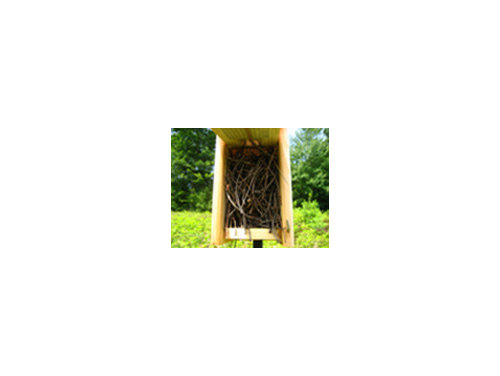
So I cleaned out the box and put out the 'Vacancy' sign. I saw a male bluebird at the opening of the box one day, and I figured he & the Mrs. would be back for round 2. Instead, some other type of bird has taken up residence. This one has a longish beak, is a sort of two-tone brown, stands on top of the box and sings away is a very 'songbird' sort of way. Not a sparrow, I'm sure of that. But what could it be? The picture below shows the nest constructed of twigs, not pine needles. You can see that the bird has filled the box, and the 'nest' is somewhere in this mess, I'm quite sure.

I'm in southern New Hampshire.

Image link:

Comments (24)

  • 18 years ago

    You have a House Wren

  • 18 years ago

    That's it alright. In reading about this type, the House Wren seems to be quite the aggressor...mean, even!

  • Related Discussions

    surprise!

    Q

    Comments (3)
    While it's certainly possible he could have left prematurely, it could also be he was just the first one ready to fledge. One nesting I had a year or two ago, I saw the babies in the trees with parents feeding. I had assumed they all fledged. No sign of activity at the box, so two days later I opened the box and two more flew out. They were more than ready to go and headed right up into the tree. So it could be the ones still in the box are just not quite ready.
    ...See More

    2nd nesting

    Q

    Comments (5)
    Yes there are a few people that still visit this site. I check it from time to time, but it's very inactive compared to the bluebird nut cafe, and that can be a bad thing if you have an emergency and need help quickly. I am not a moderator there but I do check in almost every day. I wish we could get everyone on the same site lol.
    ...See More

    All fledged

    Q

    Comments (4)
    Thank you all! I am not exactly sure but since I am in CO I think they are Western BB. Yah, they are the fledglings from the 1st brood. At one time, 4 fledglings (never saw all 5 them together) and parents were at the feeding time, all tried to bring mealworms to the nestbox, quite a traffic jam. Sometimes a fledgling would bring a mealworm in, then comes out with the same mealworm, so apparently they are not quite a skilled caregiver yet. Below is a fledgling checking the nestbox. The same BB pair has come for the last 3 years. I know they are the same because they know the where the mealies are right away, even when I place the bowel inside the "jail house" feeder. Until next year :-)
    ...See More

    3rd sets of eggs from same parents, none hatching

    Q

    Comments (6)
    Whadda Know? Amazingly enough, you were correct. This morning was 17 days after last egg was laid. Opened door and there were baby birds. Didn't get an accurate count on how many hatched. Sun was shining in nest and I was being dive bombed by parents. Will check again tomorrow to get accurate count. 3rd time was the charm! jk
    ...See More
  • 18 years ago

    Yes Chris the HOWR is major enemy #2 for all other cavity nesting birds. The House Sparrow being enemy #1. The problem with the WOWR is they are protected birds where the HOSP is not and can be controlled.

  • 18 years ago

    I'll just add that perhaps this isn't even a "real" HOWR nest - it may just be a dummy nest with all those twigs. If it is, this little guy has put it in place to keep someone else from using "his" box.

  • 18 years ago

    Yep, a house wren. I'm sorry. :(

  • 18 years ago

    I can't tell whether this is a dummy nest or one for real use. It is mid-July, and I'm not sure whether this is when a House Wren would lay eggs. The bird does go in and out of the box, hopping up on top and singing its song. As you can see, there's quite the barrier to entry for any other bird that might want to try.

    {{!gwi}}

    {{!gwi}}

  • 18 years ago

    Chris, the best I can tell it looks like a dummy nest. You will have to tilt it out to see if there is a soft nest cup in there or not. If there is a soft nest cup and eggs I am sorry. If not take it out.

  • 18 years ago

    I think I saw some white cotton-like material beyond the thicket of twigs when I opened up the box (above). I will look a little closer tomorrow. Also, I see no evidence of more than one bird (i.e. no obvious male & female couple sharing the work). Maybe house wrens operate as 'single parents?' Or, the male & female look identical? I will certainly leave things alone if I see what I think is evidence of a nest. But even if I obliterate the whole thing, is mid-July a season where any other birds are going to come to the box and set up a nest? If not, maybe I should just let the house wren have its fun thinking it 'owns' this particular bluebird house ;-).

    Chris in NH

  • 18 years ago

    Chris, the result of allowing wrens to nest in your boxes is that you will probably then have them season after season. They return to areas where they have success. Lisa is correct that house wrens are very destructive to bluebirds and other native cavity nesters. They will remove eggs and young hatchlings from nests and fill boxes with sticks, many times without using the box for nesting themselves. I've lost 2 separate bluebird nestings to wrens here at my house this year. If this nest ends up being a dummy nest, I would recommend removing it and then monitoring your boxes closely to prevent house wrens from building in them.
    As for the lateness of the season, I'm not sure about your area but have several pairs of bluebirds beginning 3rd nestings here in my part of Maryland.
    Kathy

  • 18 years ago

    Sorry we have neglected to give you this website. www.sialis.org there is a section on HOWR. Good Luck!

  • 18 years ago

    OK...thanks for the advice, everyone. The bird house is only 30 feet or so from the right side of my house, and it's easy to monitor through the windows.

    {{!gwi}}

    I did open up the box and carefully check waaayyyyy in back for evidence of a nest. Indeed, there was a 'cup' of sorts, made from soft grasses & whatnot. No eggs, though.

    My bias is to always try to 'do the right thing,' and despite the literature suggesting that these little house wrens are 'bad news,' I also feel a duty to let this bird run through its cycle...since I cannot confirm that this is a dummy nest.

    Having had one brood of bluebirds (my first ever, on my first try!), I'm pleased at the results. However, next season I will be very vigilant regarding 'other species' and nipping unwanted interlopers in the bud. Since the bird house isn't way off in a field somewhere (relative to my house), monitoring should be easy.

    Thanks again!

    Chris in NH

  • 18 years ago

    Now, mere moments after I posted the above, I went to the link people posted above and I read about these 'HOWRs.' Evil creatures, these! So my question to the community is this:

    Should I destroy this nest right here, right now since there are no eggs in it? Am I violating some national wildlife law by doing so? In the end, I can do what I jolly well please (lol). But because I'm not harming any birds or eggs per se, should I just go ahead and play Mr. Evil Landlord and evict this tenant without cause or due process?

    Chris

  • 18 years ago

    The male and female house wren look alike.
    There is no law against removing a "dummy nest." I never even let them get that far, and it can be quite a challenge. As Kathy said, they return to areas where they have success. Even so, we have already lost 5 bluebird eggs due to house wrens just this year, one from the first brood, and 4 from the second brood were poked by HOWR. We are near dense woods, so we will likely always have problems with HOWR. Hopefully, the bluebirds learn quickly to defend their nest with constant vigilance.
    House wrens will even remove the eggs and young of other house wrens. Not the best neighbors.
    BlueBars

  • 18 years ago

    There are no eggs, you are not killing anything. Do think about the fact that HOWRs will come back and nest again in the same area and so will the babies. Fact: HOWRs toss eggs and kill babies. You decide. A lady over in the Bird Watching forum ripped out a Robins nest not once but TWICE, the only thing she was protecting was her porch from a little poo!

  • 18 years ago

    If there are no eggs, I'd remove the nest. House wrens do not make good neighbors for bluebirds.
    Kathy

  • 18 years ago

    Thanks again, everyone. I feel strongly about protecting the little bluebird...especially since they are portrayed as timid and lacking in the skills needed to defend their territory.

    The House Wren nest is now gone, and I'll be on the watch for further development. This community was invaluable, so I thank all of you for your advice and words of wisdom.

    Chris in NH

  • 18 years ago

    I think you did the best thing, Chris, but I must comment regarding your mentioning that bluebirds are portrayed as timid and lacking in skills to defend their territory. In the past, bluebird territory differed from that of house wrens. As someone who has been a bluebird enthusiast and monitor for many years, I must say that wrens are no longer reading the manual and are not following the rules on where they are supposed to nest! Bluebirds can and do defend themselves and their nests (Dave, you need to repost your bluebird/hosp battle photos), but house wrens are the sneakiest of birds. They are quick and can be in and out of a nestbox in a matter of seconds. BlueBars can tell you of the battle between a bluebird and a house wren inside a nestbox and I'll simply say that the wren left minus some feathers. Unfortunately, even an incubating female bluebird must leave the nestbox occasionally and that is when the wren seems to appear.
    House sparrows are another thing entirely. They are non-native and are extremely aggressive towards not only bluebirds but towards all other native cavity nesters. A bluebird, tree swallow, chickadee or titmouse is simply not equipped to battle a house sparrow inside a nestbox. I have witnessed the result of such attacks too many times and hope it is something you never experience. Since man, in his great wisdom, brought house sparrows to America to "help", house sparrows have wreaked havoc not only on crops they were supposed to protect (from insects), but on native bird species as well. House sparrows do not need cavities (nestboxes) to nest in but studies show that if a house sparrow is allowed to fledge from a nestbox, it will look for one when it is time for it to breed. That is why it is so important for people to monitor nestboxes when they put them up.
    In all my years of monitoring bluebird trails, I must say that the word timid is not a word I would associate with this beautiful, brave, determined bird. You will come to see this for yourself if you monitor your nestbox closely and let them teach you about their battle to survive. I promise that your heart will be broken now and then--Mother Nature will have her way--but you will also come to know just how precious their lives are and why we all work so hard to protect them.
    Kathy

  • 18 years ago

    More than once, I have found little brown house wren feathers inside the bluebird's nestbox (and fortunately no blue ones), so I know the blues have done battle with HOWR. Sometimes wing feathers; but once there were hundreds of little brown body feathers. I giggle every time I think of that little HOWR hiding in the woods with only a leaf to cover him.
    But unfortunately, more than once, I have found broken eggs (or eggs were taken and dropped elsewhere by HOWR. Once I checked the nestbox on the day that 5 bluebird eggs were expected to hatch, and instead found all of them on the ground below the nestbox, broken open and being devoured by ants. It's heartwrenching.
    Experienced bluebirds will defend as best they can, chasing off competitors. But it takes only a fraction of a second for the stealthy HOWR to do their dirty deeds.
    BlueBars

  • 18 years ago

    Absolutely the correct thing to do. You cannot allow any
    HOWR nestings in any of your boxes. I consider them worse than HOSPS. A 1" hole restrictor won't stop them and that needle like beak is lethal.

    Currently have 3 two day old blues that would have been 4 had it not been for a single HOWR and a tiny pecked egg. That's only after active monitoring. Who knows how many other of my previously unmonitored boxes suffered the same fate.

    Don't let their size and sweet song fool ya. HOWRS really are little ninjas.

    Linda

  • 18 years ago

    Yes, the Ninja metaphor is quite apt. I hear people talking about 'barriers' so that bluebirds can enter but the house wrens can't. I don't see how there can be anything even remotely successful because both birds are nearly the same size. Whatever blocks one will block them both, no? Thankfully the chirrupy (albeit annoying) sing-song of the house wren alerts me to its presence; I'll keep ever-vigilant.

  • 18 years ago

    They won't be singing when they do dirty deeds like stealing eggs, tossing young, and/or tossing other birds' nests. Thier M.O. is Silent and Quick. They sing mostly to proclaim their territory or attract a mate.
    Some people have tried a home-made wren guard, a relatively new invention, with mixed results. It seems to be most effective when bluebirds are nesting AND BEFORE a wren has visited. Read more on Bet's web site.
    BlueBars

    Here is a link that might be useful: http://www.sialis.org/wrens.htm#guard

  • 18 years ago

    A wren is a lot smaller than a Bluebird.

  • 18 years ago

    Yes, they are a whole lot smaller than a bb which is why you can't use a reducer to keep them out. They can get through a 1 1/8th inch reducer. Anything a brown headed nuthatch can get through, so can a house wren.

  • 18 years ago

    Chris, a wren guard does not prevent birds from entering a nestbox. The premise is that, if you conceal the entrance hole before wrens know its there, then they will not bother a nesting. Many people have had success with wren guards. I, unfortunately, have not.
    Kathy

Sponsored
Bella Casa LLC
Average rating: 5 out of 5 stars17 Reviews
The Leading Interior Design Studio in Franklin County