Houzz Logo Print
chickadeemelrose

Feeding cardinals and not house sparrows

16 years ago

I have a quandary which may be unsolvable, but I thought I would ask to see how others have dealt with this problem: I want to feed cardinals, who only feed on the ground out of sight right now because all of my feeders cater to smaller birds.

I know that if I were to put out a platform feeder house sparrows would be attracted and I don't want that.

Would a fly-through feeder be a safer bet?

Comments (14)

  • 16 years ago
    last modified: 11 years ago

    Try feeding Salflower Seeds. HOSP aren't very fond of it.

  • 16 years ago
    last modified: 11 years ago

    I managed to get cardinal to feed out of my tube feeder. It has a perch large enough for them to land on and eat. Obviously a flat fly through would be even better.

    As for house sparrow, it's high dependent on a variety of different factors. I tried switching to salflower seed and they still come. IN fact, they eat everything, which makes them difficult to get rid of.

    I have had moderate success employing a hoop device. In my case a 30 inch diameter hoop above my feeder seems to scare them enough to keep most of them away. If I can put lines around the hoop, it would work better, but I think it might repel the cardinals.

    I have enclose a link to an article on this.

    Here is a link that might be useful: Study on Hoop and Monofilament to repel house sparrows

  • Related Discussions

    Bully house sparrows are chasing away my hummers!

    Q

    Comments (8)
    Ahhh, got lots of pesky sparrows here but the even peskier grackles keep them in check. The mockingbirds and great kiskadees then in turn keep the grackles in check. While the big birds are fighting amongst themselves the little hummies zip, zing and zoom around without any fear. The hummies are pretty territorial and they have staked out the eastside yard and backyard. I've seen them chase off mockingbirds from the fruit trees back there! I don't have it in me to kill off a bird - even a pesky sparrow...but I have resorted to removing sparrow nests from my birdhouses - everytime I see them starting to build - I grab the ladder and chase them away. They built nests in the neighbor's birdhouses :o) ~ Cat
    ...See More

    Trapping House Sparrows

    Q

    Comments (4)
    Bluebirders routinely trap House Sparrows because they are competitors for nest boxes, and the sparrows will kill the chicks and even adult Bluebirds occasionally. I had Bluebirds nesting in a snag in my back yard for 2 years (the snag blew over last fall), and trapped several House sparrows using an inbox trap. There is a lot of good info on trapping House Sparrows at the link below. Here is a link that might be useful: Managing House sparrows on Sialis.org
    ...See More

    house sparrow invasion!

    Q

    Comments (3)
    You might also try a device called Sparrow Free Magic Halo (described in the link below). It's hard to find, but I've had mine up for a couple months and have had a drastic decrease in house sparrows. It's funny to watch them try to decide if it's safe to go near it. I've also changed the feed I use, too, which I'm sure helps. But they were still visiting the feeders before the halo was put up (even w/ the new food), and after the halo has been up, there are only a couple that come back, and they stay on the ground most of the time. Here is a link that might be useful: Magic Halo
    ...See More

    House Sparrows

    Q

    Comments (2)
    I like House Sparrows and the babies are definitely cute. These pictures were taken on June 15, 2011. I think they were newly fledged and used to being crammed in tight spaces so they were comfortable on top of the feeder. Claire
    ...See More
  • 16 years ago
    last modified: 11 years ago

    Perhaps the reason your not seeing the Cardinal is that your not looking at the right time of day. At my feeding station the activity starts at predawn first light when a flock of about 30 to 50 Morning Doves come in, and generally I see a half dozen wild turkeys feeding on the ground. At about sunrise to 2 hrs after sunrise we have 15 to 25 Cardinals along with about the same number of Bluejays. The Titmice and Chicadee's begin about an hour after sunup and they feed all day, along with the woodpeckers, sparrows, Junco's, and finches and the ocassional cardinal or bluejay. The Cardinals and Bluejays again show up in force about two hours before sundown.

    I set up my main feeding station in a maple tree about 55ft from my window and I have a small tube feeder with birdseed and a second tube feeder with nijer seed about 15ft from the window.

    From the photo of my feeding station you can see that I have a hopper with basic birdseed hung from a low limb. On the trunk of the tree I have a suet feeder and a net bag filled with apple and orange slices. Every time I fill the feeder, which is usually twice a day, sometimes 3 times, I sprinkle at least a 1/2cup of seed on the ground.

    In addition, i go to the local commercial bakery and get 3 day old stale bread, which they sell as "Bird Bread" @ 10 loaves for $1.20 I drop a few slices of bread or buns on the ground, and when i get Bagels I hang a few on twigs on the tree limbs. In addition, I often tack a few chunks of raw suet on the tree limbs and drop apple and orange slices on the ground, and sometimes I even drop stale popcorn on the ground.

    In this manner there is plenty on the ground for the birds that prefer to ground feed, Cardinal, Bluejays, Junco's and Sparrows.

    Rather than attempting to discourage Sparrows I decided to try to photo document some of them. To date I have photographed 7 species of sparrows, not to mention a few other birds that I had formerly mistaken for Sparrows, such as Pine Siskins, House Finches, and American Goldfinches in winter plumage.

    By keeping an abundance of food and presentation methods I have nearly eliminated competition at the feeding station.

    I am attaching some photos to show that all the birds seem to get along very well here.

  • 16 years ago
    last modified: 11 years ago

    Paul - Interesting read. Pretty much confirms my experience with the Magic Halo over the years.

    Lazypup - You are one dedicated birder. Thanks for sharing.

  • 16 years ago
    last modified: 11 years ago

    Thanks everyone for your ideas on this. Renee 2006, I haven't tried safflower seed for a long time and I guess I should. Paul, using a metal oval without wires may be something I should think about - I use wires on most of my feeders (or else the HOSP do take over);but no doubt the wires would discourage a larger bird.

    Lazypup you've given me real food for thought (no pun intended!) about where my feeders should be located relative to my house (farther away than they are now) and trying the hopper feeder I have stored in the garage! I know the cardinals are there, they sit in our tree and look over at the feeders (which I'm sure are too close to the house for comfort for them). Also, none of the perches on these feeders are okay for them to use. I'm hoping I can change that.

    I can't do as much for the birds as you do but at least I can figure this out. I am so envious of the birds you see, especially the wild turkeys. My dad used to see those and a lot of other wildlife where he lived, near the Appalachian Trail. So neat.

    Also, lazypup, I appreciate all the photos you attached, that took some time and they are very helpful.

    Thanks again to all - :)

  • 16 years ago
    last modified: 11 years ago

    whenever I hear people discussing ways to discourage the sparrow I have to ask myself why? As You can easily see from my photo's when there is an abundant supply of food the birds will all mingle well. From my observation it is only when the food is in short supply that they really begin to be territorial.

    The question then becomes, why is the seed in short supply?

    No doubt the answer here is simple economics. People don't care to spend a lot of money on expensive birdseed, only to have it consumed by the less desirable birds and they don't get to see the species they are really interested in.

    From my experience the solution here is to shop around for your wild bird seed. By example, we have a local store that caters specifically to feeding and attracting wild birds. They sell a general mix of wild bird seed for $15 for a 20lb bag. On the other hand, Walmart has 20lb bags of the same seed for $10, however at Walmart it is a seasonal item and by now you probably can't find it.

    How would you like to find a year around source that has a better selection at prices far below the average retail store prices?

    In almost every community there is a store that specializes in selling feed, grain and hay for horses or farm animals. When my sister goes to the feed mill to buy feed for her horses I tag along and buy 50# bags of premium wild bird seed (mixed seed & peanuts) for $12 plus I buy a 50# bag of black oilseed sunflower seed for another $13. I then mix the two together and I end up with a premium blend for an average of $.25/lb.

    If you cannot find a Feed & grain supply in your community check out TSC (Tractor Supply Co.) TSC is also a great place to find feeders of all types for prices far below what you find in the regular retail stores, but then feeders are so simple to build i don't see why anyone would pay the prices they ask in most stores.

    While we are on the subject of bird feed, you may be surprised at how much you throw away every month without realizing it. When you bake a ham or a roast trim off the excess fat and put that in your suet feeder, the birds love it.

    At my house we all love to eat acorn or butternut squash. When you hollow out the seeds put them out for the birds, here again, they love it. Making a salad? Save the carrot peelings of the birds and by all means, be sure to save your orange or grapefruit peelings. I have seen a Bluejay grab an entire half section grapefruit peel and fly it up into the pine tree.

    Stale popcorn, potato chips, pretzels, breakfast cereal and cookies all go over well with the birds and as silly as it may sound, even leftover porky beans, whole kernel corn or green beans will quickly disappear when the birds find them.

    As you can see, I have taken feeding the birds rather seriously however to tell the truth it is more an means to an end. Since I retired last June I have taken up nature photography as a hobby, and since it is a bit too cold to get out in the woods like i would like to do, this is a way i can bring nature to me while i comfortably sit in the house...LOL.

    Gein that the subject of this thread was how to attract cardinals I thought i might post a couple more Cardinal Picks, along with one of my favorite pics of a Bluejay.

  • 16 years ago
    last modified: 11 years ago

    whenever I hear people discussing ways to discourage the sparrow I have to ask myself why? As You can easily see from my photo's when there is an abundant supply of food the birds will all mingle well. From my observation it is only when the food is in short supply that they really begin to be territorial.

    I would say there are two groups who discourage sparrows, (for 95% of the people, sparrows in this sense refers to non-native "house sparrows", not native sparrow species. The first group are feeders who do not want their feeders dominated by this non-native species. The second group are the more the more involved birders, people who have blue bird boxes, purple martins or interests in other cavity nesters (chickadees, titmouse, wood peckers, etc). This group understands while House Sparrows are a nuisance at the feeder, they kill and out compete native birds for nest cavities. Its hard to imagine come breeding season these little birds will peck some other cavity nesters to death. I never believe their impact until I saw it first hand in bird boxes or similar. Its this behavoir that earned them this qoute.

    "Without question the most deplorable event in the history of American ornithology was the introduction of the English Sparrow." -W.L. Dawson, The Birds of Ohio, 1903

    Many birders who try to encourage cavity nesters actively control and destroy house sparrows. The same goes for European Starlings which impact large cavity nesters. People change their opinion when they have a chickadee or bluebird nest in a box only to watch a House Sparrow kill it inside the box and build a new nest over its corpse.

    I've trapped House Sparrows before and used "people" food (bread, popcorn, cheerios, etc) as bait, sinces its very selective for House Sparrows and Starlings. In my opinion, removing these species has a very favorable impact on feeder/backyard dynamics, but its a full time job.

  • 16 years ago
    last modified: 11 years ago

    Well, that depends on what you mean by sparrows? When I think of sparrows, I think of the New World sparrows like American Tree Sparrows, Song sparrows, Fox Sparrows, White throated sparrows, etc. These are generally welcome by most.

    House sparrow are a weaver finch species from Europe. They are fairly aggressive and have a tendency to drive out other birds from the feeder by their sheer number. I was Ok with them until every day, a flock of 50+ house sparrow converge on the feeder and cover the entire feeder. The cardinals initially try to fight them off but eventually the sheer number drives them off. Also that many birds can consume the entire feeder in a matter a hour.

    House sparrow generally live near humans. The more rural the area, the fewer the sparrows. In the city,they may be the only birds you see.

    As others have mentioned, House Sparrow can also compete with native species for nest space and are occasionally aggressive enough to kill for it. This has led some to trap and kill them to protect native species, I just want them to stay away.

    Paul

  • 16 years ago
    last modified: 11 years ago

    I really was hoping only for a "how to" answer. I didn't want to encourage a "house sparrow discussion." I don't think those ever turn out to be productive.

    Assumptions made on my question are incorrect. How much money is spent on (supposed insufficient) quantities of food has nothing to do with the question. What type of feeder is used and where it is located does have everything to do with it.

    Many, many people on this forum will tell you that house sparrows are a menace. And that they are a menace at feeders is not insignificant. Just because one complains about that does not mean that he/she is ignorant of the damage the house sparrows do to nests and young of cavity-dwelling birds.

    I can see a pair of cardinals out my window right now, but realize now that they can't use the types of feeders I have out there. I am going to try my hopper feeder.

    I am sorry to have to reply like this, but I asked a simple question to which I was hoping for a simple answer. I do thank you for your earlier help and ideas though.


  • 16 years ago
    last modified: 11 years ago

    chickadee-I have a hanging platform feeder about 15' from my house. House sparrows, chickadees and cardinals frequent it daily. It seems to me, more house sparrows are attracted to the mixed seed which contains millet. I had a bell shaped mixed seed hanger which I tossed out this morning because I had 7-8 house sparrows going after it. I put black oil sunflower seeds in the hanging platform feeder and even tho the sparrows eat it, I think fewer come to it. A couple days ago I watched a cardinal chase a house sparrow further and further up the burr oak until the sparrow left the tree. Just my experience regarding the topic you were asking about.

  • 16 years ago
    last modified: 11 years ago

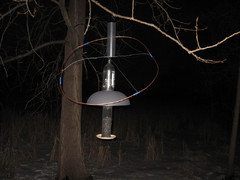
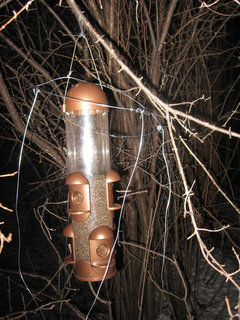
    Enclosed are photos of my homemade creation and can be created in roughly an hour (or less).

    Here's a tube feeder that I purchase that the cardinal will use because it has a metal perch. I create a loop using some soft drawn copper pipe (available in hardware store under plumbing), some wire, and duct tape. As you can see, the initial prototype is rather lop-side, I'll have to fix it later. The hanging wire are 16 gauge galvanized wire that attach to the hoop by wrapping around it. I then do a hook at the other end and hook it to the hanging chain.

    It doesn't stop all house sparrow, but cut the use of it down by 80% or so. The cardinals, chickadees, and red wing black birds are not bothered by it. Before the hook, a stream of house sparrow would blanket the feeder, now it's down to a few that feed from the feeder. The rest hang around on the ground below the feeder.

    After the mod to the sunflower seed feeder, the house sparrow shifted their eating toward the finch feeder, causing a displacement of gold finches and tree sparrows. To get around this, I create one foot hoop with 4 hanging wires again using duct tape. The wire are attached to the feeder using twist ties from bread. I use the same 16 gauge wire for the hoop and hanging wire. I use wire instead of string because I don't really birds to get tangled in it and I don't have to worry about adding weights. The house sparrows went away entirely. The hanging wire is far more effective than the the hoop.

    Note that I have read studies that indicates that the hoop and line may not work during breeding season. Whatever instinct preventing them from flying past the hoop and line is overridden during breeding season.

    Paul

  • 16 years ago
    last modified: 11 years ago

    I have a mesh cardinal feeder filled with BOSS. The cardinals love it, as well as titmouse, juncos, chicadees, woodpeckers, and nuthatches. The squirrels have tried in vain to get to it (not to mention deer). Next time I will try just safflower and see what happens.

    I see HOSPS all the time in the spring/summer, so much so that I have traps ready for them. This time of year I don't see many. They come and go and don't stick around for more than a day at a time. But come Spring, they'll be here in hoards.

  • 7 months ago

    bedelia, what kind of traps do you use for HOSPS, as they go to my feeders and empty the whole feeder on the ground. It only takes one brave HOSP to empty the entire feeder.

Sponsored
NME Builders LLC
Average rating: 5 out of 5 stars2 Reviews
Remodeling Company in New Albany, Ohio