Houzz Logo Print
mikeandbarb_gw

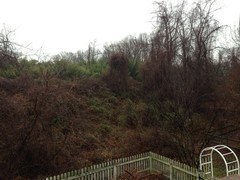
I need to get rid of japanese honeysuckle

19 years ago

I don't want to use round up because this is next to my garden but on the other side of my fence so not in my yard just yet but have had to dig a few out this week.

My question is can I use salt on the ground to get rid of the japanese honeysuckle? Reason for using salt besides my garden is that where the honeysuckle is growing is a run off that goes into a creek one block away that runs into our lake about a mile away.

TIA, Barb

Comments (18)

  • 19 years ago

    If it is not that much I would pull it instead of using salt. The salt will kill anything around it and possibly get into your garden. If a mile away from the water it won't hurt that. I just pull because it seems to always be in and amongst ferns or something I want. This is a good time to do it also.

  • 19 years ago

    I would prefer Roundup instead of salt. Salt may kill the honeysuckle if you use enough, but it will kill everything else, too, and will remain in the soil for a couple of years. Also, salt is not something you'd want to introduce to runoff or the creek. Roundup will kill any plant it is applied to, but breaks down in the soil so that something else can grow a few weeks or months after you spray.

    You could simply pull and pull and pull until the honeysuckle stops resprouting, or pull/cut the honeysuckle then spray Roundup on the new sprouts, repeating until new sprouts stop appearing. Roundup isn't approved to aquatic use, but your location doesn't sound like it is even close to being an aquatic site. If you are a block from the creek the ROundup shouldn't cause any impact in the creek. It shouldn't even run off of the site where you apply it as long as you don't apply before a rainfall. i'd try to cut the honeysuckle to ground level before you spray so that you only have to spray a small area near the base of the vines.

  • Related Discussions

    Do you get rid of Japanese Beetles by hand?

    Q

    Comments (3)
    Hi Sandy Thanks for the site, and yes Ladysthumb seems to be what it is. I Don't have Rose of Sharon and I have not grown Holly Hocks in a few years because they were never pretty because of the Beetles. I may at least in spots try the milky spore next year. I wonder how far the Beetles will travel. I have killed many, many of them this year. Connie
    ...See More

    Get your Japanese honeysuckle at Lowe's!

    Q

    Comments (6)
    At Monticello, they claim that Jefferson planted poison ivy as an "ornamental" and that it was commonly sold by dealers as such. Here is a link that might be useful: Jefferson's Garden
    ...See More

    I need to know how to get rid of the dirt stain as shown below

    Q

    Comments (1)
    Removing the stain will depend on what type/kind of material it is on. Need more information.
    ...See More

    Your preferred method of getting rid of Japanese beetles?

    Q

    Comments (2)
    I haven't figured it out. I don't think there is a reliable protective to spray. I am going out 2x daily and spot spraying with Bayer Advanced Rose and Flower Insect Spray. It helps, but if you have an huge infestation as I usually do, you won't keep up, but you will kill a lot of them. This weekend I will try BeetleJus for the first time which is supposed to be an organic protective spray. It has good reviews but I don't think anything on the market will stop the infestations I have here. This year I have about 20% of the usual infestation here because of drought, but it rained yesterday and today, so this weekend I am bringing out more armament.
    ...See More
  • 19 years ago

    One thing you might try is to paint the stems with concentrate of Brush-Be-Gone (active ingredient triclopyr). What I do is peel off some of the loose, papery bark to get down to the cambium, then apply it. It should be absorbed into the stem, killing the root system, but without the "collateral damage" from broadcast spraying. This would also prevent runoff into water bodies.

    I agree with the others - the salt is an idea that will have environmental repercussions beyond getting rid of a plant. You're probably going to cause a lot more environmental damage than you would with careful application of herbicides with short soil-half life.

  • 19 years ago

    We put out a salt lick for the animals about 10 years ago..only for the one year. Nothing grew around the area for about eight years; on the slope, the runoff from the salt covered 15 feet...nothing growing there.The vegetation is still sparse. Don't use salt, just pull. Actually, it is a very agression-releasing activity. Also, there appears to be new evidence that Round-up does have some negative properties. I am trying to limit my usage until I hear more from these sources.

  • 19 years ago

    I have alot of it and still prefer to pull it. I find that pulling it after a rain makes the job much easier. Take a few minutes to examine how it grows - mine usually has a small woody knot at soil level and that is what I grasp to pull. At my friend's house, the jap. honeysuckle is much younger and we can usually pull great runners of it all at once. It's good to understand how yours grows first to be most effective at removing it.

    Good luck! We're all rooting for you ... :)

  • 19 years ago

    Last year I got permission to remove a huge mass of it that was rooted on my neighbor's side of a shared fence but grew into my yard. I cut it away from the fence, dug out the roots and reseeded. He'll keep his side mowed and I will pull anything that sprouts on my side and that should discourage it. I did not use herbicides because the neighbor has chemical sensitivities and it was also too close to my plantings. I do use Round Up or off-brand equivalent and understand it to be reasonably environmentally friendly. It's the only way I can discourage some really noxious weeds in my yard, wiregrass and nutsedge especially.

  • 19 years ago

    I can understand someone's reluctance to use a chemical like round up, particularly if you are trying to garden organically. That being said, round up is much safer for you to handle than some other organic alternative like 20% vinegar and it much better for the environment, when handled properly, than salt.

    If the stems are too large to pull by hand, I probably would cut the stems off and then treat the stumps with round up (or ortho brush be gone). The chemical application on the stump can be controlled and discreet, rather than trying to spray the entire shrub. Please take care and follow instructions carefully.

  • 19 years ago

    I second the reccomendations made by Ladyslipper and Joe Pye. Japanese Honeysuckle is very difficult so be prepared to attack it many times. If you are in an area where it is legal to do so, you can also repeatedly burn and poison the japanese honeysuckle. FYI, there is a glyophosphate product approved for use around wetlands called Rodeo.

  • 19 years ago

    I have been very happy using my weed wrench. (The medium size) It was not cheap but it works VERY well and is quite tough.
    I gues it comes down to how much you would use it.

    Here is a link that might be useful: weed wrench

  • 19 years ago

    I have had good success spraying areas of Jap. honeysuckle with glyphosate in late fall, when it is still green and all the surrouding native are brown and dormant. This makes it easy to see the honeysuckle and it doesn't damage surrounding vegetation.

  • 19 years ago

    Salt is safe unless you are in a desert area. Up here, we dump truckloads of it into the environment for snow removal every year. It will only work in dry weather, because rain will take it into the ground and on its way to the ocean. There is always salt in the ground and in water in small ammounts and it only concentrates in the ocean and some rare inland areas that do not drain to the ocean.

    The main problem you have is the extreme local invasiveness of japanese honeysuckle. As long as it grows on the other side of your fence, it will keep spreading to your side. And the more vigorous the growth on the other side of the fence, the more virogously it will try to spread. If you do not remove it all, you will be fighting this battle forever regardless of what you do on your side of the fence.

    Ziggy

  • 19 years ago

    Scott---I too need to get rid of some japaneese honeysuckle and I love the idea of the weed wrench, although pricey. Its growing along a fence about 10ft one way and at least 15 the other and is well rooted been there many a year and I need to get rid of it one way or another.

  • 19 years ago

    Salt is very, very harmful to plantings, and it does work it's way into the groundwater, and surrounding bodies of water. High concentrations of it(pouring it around a plant you don't want) will kill everything by leaching into the surrounding soils, and its effects will be noticeable for years. Been there, done that!

    We dump tons of it into the environment every year, also. The local and state gov't. are just now starting to realise the environmental damage it does.

    I vote for a weed wrench, or, failing that, the "glove of death" method of glyphosate application. It's a very discrete method, no over-spray.

  • 15 years ago

    Here's an article from eHow on how to get rid of Japanese honeysuckle. It's good, gives a step by step account of how to get the job done.

    Here is a link that might be useful: How To Get Rid Of Japanese Honeysuckle eHow Article

  • 13 years ago

    I know this is a very old thread, but I have a TON of this stuff growing behind the house that I bought a few months ago. A tree in my back yard just came down a few weeks ago and now there is no privacy for the house at all as there is a street going about 50 yards behind my property line. Anyone got any thoughts on planting shade trees or the like in the patch of vines? Also, it looks like there are several kinds of vines competing back there, the Jap Honeysuckle is evergreen, and there appears to be a non-evergreen/decidious vine. I'm in Central MD. Any input is greatly appreciated.

    also - the first thing I plan to do is get in the patch and try to clear the vines off of the trees that are trying to grow up through it. Still looking for ideas though. thanks

  • 9 years ago

    Round-up is banned where we live (France).

  • 9 years ago

    Triclopyr will also work, painted on cut stems. Tiny amount of chemical, big results.

Sponsored
AIS Renovations
Average rating: 4.5 out of 5 stars15 Reviews
Custom Craftsmanship & Construction Solutions in Franklin County, Ohio