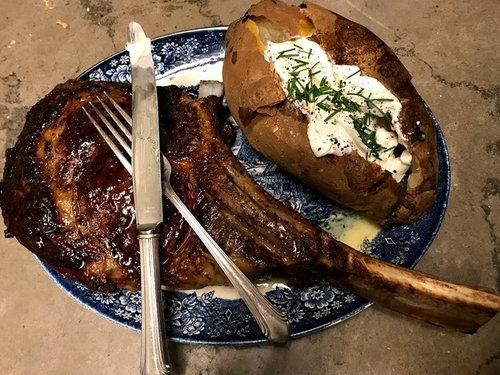
Super size Father's Day -- Tomahawk Stea
7 years ago
Featured Answer
Sort by:Oldest
Comments (7)
- 7 years ago
- 7 years ago
Related Discussions
Troy Bilt Super Tomahawk Chipper Shredder
Comments (13)Bill: The fellow I bought it from doesn't have a screen, and in fact didn't realize it needed one. One of his complaints about the machine was that it didn't chop leaves very fine. Actually, he used it almost completely for chipping, so didn't really NEED a screen. From the pictures on e-bay, there's a slight difference in size and shape between the non-chute on the side and the older "straight down" model, but I don't have the dimensions on the older style and so can't be sure. Neither can I find a parts number for mine. I found an exploded diagram on-line, but it didn't show a screen. Apparently they were an option. Oh, well..., I'm haunting e-bay, as you suggest. I think that's where I'll find one, eventually. Actually, there's an offering from an e-bay store (somewhere up in the midwest) for two, right now, one very large, one very small openings. I was kind of hoping for an "in-between". Thanks, again for the help and the links! Tom Hiter...See MoreInformation on an old Troybilt Super Tomahawk...
Comments (159)Hello - this seems to be the forum with the most recent activity on the Tomahawk on the Internet, so I am resurrecting this thread. I picked up an 8HP Electric Start model in decent shape last year, and I used it for a solid week before putting it away in the spring. Unfortunately when starting it up this fall my carb seemed to be leaking a lot of gas so I decided to change it out. There are tons of cheap ones on amazon but unfortunately and strangely, all have a lower bolt mount about 1/2 inch longer that prevents them from properly mounting on my tomahawk. Compare a very expensive B&S original #390323 to any of the cheap ones to see the difference. I was lucky to find an aftermarket one on ebay this evening that has the proper lower bolt mount height, we'll see how it looks when it arrives....See MoreMolasses: Sweet and Super by Malcolm Beck
Comments (10)Here's another little tid-bit regarding this same article. This is from my favorite soil scientist. Those that know her will recognizer her writing style. She's got a unique way of putting things (yes, there may be a little crush going on here): The way I look at molasses is that it is a great bacterial food resource. Add molasses to anything, at the right concentration, and bacteria bloom! Quite a bit of what Malclom Beck talks about in the post linked below (that Louis sent in, thank you for that!) is the necessity of having the right sets of microbes in the compost or soil in order to get the benefit you want from growing a whole bunch of bacteria. Malcolm makes sure that there is a good inoculum or addition, of Nitrogen-fixing bacteria present. Most of the time, by managing the composting right, those bacteria are present in the compost. Where did those bacteria come from? They were on the organic matter originally put into the pile. But you can hedge your bets and add the particular sets of microbes to make sure you have them. The bacterial species to get are: 1. Any FREE-LIVING Nitrogen-fixing bacteria, such as Azotobacter, Azospirillum, Frankia, Azomonas 2. "Bad-guy" fungi suppressors, such as Bacillus subtilis, Bacillus megaterium, B. flourescens, 3. If concerned about pesticide residues in your soil or compost, then buy a mix also containing Pseudomonas laterosporalis, P. licheniformis, or other some fungal species know to do a good job breaking down pesticides. Sorry, can't remember the names of the fungi. When you buy an inoculum, check to make sure it actually has the bacteria in it you want. If you learn to use a microscope, or have a local friend who can use one, you can check easily to make sure there area at least bacteria in the mix. Bacillus species are distinctive, so you can check for them just by appearance - big fat rod shapes.....some short, some longer, some really long, single, or chained. ---------------------------- Folks have spoken a bit about EM on this list serve, and if you have severely compacted soils, areas of your lawn that puddle and do not drain properly, then making a little bit of your compost with an EM addition might be a good idea. EM is a particular mix of a number of bacterial species. Sorry, no fungi in this mix that survive in soil (or, let's hope they don't survive in your soil, the yeasts that are normally in EM aren't beneficial in soil). EM is prepared in a way that means the species you buy will be low-oxygen environment organisms. They work in compacted or low-oxygen environments WITHOUT making alcohol (which is the danger when your compost goes anaerobic). These species don't volatilize ammonia, rotten egg smells, or make phosphine gas. So, you don't lose your important nutrients if the compost or soil goes anaerobic and these guys win out against the more "rotten" bacterial species. So, if you have soil, or compost that is stinky or smelly, or have areas of puddling in your lawn, make a compost where you have added these organisms, can put a light dusting of this compost on that area and water it in. Or make a tea from that compost, and drench the area. But REMEMBER, in two weeks to come back with an inoculum of AEROBIC organisms, such as a compost with no addition of EM, or a compost tea made from a normal aerobic compost. The species that should be in EM are: 1. Lactobacillus Long slender rods, may be single, two in a chain, or multiple in chains. But always slender rods (to differentiate from Bacillus species) 2. Pseudomonas species - but mostly the low-oxygen environment ones. They do have ability to chew up pesticides, so possible a good place to get a good mix of these species. 3. Actinobacteria - a herd of species. These bacteria grow in filaments, so they look like very slender threads. They look alot like fungi, but are too thin to be real fungal strands. So, when you see "pencil-lines" in your microscope, those are actinobacteria. In all my experience, having high amounts of actinobacteria in a productive pasture or row crop / broadacre soil is an indicator of bad things. These bacteria do not help the crop species most of us grow. They do help brassica though, and riparian and wetland plants. So........ are these good bacteria? Depends on what you want to grow. 4. Non-sulfur, purple photosynthetic cyanobacteria. Very distinctive purple to violet color in the cells of this organism. Doesn't typically survive transportation in the mail, doesn't survive in bottles stored in the dark. It is a photosynthetic organism after all, and despite the fact some EM salesmen say it doesn't need sunlight to survive, all the data we have from looking at the product shows no survival of this organism once the product gets to us through the mail. 5. Yeasts...... these are fungi that grow in low oxygen conditions. They look like big round to oblong balloons that some times grow in clumps, and look rather like little cactus clumps. Not good to be seeing alot of these in soil. Definite indicators of compaction and lack of oxygen. Yeasts aren't good at building structure or helping make things better in soil, at least that I have ever seen. An EM without lots of yeasts would be better than one that has lots. Hope this helps clarify why molasses can do good things in soil. Okay, it's me again. I wanted to point out that when she talks about adding compost to your soil, she doesn't mean the usually recomended rate of 1/3" or a cubic yard per 1000 sq.ft. She means a light dusting of the best compost you can make. What's more is that when you have a soil chemistry test performed, and that test makes recomendations based on Ca:Mg ratios and available NPK, you can achieve the same results using 1/600th the recomended rate by applying those elements to GOOD compost and using that to amend your soil. The reason being that the nutrients are held in suspension by the microbes in the compost. Someone start a new thread if you want to discuss this more. Are you guys keeping up with me here? Info overload or what? Heh, heh...keep it comin'. If you guys like these types of discussions and want to dig a little deeper email me and we can talk. We're havin' fun now! Greenjeans...See Moreupdate: obf march days swap continued
Comments (102)Wow! Did I ever receive a box from Sue! It was worth the wait! I don't even know where to start on my favorite things as I loved it all! You did an outstanding job of spring and purple things! Rec'd: Large bag of tulips purpled with pride blend Large dinnerplate dahlia bag of Sparaxis bulbs bag of freesia bulbs poppy grow kit garden rock with purple flowers and lady bug on it beautiful spring sign done in pastels hand rake-needed this, can't find my other one purple garden gloves black cherry candle-love the scent purple water bottle small mini fan solar dancing bee-nurses at hospital have these sitting on their station desk and I loved them, had never seen them before, so was excited to see one! frog and snail pot holders package of jobe's fertilizer spikes slinky in purples and pastel colors-very fun absolutely beautiful gem stones polished and ready for necklaces-LOVE these and pair of earrings made with polished rock-gorgeous!!! I am thrilled with my box! Thank you so very much!...See More- 7 years ago
- 7 years ago
- 7 years ago

dcarch7 d c f l a s h 7 @ y a h o o . c o m