

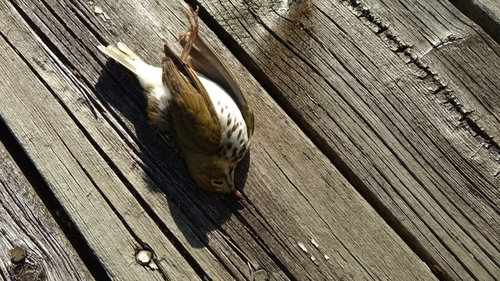
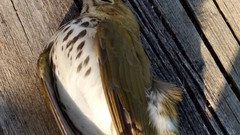
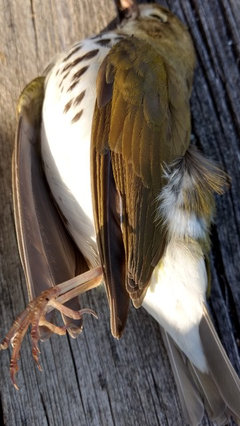
Dead Bird -- Please Identify and Give Ideas for Cause of Death
9 years ago
Featured Answer
Sort by:Oldest
Comments (12)
- 9 years ago
Related Discussions
Fish Death-What happened? Pic :(
Comments (42)I would have reacted the same way! This is beginning to sound like "The Pet Cemetery"! We have a few skeletons in our yard as well. One green heron: Just after I'd installed our pond, 11 years ago, we had a visit from a green heron. The day he appeared, we were installing the icemaker in our frig. I shoo'ed the bird away, as DH beckoned me for assistance. So, I asked my son (then 14 yrs. old) to keep an eye out for the fish monger and shoo him away should he return. The next thing I know, my son says he got a fish and I got him. The green heron had returned scooped up a fish and retreated for lunch on the fence. My son shot him with a pellet gun. I was shocked, and asked why he shot the bird; it was a protected species and I'd asked him to shoo the bird away. His answer was he'd misunderstood me to say shoot the bird. Anyone who knows me, knows I'm an animal lover who would never kill anything, unless it threatened human life. I was flabbergasted to say the least, but also concerned. The bird had fallen into my neighbor's yard; I didn't know if he'd wounded it or killed it, but knew we had to discretely check its status. Not wanting to draw attention to my son's mistake, he barreled over the fence w/the use of our ladder and recovered the evidence. The bird was dead, but the fish was alive (and continued to survive). "Jimmy Heron" is buried in our backyard..........along with about 10 rats (probably more), a couple of fish and one oppossum. The oppossum was dog kill. That about killed me! Our Samyoid has a thing for oppossums; I've taken 2 to the vet's for repair. Thank goodness the Samyoid has gone blind...........probably an oppossum curse put upon her rather than the diabetes. The rats.......one thing the Chamber of Commerce will never tell you about, is the rats in Tampa! When we moved here I was totally disgusted! The house had been empty for 6 months, the yard totally overgrown with vegetation. Our first night in the house, we heard a noise which sounded like a herd of buffalo crossing the roof. It was 4 days before we identified the culprits, and then I was ready to move! DH decided to put out rat traps. He was not discouraged by their numbers. I swore off any responsibilities w/traps. The first night of traps, we were sitting at the table having dinner. First, you could hear the snap of one trap, followed by many more. Sounded like the percussion section of an orchestra. I thought I'd lose my dinner. Believe me, it took only that one experience for DH to decide there had to be a better way to rid the homestead of rats. The better way, of course was to clear the property of hiding places, and at the time, it didn't seem we could move fast enough. We cleared out 4 trees (I still have 17 on the property) and all the undergrowth; then the house was tented. When I mentioned this to one of our neighbors, the neighbor's reation was, "Oh, yes, grove rats" like they were domestic pets! (Our neighborhood used to be an orange grove. Rats eat the fruit off of the trees. When they developed it, not all the rats ran away; they remained to prosper.) A few days after we'd cleared the landscaping, another neighbor was alarmed when she said she had NO idea why she suddenly had rats under her decking, but would have to deal with it. I stiffled a laugh. Another neighbor told me he and the previous owner of our home used to sit in the back yard with pellet guns and shoot rats as they ran along the fencetop. Since he lived directly behind us, they always made sure they hunted together to avoid injury or damaging the other's home. They buried a few rats in the yard as well. So, that's the buried treasures in our back yard....so far....See MoreRon - On Grafting - Own Roots, Rose Life and Death etc.
Comments (24)Taoseeker, Thanks for the information on the European history with long term use of their most common rootstocks. I find it interesting and very useful and hope for long term good results - more vigorous root growth translating into more resilient bushes. I do remember seeing a number of times R. laxa use mentioned in the hybridizing experiments by the Canadian pioneer prairie hybridizer. One of the Skinners I have is apparently a cross with it and a pimpinefollia - sorry have not taken the time to check if it is Haidee Suzanne Butterball or all. Makes me wonder if that was the influence of their European ancestry, availability or factual superior hardiness - don't know but in 5 years I should. By the way very pleased to see very good cane survival for the first year on my Portland named Marie Jean I got from Lynnette last year when she gave up on it. Melissa, There is a gentleman in British Columbia I met through Lynnette who has made it a mission to collect and save Geschwinds. I need to let him know what I received and get him some cuttings. The two Canadian nurseries that I would be happy to share cuttings (gratis) that graft I have not approached as it gets too close to commercial for me and I would have to be absolutely sure that the roses are out of patent before even contact (most are over 100 years old so I am probably safe). However I sense both of them have absolutely the strictest of QA controls and would do it on their own so as to be sure of providence and disease free stock - if they survive winter and prosper I may contact them to guage their interest ... they both export to the States. Kaylah Hi, I was fortunate my Charles de Mills that I cover and is in the south gardens has 3 foot canes and lots of them ... problem is blooms are usually in short supply and last year I think I got 3. I leave it as it always grows well and takes to protection well. All my other dark gallicas are history except for the many exmaples of Belle d'Crecy I got as delambre - it also seems to survive well if covered ... but too much damage and the blooms are gone. All my cardinal Richelieu departed voluntarily over the years (3). Me I fool around with teas but only in pots and bring them in in October ... got a couple new ones this year. My FMkruger ... is a monster in zone 3 (hahhaha) and I think I must of got the most vigorous clone of this tea via Quebec. Kids you not take a cutting - stick in earth in the house and it takes like in February when I accidentally snapped a branch off ... now I got two with the younger being already at least foot high in 4 months and has gone through one bloom cycle. But the one I really miss is Mrs Schwartz ... almost as reliable as Mlle Franz Krueger (sp) ... forgot to take a cutting and over wintered her in the garage and she and all the other ones died - fortunately had cuttings for 3 of them in the basement to replace them - there as tall in two 365 day a year growing seasons as the originals....See MoreBirds - Any ideas for birdfeed falling into garden?
Comments (21)Interesting about the kinds of seed everyone feeds. I feed primarily black oil sunflower 9expensive at Lowe's, but cheap at Tractor Supply - ($15 for 50 lbs). Black oil seems to be the preferred feed for cardinals, chickadees carolina wren, downy woodpecker, mourning dove, flickers, tufted titmouse,bluebirds, and an occasional jay. Sparrows feed on it, but prefer the hulled seed, as do the chickadees and wrens. An added bonus - the sunflower hull of the black oil seed seems to help the compost, and it mulches nicely in the flower beds! Used to get that weedy flower in GA, when I didn't use the sterile seed. You are also probably getting thistle seed in there. I feed probably 80 pounds of thistle in the winter, for the finches, primarily gold and red, with some buntings showing up in spring. If you feed thistle be very careful to get the sterile seed. its fertile and tends to fall below the feeder (doves and mice will eat it). I actually like the look of thistle, and the fact that it attracts bees, so my thistle feeders at the wood line all are not sterile. Come spring, I will get hundreds of thistle plants, that by summer will be beautiful purple flowers for the bees, and come late summer, natural seed for birds passing through. If you can tolerate the spiny leaves, and thistle 'fluff'(which bluebirds use all winter here for nesting), let it grow, it really is a pretty plant If you want to get rid of that 'smell' below the feeder, avoid seed with corn, when I fed a mix with corn, the corn would sometimes sit and ferment, or, as you discovered, grow. Corn here, whole or cracked, is an attractant of crows. I do throw cracked corn in the woodline to keep them away from the sunflower. Using cracked corn away from my garden, also keeps rabbits, squirrels, chipmunks, and racoons at bay! Crack corn doesnt seem to grow into stalks either. It does, however seem to cause my grass to die, so I keep it in areas that I don't have plantings....See MoreWoman dies, cause of death: range
Comments (22)Fluoride is a carcinogen. No one denies this. Its risk of lethality is vanishingly small. The issue surrounding fluoridation of the public water supply is one of cost:benefit for the population at large. Personally, I come down on the side of mass-fluoridation but it seems to me one of the (few) public health issues where reasonable minds can disagree. This said after a lot of careful study of the problem. Since in the case mentioned by Pamela legislation isn't suggested, or mass-forcing of elders to install induction cooktops, the comparison isn't really apt. Learning about the safety benefits of the appliance, in particular conjunction with the needs of elders, is basically just a win-win situation (especially for the manufacturers! ;) ). And thanks, pamela, for pointing out this issue of fire-hazards. I hadn't realized it was so big. Frankly, I am guessing many of us middle-aged sorts on this forum are just beginning to learn about the issues surrounding our aging parents. Linking them to more plebeian issues of consumerism is an eye-opener. And for those of you beyond the divide (of middle age), couldn't you just take in a little bit of the love and concern considered here by your 'children'? There is, maybe possibly, a slight tradeoff to be affected between freedom and safety. But we who care about you place some value on the safety part perhaps at slight expense of the freedom-part. This is the stuff of negotiation, not excoriation. IMHO. Also, note that the anxiety surrounding the issue for many has its own 'cost' -- hard to quantify for sure. But it does belong in the cost:benefit analysis somewhere, not just the literal numbers of deaths. And that anxiety exists among all, elders and their children and gchildren too. It's a hard thing to tote up but really pervasive. I think that's at the heart (pun winked at if not originally intended) of Pamela's post, frankly....See More 9 years ago
- 9 years ago
- 9 years ago
- 9 years ago
- 9 years ago
- 9 years ago
- 9 years ago
- 9 years ago
- 9 years ago

Related Stories

FUN HOUZZHow to Survive an Epidemic of Walking Dead
Tips to use around the house and garden to prep for the zombie apocalypse
Full Story
SUMMER GARDENINGHouzz Call: Please Show Us Your Summer Garden!
Share pictures of your home and yard this summer — we’d love to feature them in an upcoming story
Full Story
GARDENING FOR BIRDSBackyard Birds: Meet Some Clever and Curious Jays
Boisterous jays provide plenty of backyard bird-watching in winter. Here’s how to identify all the varieties and welcome them into your yard
Full Story
GARDENING FOR BIRDSWhat to Know About Birds Nesting in Your Yard
Learn how to observe, record data and help ornithologists with NestWatch’s citizen science project understand bird trends
Full Story
GREAT HOME PROJECTSHow to Give Your Driveway and Front Walk More Curb Appeal
Prevent injuries and tire damage while making a great first impression by replacing or repairing front paths
Full Story
GARDENING FOR BIRDSFeed the Birds: 6 Plants for Abundant Winter Berries
Be kind to your fair feathered friends during lean food times by planting a shrub or tree loaded with nutritious snacks
Full Story
MOST POPULARCrowd-Pleasing Paint Colors for Staging Your Home
Ignore the instinct to go with white. These colors can show your house in the best possible light
Full Story
GARDENING GUIDESBackyard Birds: How to Care for American Goldfinches
The American goldfinch is a bright-in-the-summer visitor and one of the only vegetarian songbirds. Here's how to give them a healthy habitat
Full Story
HOME OFFICESQuiet, Please! How to Cut Noise Pollution at Home
Leaf blowers, trucks or noisy neighbors driving you berserk? These sound-reduction strategies can help you hush things up
Full Story
MODERN ARCHITECTUREKeep Your Big Windows — and Save Birds Too
Reduce bird strikes on windows with everything from architectural solutions to a new high-tech glass from Germany
Full StorySponsored
More Discussions
tsugajunkie z5 SE WI ♱