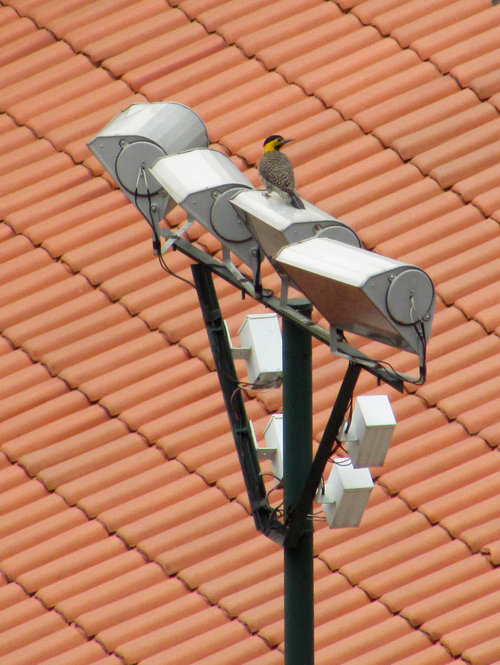
Thank you :) I noticed Campo flicker around a month ago. It was making impressive sound (early morning) :))) Other birs are less loud. P.S. Everytime I hear it I run with my camera to balcony :))))
I did a little searching to see what a woodpecker might be doing in a relatively treeless area, and apparently this is a common occurrence with the Campo flicker nesting in mud banks and searching for ants and termites on the ground. This is probably the beginning of the nesting season in Brazil.
"When Charles Darwin observed the campo flicker in Maldonado, Uruguay, he was struck by the fact that, while it had all the physical features seen in related woodpecker species, it did not occupy trees, and instead built its nest in mud banks. This observation was used to support the theory that significant changes in behaviour could give rise to new species. However, another naturalist who had observed the campo flicker nesting in tree holes accused Darwin of falsifying evidence to support his theory of evolution (3). Today, it is known that in wooded regions, the campo flicker nests in trees, while in treeless areas, it will nest in mud banks (2)(3). Other nesting sites may also include telephone poles, dead stumps and termite mounds. Nesting takes place between January and April in Surinam and from August to November in Argentina. The nests are excavated using the bill-hammering technique commonly exhibited by woodpeckers, and once prepared, a clutch of four to five eggs is laid within the cavity, and incubated by both parent birds (2).
The campo flicker mainly feeds on ants and termites, consuming large amounts, which is evidenced by a record of over 2000 ants found in the stomach of one individual. Beetles, grasshoppers and nestlings are also taken (2), as well as fruit (4). Foraging generally occurs in small groups, which are often found clustered around an anthill. Most prey is located while walking along the ground, by searching amongst stones, in decaying fallen logs, or on roads. Occasionally, however, foraging also takes place in isolated trees, on cacti and fence poles (2)."
Ingrida (São Paulo/Brazil) thanked claireplymouth z6b coastal MA



claireplymouth z6b coastal MA
Ingrida (São Paulo/Brazil)Original Author
claireplymouth z6b coastal MA
Ingrida (São Paulo/Brazil)Original Author
User