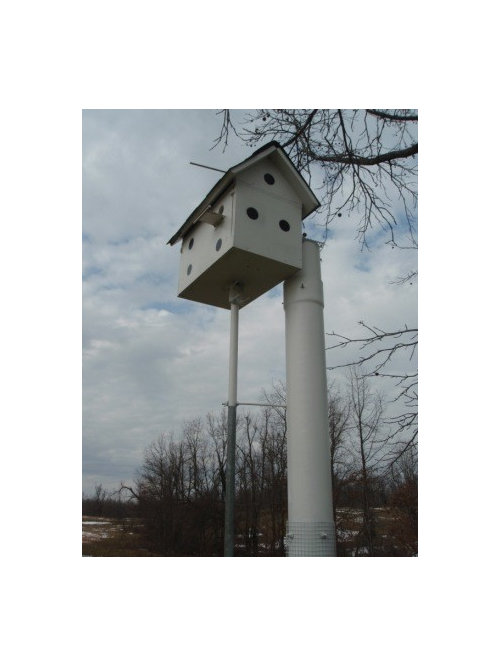
Here is an outside picture of my Controller trap I built 8 years ago for protecting my martin colony from starlings. I am now nearly 100% clinger entrance and after this year I will no longer have round holes for my martins period. However even though the starlings will not be able to get into any of my gourds with the clinger entrance on them I will still keep this wonderful trap in use year round and here is why. As I have said before eliminating starlings from your yard greatly helps all species of native birds and not just the cavity nesters. Once the starlings numbers are drastically reduced or elinminated from an area the native birds of all kinds begin to reclaim what is rightfully theirs and a trap like this will make a huge difference after just a few seasons of use.
Here is how it works. You will notice in the picture of the outside it looks like a multi-cavity martin house with about 8 holes in it or so. However it does not have 8 holes in it. There is only one entrance hole and that hole is in front of the little plastic porch you see on the front of the trap. The other holes are not holes at all. They are just black spray painted circles(dummy holes)and they are eye candy to catch the eye of the starlings as they come investigating especially now at the beginning of the nesting season. The starlings here usually notice the gourds at first and they try and land on them. Right away they are met by some pressure from the martins and as I said most of my gourds the starlings cannot enter anyway. Well they then spy the trap about 180 feet away from the colony under this big sweet gum tree and they must think.."Hey there are some nice big round holes with no martins." The they fly over to the trap.
Before I continue I want to mention the sweet gum tree. See the trap being right next to the tree as you will see in the attached picture is how you keep martins out of it. Martins do not like to nest close to trees and I have never,ever seen a martin land on it. They have flown towards it but they always bank away and head back to the gourds. However the starlings actually prefer it near a tree that I have seen. You can watch the sneaky suckers work their way down the branches to the roof of the trap. Then they land on the porch and then they enter..and then this hole is the last hole they ever enter.
Inside this house is a fake compartment made out of aluminum flashing. Aluminum flashing is weightless. I made the compartment 6 inche stall by 6 inches wide and it extends nearly the depth of the house..about 10 inches. Then I spray painted the flashing black and while the paint was still wet I threw some thick wood shaviong on it and shook it around. The wood shavings stuck and this gives the inside of the flashing compartment the look of a wooden cavity. Now this flashing compartment is mounted on a See Saw you might say..a Teeter Totter for starlings..Once the starling enters his body weight cause the flashing compartment to fall and then he cannot get back out the hole he entered in the front top of the trap. The only way out is through another hole on the lower backside of the trap and that hole leads into the 6 inch PVC pipe you see mounted vertical to the back of the house.
As soon as the starling feels the floor fall from underneath him he does not hesitate. He bolts through that back hole thinking he can fly up and out of the 6 inch PVC pipe. He sees the light coming through the top of it and there is a screen on top. You can just see it in this picture. Once in the PVC pipe he cannot open his wings enough to fly and down he goes into the holding cage at the bottom of the PVC pipe. Once there I notice him and then take care of eliminating them for the Red Headed Woodpeckers,the martins,Flickers,bluebirds,etc,etc.. Now here is the sweet part of the trap.
It has a counterweight on the other side of the see saw. The see saw itself is made from aluminum tubing and pivots on a stainless steel angle piece I designed and mounted in there. This trap concept was developed by a guy named Andrew Troyer of Pennsylvania who has martins but I kind of took a step further than his design by making it out of Stainless and aluminum so it can be set extremely hairy and trip and the reset so easily. That's right..reset! Once the starling gets out of the flashing compartment and into the PVC the counterweight on the other side of the see saw resets the trap for the next starling that comes along. A starlings weighs about as much as 8 or 9 quarters..males usually are the heaviest..and my trap will trip with the weight of only 4 quarters and one nickel. I could actually trap House Sparrows with it but I don't and here is why..
On the holding cage just out of the picture at the bottom I have a 1 and 1\2 inch escape hole mounted on the side of it. This way should any beneficial bird like a Bluebird,Titmouse,Chickadee,Downy,Carolina Wren,Tree Swallow,etc ever get trapped they could instantly get out of this 1 and 1\2 inch escape hole. Starlings on the other hand cannot enter 1 and 1\2 especially if it is over 1\2 inch thick like my escape hole is. This feature gives me peace of mind knowing that I will never,ever trap a bluebird or any of the others I named but because of the escape hole I cannot trap House Sparrows but that is okay...I have the Spare-O-Door traps for them in my Trio Martin House and they work great to deal with them.
It is a great feeling to have control over starlings everyone. The native birds retrun in droves..I know. I have seen it happen here bigtime since 1999. Anyone can build a trap like this to rid your yard of starlings. I think you can get the plans from Mr Troyer from the PMCA(Purple Martin Conservation Assoc)..His trap however is really big and mounted on heavy 4 by 4 wooden posts. I saw no need for all of that so I just scaled mine down. It is 10 feet high from the roof to the ground and I have a PVC cleanout at the bottom of the pipe below the holding cage to get the starlings out plus last yaer after I had a new roof put on my house I took some extra dimensional shingles and put them on the roof of my Controller Trap grin..Matches my house now. Love this trap and what it has doen for the native birds here. Just today 4 Red Headed Woodpeckers were at my suet feeders at the same time!!! Four of them. They are so spectacular and they were not around here in 1999 before I built this trap,started a martin colony,added the BB Trail,and began all out war against the native birds #1 enemies..The House Sparrow and the Starling. This trap in this picture is a starlings undoing folks and the Purple Martins best friend and "Watchful Guardian" always on duty all year long smile...Mike
Image link:








way2lithuania
bluesmanOriginal Author
Related Discussions
First Purple Martin Arrives!
Q
And they've arrived! (Purple Martins)
Q
Caroline, have you checked this out? re; purple martins
Q
And more Purple Martins nests and eggs!
Q