Houzz Logo Print
dandy_line

100,000 Buckthorns to kill

I thought I would open this subject on my system for killing Buckthorn here in Mn. I have been working on my 3 acre plot for 5 years now trying to kill it all. There were about 50 large trees and many more small shrubs when I started. Cutting down the trees and shrubs opened up the canopy and subsequently, the plants suckered with 50 times more plants and the dormant seeds in the ground added thousandns more. So, my system now is to use strong doses of 2-4-d. I can get 65% 2-4-d at Fleet Farm for about $16/gal. Using a strength around 2%, I get the new growth in April and May before the native plants come up. This pretty well kills the new growth and most of the plant.

So, along with pulling by hand, digging with shovel, and dousing with 2-4-d, I estimate my total kill will be around 100,000 plants by the time I'm done(another 5 years, maybe).

Comments (789)

  • 5 years ago

    Haven't tried it. Would you have to wait for July to get the sap flowing in the right direction?

  • 5 years ago

    Triclopyr has worked all seasons when immediately applied to lopped cambium, hence my optimism. Solutions@ : "For best results, apply Milestone when plants are actively growing, which typically occurs early in the summer." Seems worth a shot. Now to guesstimate proper dilution factor...


    TechLine Invasive News: "Milestone has low risk of runoff in surface water compared to the current market standards. The runoff impact of Milestone® is mitigated by low use rate and rapid photolysis in water." Another huge plus.

  • Related Discussions

    This looks like Buckthorn, but is it?

    Q

    Comments (3)
    Ok-my first encounter with Glossy Buckthorn. I'm only familiar with Common Buckthorn. But they are both on the prohibited list here in Mn. I could tell from a distance what it was, the genus anyway. Thanks for the education. Here is a link that might be useful: Identifying Buckthorn
    ...See More

    My Indian Pink has been replaced by Buckthorn

    Q

    Comments (6)
    !?@?!?#? Buckthorn! Its growing in my bushes everywhere. Can't really dig it out without hurting the bushes its growing into, and how can I spray it without getting it on my good bushes. When its little, you can pull it out by hands, but its hard to spot when its so little, and once its bigger, its hard to get rid of. sorry for your dilemma!
    ...See More

    Viable sea buckthorn seeds from super market freezed beries?

    Q

    Comments (2)
    No, it's not a whack idea at all. I think it depends on the species and its particular natural and evolutionary history. Sea Buckthorn seeds should be specifically adapted to germinating only after being frozen in the fruit, since they are produced late in the growing season, persist on the trees into freezing weather, and therefore must remain viable until spring. Germination definitely cannot take place in the fall, as the soft-tissued seedlings would quickly be killed by the first frosts. So I guess what I'm saying is: give it a try! It might work. By the way, I also love the fruit of some of Elaeagnaceae, such as Autumn Olive (Elaeagnus multiflora), and certain large, red-fruited cultivars of Russian Olive (Elaeagnus angustifolia). They're all very high in vitamins. I suppose you can't order any plants from the US, but Miller Nurseries (www.millernurseries.com) sells what they call "Sea Berry" but which is probably the same plant. If they can't ship to you, maybe they could send some dried seeds? Good Luck, Chris
    ...See More

    Ready to plant Buckthorn!

    Q

    Comments (3)
    Thirty years is a long time to fight anything. Is there possibly a local organization that could assist you. I'm in quite a battle with it right now. I do late fall foliar spraying and basal treatment for larger plants. I really, really dislike it, but you have to admire its tenacity and adaptability.
    ...See More
  • 5 years ago

    Seems like Milestone would be a great option for stump treatment, it's too bad you'll have to experiment to find the right concentration. I'd start with foliar spray concentration and see what happens, and keep doubling until you get results, then dial it back to find the happy medium. I'd try it myself but I've already eradicated everything big enough to try it on. I supposed that's a good thing!


    On a side note, I've noticed several homeowners in my neighborhood have been attempting in the last month to remove invasives in their woods, and none of them seem to be stump treating at all. Boy are they in for a rude surprise.


    I've mostly been working on garlic mustard eradication, for the gazillionth time. I thought I had it pretty much under control last summer, but it all came back last fall, and Milestone didn't faze it, so I'm back to glyphosate. I fear I have an endless seed bank.

  • 5 years ago

    gnomeabram: TechiLine site referenced contains weed / herbicide / rate / timing chart (no BT info). Lists Garlon-4 Ultra as GM agent of choice. I had success in shady area using Milestone. Don't know if that's the difference as used glyphosate or 2,4-D + Triclopyr combo in sunny / part-shade areas. We've seen GM explosion in south viaduct area thought under control also. Bumper bedstraw crop in west slope wildflower field plus heavy clover infestation in the fescue. It's always something, no?

  • 5 years ago
    last modified: 5 years ago

    Just wanted to pass along positive results of an experiment. Much of of my prairie area became choked out by canada goldenrod over the years. Other areas were choked out by split leaf coneflower. As much as I like those plants, they made the prairie planting a failure, because I needed the deep roots of prairie grasses to hold back the riverbank. The goldenrod and coneflower had shallow roots.

    Last summer about this time, I tried spraying some areas with MSM herbicide. At first, it looked like a failure, but I noticed later that the plants that I sprayed had not grown or flowered like the plants I didn't spray. This year, looking at the sprayed areas. it is all grasses - no goldenrod, no coneflower, and the grasses are looking healthy.

    For what it is worth...

    Bill

  • 5 years ago
    last modified: 5 years ago

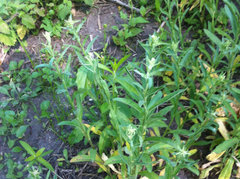
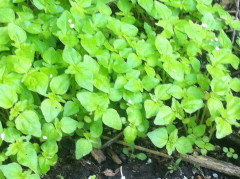
    Bill_G: Thanks for post. Updates always useful, hoped someone besides me would jump in. Can anyone identify Weeds 1 and 2? #1 shallow-rooted, multi-stemmed greyish-green leaves that overran bare root elderberry area planted 2019. #2 blankets open wetland buffer zones lacking buckthorn.


    Herbicide observations mixed. Applied Prodiamine 65 @ rate of 2 TBSP per gallon early May. Appears fairly effective against crabgrass, less so preventing quack and other nuisance grasses. Ineffective suppressing foxtail barley in county boulevard abutting our property. Milestone and Q4 Turf Plus don't touch it. Read Certainty (75.0% Sulfosulfuron) effective--has anyone used?


    gnomeabram: You are correct re: Milestone useless against GM. 2019 photo seems result of 'nuking error' using oz. rather than proper ml dilution. No carryover effect as GM now sprouting. M 1.5ml / gallon on county blvd has kept most broadleafs at bay though. Haven't yet tried Milestone as BT foliar treatment -- has anyone?


  • 5 years ago

    Without a picture it's pretty hard to know what is over running your plants. I'm always fighting foreign stuff here, like Balkan Catchfly. But over time I am winning the battle.

    The Buckthorn battle is turning a corner for me at the Arboretum. It's getting difficult to find any groups of it anymore. I have to go farther into the remote areas in order to earn my keep. I'm going to start replanting a little niche area with some of my woodland plants. The BT is now gone in there and it has a nice population of Bluebead Lily already. So some nice Blue and Black Cohosh , Dogbane, and May Apple will dress it up.,

  • 5 years ago

    Over the weekend, I was out in my yard messing with a few things - one was going after the creeping charlie. That has been hit or miss. There will be two plants next to each other, one dies one laughs at me. Using Speed Zone (2 oz per gal) + triclopyr (1oz per gal) and a glug of MSO as a wetting agent. Along the fence line, there were three small buckthorns. I hit two of them with the mix in the backpack sprayer, and they are already badly wilted today. Charlie is still laughing.

  • 5 years ago

    Ok, I see the pictures now. 1st does remind me of Balkan Catchfly, 2nd reminds me of Impatiens, Pale Touch-me-not, a native that goes berserk on any open ground I have. Humming birds thrive on it during migration.

    i posted them on Name That Plant

  • 5 years ago

    A question for you buckthorn warriors...


    I've been using an Echo brand diaphragm pump backpack sprayer, model MS-401, and have liked it. It has been comfortable to wear, functional, easy to control the low pressure for buckthorn spraying or higher pressures for doing the yard stuff. The only thing that has been less than good was the crappy spray nozzles. The sprayer is the same as an RL Flo-Master backpack, just labeled for Echo.


    Yesterday, though, the pump sprung a big leak, and let's just say that there won't be any weeds or buckthorn growing on my back side for a while. In looking for repair parts availability, it looks like the pump part is not rebuildable, and costs as much as the whole sprayer. This rubbed me the wrong way.


    Which sprayers have any of you been using? Are you happy with them?

  • 5 years ago
    last modified: 5 years ago

    Hi, nice to hear from you despite issue. I've never used backpack sprayer, rather Hudson 1.3 G pumpless tank. New model incorporates rechargeable lithium battery which is slick.

    Our issue comes courtesy of neighbor with whom share pond. Fescue looking gorgeous this season. My weed control program of prodiamine 65 followed by spot Milestone + 2,4-D or Trimec as needed yielded lush cover including distant spots where inherited a mix of fescue + prairie grasses. First year those spots in full sun folded over into verdant green carpet. Well just too unsightly. Mr. Mow His Sparse KBG <1/2" petitioned city to force mowing. And guess what? Though Minnetonka gives lip service to sustainability and low water usage we're not permitted any turf >10"; that is, total length even if laying on the ground. Tom mowed when 90' Wednesday so with no irrigation system anticipate turf will go dormant. Last weekend planted blue spruce on that distant spot that was 80% weeds when moved in. If told to mow again before fall I plan to kill off all the grass and let weeds reclaim. This weekend we began planting tall viburnum varieties to block off view of our yard -- can't be forced to mow what one can't see unless trespassing says Tom. (Yes, I witness MHSKBG trespassing and we know he's cut down multiple trees on the property--filed two police reports.) Seems we will be visible --and vocal --test case as Minnetonka Council is encouraging No Mow but appeal rejection letter went on about fact that none of the fescue used in such seeds mixes native to MN or US. What the hell?!

  • 5 years ago

    What a nightmare~ In my case, I have to put with Ms "I demand an English Manor lawn even tho I live in the woods". but it's not the extreme you have. Does the city expect mowing right down to the pond? The DNR would object to that. There needs to be buffer strip around it.

    And for the ten years I have been here I started planting trees and shrubs immediately to block off the view of my neighbors' grey house with big blank wall. She uses a gas leaf blower for hours at a time to get the smallest foreign object off the grass. And she does it just about every week in the summer.

    Sorry for my rant. I really hope you win your battle with Mtka.

  • 5 years ago

    Dandy and Terrineff, I feel for you guys! I can relate - my sprayer broke going over the lawn to quinclorac the very few crabgrass stragglers that escaped my pre-emergent last spring. I keep telling the Miz, "Hey, it's green, isn't it?"


    An acquaintance in Cambridge did his whole yard in a beautiful prairie mixture. One day, when he was at work, the city came by and mowed it for him. People don't understand.


    Terrineff, at least you didn't do that no-mow with plugs of Prairie Dropseed, and all the work and expense to get that established. One would think that the City would understand the choice between the beautiful no-mow fescues, and no mo lawn whatsoever.

  • 5 years ago

    bill_g_wisconsin, Did you make any progress with your Creeping Charlie. I have a large ever expanding mass in my woods that it seems I must deal with. Certainly, way too large to pull.

  • 5 years ago

    Pat & Bill Brown, I don't think that pulling it works, anyway. Now is the time to get at it, They recommend two treatments in the fall, a few weeks apart. I've got one treatment done, one to go in a few days, and haven't been out in the yard to see if it put a wilt on them. The idea is to weaken them and let the winter kill them. The mix I'm using in the backpack sprayer is 2 fl. oz. of Weed Free Zone (Fertiloam) and 1 fl. oz. of triclopyr in a gallon of water. Also using a wetting agent.

  • 5 years ago

    I managed to kill all the creeping Charlie with a summer mow, then after it grew back, hit it with glyphosate August 31st. It was 2.5oz/gal 41% concentrate. Didnt have any plants around it worth saving though.

  • 5 years ago

    Wow-Creeping Charlie, another one they still sell I believe. I think almost any herbicide is good enough to kill it. 2-4-d is a little kinder on the non-broadleaf species.

    I spent time at the Arb one day last week, and I was totally overwhelmed by the Buckthorn sprouting in some places. Another few years and I may have it.

  • 5 years ago
    last modified: 5 years ago

    dandy_line: Earlier on this thread are numerous references to difficulty knocking out CC plus several selective herbicide CC mixes. My 2018 post: "Mix has evolved to 1% Triclopyr-4 / 1% 2,4-D / 0.5% surfactant / Q4 Plus Turf Herbicide concentrate diluted 2.5-oz. to one gallon water. Single treatment effective, even heretofore 'untamed' area disturbed by road construction and bordering neighbor doing zero weed control. Bonus? Q4 also effective against yellow nutsedge = no need to retreat area w/ Sedgehammer."

    Anyone have experience establishing a rain garden? Any & all input appreciated. Spouse decided top '21 spring project. In preparation he took out stand of male BT left as screen. I mention male because killing males turned female since August. Spot one, find up to dozen more- - upper branches often intertwined. Removing "one" near 20' Catalpa Tom ended up with BT debris mountain 15' H x 30' W. Funny, some dude walking by said you shouldn't be doing that. Tom: Do you know what buckthorn is? Dude: No, but I'm calling the police. Two squad cars. Merely waved at Tom. Glad they weren't busy with serious crime.

  • 5 years ago

    Weird! How did that not escalate into major photo op for local news! I can see it now. "Buckthorn killer nabbed by local police".

    Ok on your Creeping Charlie mix. Me-I just choose whatever mix I have at hand, as long as it is strong enough.

    Raingarden can be just about anything thatlikes wet. Suggest you call utility locate crew first(Gopher state one call). Where about is this going to be?

    A hint: I like to use the Prairie Moon catalog forb list, scanning down the column for wet/dry factor and picking out species that way. Then look also for colors, height, season, etc. Makes it easy that way. So many things to choose from. Should be a real fun project. Let me know if you want seeds.

  • 5 years ago

    Thanks everyone for their input on Creeping Charlie. Lot's to work with. Earlier discussions come to mind as well now that you mention it. Seems, some of my readings fade from my memory over time. Nice to have this all documented here.

  • 5 years ago

    Yesterday I walked down to the creeping charlie area after hitting it hard a week and a half ago. Charlie was laughing at me again. No hint of wilt. Next time, I'll try the Terrineff mixture.

  • 5 years ago

    @ terrineff, could you tell me a little more about how you do that creeping charlie mix? By 1% 2,4-D, do you add about 1-1/4 ounce per gallon on top of the 2, 4-D that is already in the Q4? Or do you calculate it out considering the concentration in the 2,4-D bottle? Same with triclopyr. I've left some pretty good scorch marks in my lawn in the past when I mixed stuff too strong.


    Reading the labels, the shelf life is good as long as it is stored at room temp, not frozen, and not stored at over 90 deg. I have a feeling that is what happened to my Weed Free Zone, storing it in the garage over the winter.

  • 5 years ago
    last modified: 5 years ago

    bill_g_wisconsin re: backpack sprayer

    I empathize with your leak. It always makes me nervous carrying these things around on my back but don't see any option if you have a lot of area to cover or a lot of plants to spray. I've had my own leaks and have increased PPE protection each year for better safety. I think we need more than what they recommend on the labels. I look like an alien in the woods when spraying. The propane tank on my back also makes me think but haven't invested in any fire retardant clothes.

    I have the cheaper 3 gallon Jacto. https://www.jacto.com/northamerica/products/backpack-sprayers. As far as I can tell its a good brand. They market professional users and sell a pretty much full line of replacement parts and accessories. After sales support is reasonably accessible too. Apparently, I should 've purchased a level up, however, for use with the kind of stuff we're using.

    One thing I'm not too crazy about with mine is that there is no way to release the pressure within the chamber in the handle where the filter resides without making a mess if it is already full. Don't know if any other models or brands address this problem differently. Also, if you go with Jacto, I recommend the white tank. It's difficult to see the level of your content with the dark blue.

    I also have an Echo 3 gallon hand held sprayer and have learned that Echo sources Hudson product which they then sell with their label through their channels. I did not find Echo support to be very good and, if I recall correctly, had to go to Hudson for help with that one where support was much better.

  • 5 years ago
    last modified: 5 years ago

    For what it is worth, I dumped the Echo backpack sprayer that had the leaky pump on the bottom. I had the same issue with their tech support, talked to the Hudson support person who handles the Echo product, bought the repair kit and it was wrong. I also was going to buy a Jacto with the pump on top, that cannot possibly leak. I like the design! In the end, there was a 4 gallon backpack with a similar design to Jacto on sale at Harbor Freight for $19. It has been fine, and when it kicks the bucket I'll probably buy the Jacto.


    Here's the one I bought. Not on sale any more, but still pretty inexpensive. I don't know how long it will last with diesel fuel, though. That brass piston model from Jacto is probably the ticket, because that is what it is made for.

    https://www.harborfreight.com/4-gallon-Backpack-Sprayer-63092.html

  • 5 years ago

    Re: Creeping Charlie - When to spray?


    I've read in this thread and elsewhere that fall (Sept/Oct) is the best time to spray. However, mine is in an oak woodland just now partially beneath fallen leaves. The leaves won't be that easy to remove as the Charlie is a good height and the leaves lie on top and between the sprouts. Uncleared, I fear the leaves will protect the weed resulting in a waste of time and poison.


    Spring offers a pretty clear shot as the fallen leaves will be broken down to the soil by winter. I was amazed how exposed this mass looked in early spring but I am also aware that the plant's juices will be flowing in the wrong direction.


    It's a pretty big area much of which is open but the edges are now creeping into shrubs that I'd rather not harm. Afraid, I've let this go too long.


    What do people think about my best timing?

    1. Wait until spring?
    2. Wait until next summer?
    3. Wait until next fall?
    4. Clear it as best I can and spray asap?
    5. Other?


  • 5 years ago

    Were it me, with broadleaf herbicide efficacy window closing, I'd immediately treat exposed areas considered significant/valuable knowing major battle lies ahead in spring. Excellent info: https://cropwatch.unl.edu/2017/low-temperature-and-frost-may-affect-efficacy-burndown-herbicides

  • 5 years ago

    Thanks for your input terrineff! Unfortunately, couldn't catch the time window. Have put a lot of hours in so far this year but didn't make it to the Charlie. Prioritized oriental bittersweet instead. Lot's of hand pulling and didn't even get through that.


    Read the article link. A good overview of herbicide effectiveness at various temps and weather conditions. It occurred to me that I was aware of a lot of this last year but quite rusty again already. It seems I need to review annually.


    Have you or anyone else had any luck or unluck spraying Charlie in the spring? If so, please elaborate.


    This will be year 4 buckthorn removal in the same area. Year 1 was pretty much cut and dab. Year 2 and 3 spray. Pulling and cut/dab seemed to be working this year but need more time and unfrozen ground. Density is down and plants are mostly small, either seedlings or sprouts off withered roots. Hope to have some time this season yet.

    dandy_line (Z3b N Cent Mn) thanked Pat & Bill Brown
  • 5 years ago
    last modified: 5 years ago

    Early fall Tom tackled three areas we delusionally concluded all male = leave standing for screen/shade. Spot "one" female, find 12 to 20 more (often branches intertwined). New philosophy? They've all got to go. View of our property drastically altered; i.e., the house, hidden from public view along western road, now completely exposed.


    My 2020 BT work to date has reclaimed an additional 10' to 15' deep of the wetland buffer zone along pond. Lop & treat, hand pull if small + soil sufficiently moist. Late season '19 foliar sprays did prevent migration and happily, mostly native plants sprouted in reclaimed areas. Terrible as 2020 has been, a true bright spot striking improvements everywhere. Despite drought, fescue migrated to claim much of the former weed jungle that was east slope along County 61. With last stands of tall BT gone, north pond views truly panoramic. Fescue migrated past a construction silt fence to claim areas I battled as Stickweed Fields two years ago. Nearly all 225+ bare roots have taken hold -- elderberries and Northern Catalpas in particular thriving. It's been work, it's been exercise, it's been frustrating, it's been challenging, but we can now see it's ultimately been a roaring success. Happy BT work, everyone.

    dandy_line (Z3b N Cent Mn) thanked terrineff
  • 5 years ago

    What good work you have been doing. You may end up having to be a consultant to your city on Buckthorn eradication You are mostly an expert by now. And the restorations are coming along nicely. Did you take before and after photos?

    I got six inches of snow yesterday and I just got notice this morning from Prairie Moon that my plants are being shipped this week! I hope I can still dig them in,

  • 5 years ago

    Oh no re: PM. What are you planting? Hopefully snow melts (here too). About before photos, take any stock Internet photo of a dense BT thicket and that was our property. Couldn't see 5-acre pond from road or even the house. Yes, Tom and I have many, many lessons learned. Could never be city BT consultant -- their recommended herbicide concentrations too low for full kill first time, every time. In the many lessons learned category.

  • 5 years ago

    It was so long ago that I forgot what I ordered. Shadblow(supposed to be decorative), Illinois Rose((a climber), Elderberry canadensis(It sin't very widespread around here, only the S. racemosa is. But it turns out I found a shrub in fruit at the Arboretum this year and did get enough seed so I can germinate my own this winter).

    I have collected lots of different seed this fall so it will be a busy winter for sowing again. Had good successes this past season so am happy. My volunteer Pagoda Dogwoods are all thriving and starting to produce berries. I have some Winterberry plants that produced a nice crop of bright red fruit, until a gang of robber Robins came in one day two weeks ago and cleaned them out. But I see a Grouse every now and then happily living off my berries so that makes me smile. And:

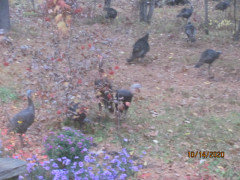
    Turkeys raiding my young Viburnum trilobum last week. Only about five years since I seeded it. (picture taken through screen door)


    How many hundreds/thousands of BT have you slewed on your property do you suppose. I bet that others going down the road have noticed your effort. Anyone with the BT problem sure sees it. And you should start seeing native plants coming up out of no where pretty soon. The seed bank is there in the soil biding its time. Your reward should begin to happen soon.

  • 5 years ago

    Based on what I've come across in my neighborhood in Washington Co, I predict 50 years from now Burning Bush will be the new Buckthorn.

    dandy_line (Z3b N Cent Mn) thanked Pat & Bill Brown
  • last year

    Wow, three years since last post. I've missed these exchanges. Buckthorn work continues, ten years in for us. Apparently war won't be won during my lifetime. Weeds being weeds, ongoing battle too. Learned "good" weed becomes bad when crowds out desired natives (ex., boneset choked out hyssop). My herbicide preferences remain constant: triclopyr for BT, black honeylocust, V. Stickweed / Q4 Plus Turf for broadleafs & sedges / glyphosate on Reed Canary Grass, GM, noxious grass weeds esp. in adjoining county hwy hellstrip. Dealing with EAB ash loss by planting tilia, red & sugar maples, sycamore, alder, Tulip Tree, Japanese lilac trees, Jefferson elm, hackberry, hawthorn. Deer and later falling honeylocust branches decimated Dogwood Pagoda but damaged N. and S. Catalpas bounce back. Through experience learned Highbush Cranberry and inherited lilacs not drought tolerant. Also that bare root common ninebarks best shrub investment ever. With burgeoning rabbit population property 'littered' with cages. 2024, the year rabbits eat nearly any and everything never before touched. Conclusion? It's always something, always will be but progress is rewarding. And happily, noticed and enthusiastically commented upon by an observant general public.

    dandy_line (Z3b N Cent Mn) thanked terrineff
  • last year

    Nice to see this thread revived. I continue my fight against buckthorn on two 3-acre properties. Alas, since each property has at least two property lines that are abutted by thick buckthorn, I have resigned my self to the fact I will never be able to eliminate it. I decided a few years ago to give up the chemical fight and instead mow nearly every square inch of each property in the fall. This ensures the buckthorn won't be able to mature no matter how much there is. So far I'm happy with the results. I have gotten prairie grasses to establish in a few areas which is nice. Since both properties are located in oak openings, I've restricted my tree planting to a few varieties of oaks and hickories, with some eastern white pines for screening. So far I'm winning the fight against the deer with a lot of poultry netting and have a few trees nearly tall enough that they won't need protection in a few years. As long as I can keep up my annual mowing, I feel I have essentially beaten buckthorn.


    On another positive note, at least a couple of businesses have popped up locally that specialize in buckthorn removal. I've noticed a few properties in the neighborhood have taken advantage of these services.

    dandy_line (Z3b N Cent Mn) thanked gnomeabram
  • last year

    Wow! It's so nice to hear from you folks again. I have been struggling with a vast infestation of Buckthorn at the Brainerd Arboretum. At one point I was afraid I wouldn't be able to stay ahead of it, because after spraying the visible shoots in one area along a road in Spring, coming back in October there would be a slew of 4' tall plants of glossy leaved BT. They are the worst I've found. They grow that fast in the right environment. But they have shallow roots and can be easily pulled whereas the common BT has deep roots, but not as pervasive.

    There is new patch I just discovered that is almost entirely ten foot tall plants. I plan to go in with Triclopyr and spray the stems. It should be fun!

    Thanks for the updates and how you are getting along. Teri, I bet your neighbors are envious now after all the work you and hubby have put in. I would love to see it sometime.

  • last year

    That glossy stuff does grow thick and fast! There are landscapers here in the UP who have it as hedges around their property!


    This afternoon, I'll be going to the shoreline with a lopper and a Weed Wand full of straight glyphosate and making another pass. Might also take a squirt bottle of triclopyr, too. The thickets of BT that are left after my last pass are too close to big trees for me to feel comfortable with triclopyr, though.

  • last year

    Hello Bill. What is the concentration of your glyphosate? I buy 41% concentrate and cut it to about 4% and add a similar amount of 2-4-d. I don't believe pure Glyphosate is cost effective. I also add some Downy fabric softener as a surfactant.

    But good to know you are on top of it.

  • last year

    I use the 41% straight glyphosate with a little blue dye mixed. But this is for cut stump treatment, not foliar spraying. The Weed Wand is a sponge-tip applicator that I can stand up to apply. Getting older, it is tough to bend over. I dab the glyphosate around the cambium. The dye helps me to not miss anything. It takes very little glyphosate - literally just a few drops per stump. As long as it is done at this time of year when the sap is going down to the roots, it has been 100% effective for me.

  • last year

    bill_g_wisconsin or anyone else. What is your sense of the danger of using triclopyr around trees, especially oaks. I did alot of buckthorn cut stump dabbing followed up with 2% spot spraying, though still quite dense, the next couple of years. I wanted to keep my oaks but lost some. Some loss could be attributed to their unhealthy state prior to my intervention and some for other misc reasons but I also lost a couple nice trees that I'd rather have kept. Was never too sure about spraying around them but figured it'd take a lot of spray to kill a large tree that I was working around but avoiding direct contact. Your thoughts?

  • last year

    Pat & Bill Brown, I made some mistakes getting too close to bigger trees with triclopyr. Some, I'm pretty sure I got some onto the roots while doing basal bark treatments, and killed the trees. Another time, I got some Crossbow herbicide, which is 2,4-D with some triclopyr mixed in, and I used it to foliar spray a bunch of seedlings in the fall. Three nice butternut trees did not leaf out in the spring in those areas. I could not have gotten too much on the bark, but they were dead. Since then, I've been pretty careful, and just did cut stump treatment when getting close to trees.

  • last year

    Fun to read new posts. Re: triclopyr I've used rule of thumb to stay AL 5-6' away from trees & 3' from shrubs. We "inherited" two young-ish oaks placed inappropriately by county. Glyphosate tmt. allowed stump resprouts, required several direct triclopyr applications to kill. Black honeylocust suckers appear in cycles; I direct spray ~5% Remedy from repurposed Ortho Nutsedge Killer container. Works slick. Dealing with yellownut sedge ongoing -- tough to knock out when for example pops up in herb boulder garden or in center of substantial bush. No-mow fescue looking great with 2024's regular rains but new issue with frenetically-growing annual weed grass. Plan is next spring apply Prodiamine 65 pre-emergent to all grass areas, not just boulevard-adjacent as in past. Bill-g: I purchased Ryobi one-gallon lithium battery sprayer. Hasn't come out box yet but supposedly can spray up to 30 gallons per charge. We shall see....

  • last year

    It's such a shame to damage desired plants especially trees and shrubs. One thing I don't understand with respect to allowing a certain distance from the trunk, in the case of trees, or branches, in the case of shrubs closer to the ground, is whether damage occurs when accidentally spraying bark or spraying other plants within the drip zone. If the latter, given I'm in an open woodland, I wouldn't have had any area to spray at all. Any thoughts?

  • last year

    @Pat & Bill Brown, both have happened to me. And the accidental bark spraying was with Crossbow, which is quite dilute compared to what I had been putting on the buckthorn. I think that runoff from the basal bark treatment soaked in the ground and got into the roots.

  • last year
    last modified: last year

    PBB: Don't quite understand conclusion. To date next to zero, -ex misjudge plant as an invasive, damage to nursery plants or volunteer natives with my regimen. Rules apply: wind between 1-10mph, totally dry grass blade/ leaf status, very tight application target. Hence recycled Ortho container which allows precise placement vs. wanded sprayer. With woodlands it is true some collateral damage can occur. Ex., glyphosate sprayer work for garlic mustard once natives have begun to sprout (though never experienced tree damage from such endeavor).

  • last year
    last modified: last year

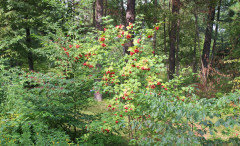
    A before and after picture from a photo I see further down, showing some turkeys raiding my Viburnum triloba. It looked so small and puny. As it is today,


    The berries stay on all winter, the birds don't find them tasty until Spring. Pagoda dogwood(volunteers) on each side.

    Edited: replace missing H's

  • last year

    Wow! That is loaded!

  • last year

    Nice viburnum. I inherited some guelder rose. I'm not sure I need to destroy them. Some flowers in the spring. Never saw such fruit though.

    dandy_line (Z3b N Cent Mn) thanked Pat & Bill Brown
  • last year

    P&B, I had to look up "guelder rose" to find out that its speciesis Viburnum opulus. Our native Cranberry Bush, v. trilobum is sometimes named V. opulus var americanum, so the two are close together genetically.

    I wonder how you came across the names of your Viburnums? Maybe they are just the natives after all.

    I don't know why the growers don't just sell the native sppecies here in NA and stop proliferating foreigners with rampant genes

  • last year

    Yes, wish those nurseries would get with the act. Yes, the 2 species are very similar looking but they can be told apart by the shape of a couple tiny glands at the base of the leaf. One must look closely. My confidence in the ID was also boosted by the confirmation of a botanist.

Sponsored
King Construction Company LLC
Average rating: 5 out of 5 stars8 Reviews
Loudoun County, VA Custom Builder for Equestrian Facilities
More Discussions